Brexit

What’s the real reason Greg Clark doesn’t like Brexit?

To those who’ve known Greg Clark for any length of time, the transformation of the mild-mannered business secretary into the Cabinet’s most fervent Remainer requires some kind of explanation. So what’s the real reason Clark finds Brexit a threat? Forget about protecting the automotive industry and manufacturing generally. The car industry is already reeling from the government’s hostile environment towards car ownership. Last year, car sales fell for the second year in a row, with diesel vehicles down 29.6 per cent. Supply was hit by testing to meet new emissions standards and demand dented by the government’s ongoing war on diesel. And there’s worse to come with Michael Gove’s air quality

Emmanuel Macron’s fear of Frexit is bad news for Britain

Emmanuel Macron launched his Big Debate on Tuesday and for the next two months the French people will have the chance to air their grievances in meetings and online. The consultation, in response to the Yellow Vest protest movement, has captured the media’s attention but nonetheless it was knocked off the top of the news agenda temporarily by events in Westminster. There is an undoubtedly a touch of schadenfreude in the Élysée Palace at the Brexit farrago, a relief that another world leader is in torment. Macron learned that parliament had rejected Theresa May’s Brexit deal on Tuesday evening, as he was nearing the end of a seven hour debate

Portrait of the week | 17 January 2019

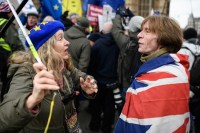
Home Brexit threw politics into unpredictable chaos. The government was defeated by an unparalleled majority of 230 — 432 to 202 — on the withdrawal agreement it had negotiated with the EU. The result was greeted by cheers from demonstrators outside the House, both those in favour and those against Brexit. Labour tabled a motion of no confidence for the following day. Theresa May, the Prime Minister, said in the House after the vote: ‘The House has spoken and this government will listen.’ She said she would talk to senior parliamentarians and that the government would return to the House on Monday with proposals. This arrangement was in line with

Diary – 17 January 2019

A few of us on the Labour left decide to see if it is possible to conjure, from nowhere, a #FinalSay campaign for a second referendum. The Labour front bench does not sound ecstatic about a second referendum, and Chuka Umunna’s lot are bound to screw it up if they’re in charge. So we schedule a meeting in the Commons, commission a meme and spread the word. Not long after this goes public, numerous Twitter users with random numbers in their handles begin accusing me of being a ‘pro-Nato White Helmet shill’, a ‘coup-monger’ and a ‘neoliberal’. The reaction at my Labour branch is more positive. We pass a motion

The vote on May’s deal was less important than you might think

Now that the Prime Minister’s withdrawal agreement has been decisively rejected by Parliament, the challenge, as Theresa May said last night, is to find an alternative way forward. But the reality is that the fall of the agreement is less important for the UK than widely assumed. It did not pin down any long-term trade arrangements. Even in the short term, the main gain to the UK was a transition period which now looks less essential than was the case when it was first mooted over a year ago. It is true that there is now a possibility of tariffs from March 30th but these tariffs are mostly small and the

Boles’s crazy plan

At first, it seems fanciful. A backbench MP, Nick Boles, proposes to take power away from the government and place it in the hands of MPs, to prevent a no-deal Brexit. Can one backbencher usurp power in this way? It’s ambitious. But under the British system, government reports to parliament, not the other way around. Usually the distinction is moot, because government can control the Commons. But when that control collapses, every kind of mischief becomes possible. Until a couple of months ago I was director of legislative affairs under Theresa May in No. 10, where it was my job to look at parliamentary procedures. It’s quite a minefield. Right now,

Brexiteers are destroying their own dream

Are some Brexiteers addicted to disappointment and frustration? Do they so crave the righteous indignation that flows from being thwarted that they are actively trying to sabotage their own project? How else to explain the extraordinary strategic incompetence of Tory MPs who say they want Britain to leave the EU yet behave in a way that makes it increasingly likely that Britain will not do so? Brexit-backing readers may well dismiss my thoughts on Brexiteer strategy because I am, of course, a dreadful Remainer. More accurately, I voted to remain and I believe that leaving the EU will give the UK a range of possible futures that are less economically

How long can Corbyn hold out against a second referendum?

Jeremy Corbyn is no enthusiast for a second referendum. He wants to, as his speech today suggested, hold further motions of no confidence in the government to try and force an election rather than have to decide on what other option he is going to support. But having tried and failed in one confidence motion, this is a more difficult position for him to maintain. Vince Cable has now said that Corbyn can’t rely on Lib Dem support in future confidence motions and has suggested that other opposition parties will soon take the same view. The aim of this tactic, to make clear that Labour can’t force a general election

Transcript: Michael Gove’s barnstorming speech in no-confidence debate

In the no-confidence motion today, Michael Gove gave one of the best speeches of his parliamentary career, praising Labour moderates and launching an excoriating attack on Jeremy Corbyn. Here’s an edited transcript. [This] has been a passionate debate characterised by many excellent speeches. Perhaps the bravest and the finest speech that came from the opposition benches was given by the member for Barrow-in-Furness. It takes courage – and he has it. Having been elected on a Labour mandate representing working class people to say that the leader of the party that you joined as a boy is not fit to be prime minister: he speaks for the country. And that

The rebel alliance

Straight after the government’s epic defeat in the House of Commons on Tuesday night, the Chancellor, Philip Hammond, the Business Secretary, Greg Clark, and the Brexit Secretary, Steve Barclay, held a conference call with business leaders to try to reassure them. The principal worry was about ‘no deal’. The Chancellor’s message of comfort was revealing of where power has shifted to. He emphasised how backbenchers are manoeuvring to stop no deal. In other words, they needn’t take his word that it wasn’t going to happen; they should take parliament’s. It was an admission that the government is no longer in control of Brexit. Further evidence of this power shift came

Darkness looms as distracted ministers fail to address the widening energy gap

Transfixed as you were by Westminster chaos, did you also spot the news that Hitachi is about to cancel or suspend construction of the Wylfa nuclear power station in North Wales? The Japanese engineering giant has evidently failed to reach agreement on a guaranteed electricity price and terms for a UK government stake in the project; its decision follows that of its compatriot Toshiba, which in November pulled out of building a nuclear station at Moorside in Cumbria, largely because it disliked the Treasury’s favoured financing model that loads risk on to the contractor. These two projects between them were intended to keep the lights on in 11 million UK

Leavers don’t actually want to leave

When intelligent, informed and rational people make a choice that onlookers can see confounds their own declared interests, we are wise to look to psychiatry for an explanation. This is where my thoughts turn, now that Tory Brexiteers have conspired to block Theresa May’s road from Chequers to the deal the Commons so spectacularly rejected this week. Until the last minute, I hesitated to accept the Tories’ European Research Group would join this rebellion. Cautiously I inserted ‘probably’, ‘by all accounts’ and ‘apparently’ into every column I drafted. That hardline Brexiteers would in the end want to kill the Prime Minister’s deal didn’t make sense. We Remainers have been unable

Why did Theresa May bother giving a statement in Downing Street tonight?

Theresa May has just given a statement in Downing Street in which she apparently said absolutely nothing. The Prime Minister walked out to the lectern outside No.10 and offered the sort of update on her diary that is normally sent out by email from the Downing Street press office. She said that she had held talks this evening ‘with the leader of the Liberal Democrats, and the Westminster leaders of the SNP and Plaid Cymru’, adding that ‘I am disappointed that the leader of the Labour Party has not so far chosen to take part’. After a day of complaining that the Prime Minister hadn’t yet picked up the phone

The impossible choice Theresa May now faces to get her Brexit deal through

What can we expect from the prime minister’s decision to speak with senior parliamentarians to gauge the kind of Brexit deal, if any, that might get through the Commons? I have been talking with members of the cabinet and those close to her – and they are divided on whether this is a genuine attempt to find a workable consensus or simply more Micawberish delay in the hope that unknown events will bail her and her government out. First things first. In the motion the PM will lay before the House, probably on Monday as she is obliged to do under the Grieve Amendment, don’t hold your breath for a

Jeremy Corbyn’s incompetence remains a reassuring certainty

It looked exciting on paper. A massive defeat for the government. Their flagship policy not just sunk but blown to smithereens. And a Prime Minister facing a no-confidence motion for the first time since Sunny Jim Callaghan was unseated in 1979 by Margaret Thatcher. And yet PMQs lacked sparkle. The mood was footsore, hungover, whimpering with fatigue. A historic day felt entirely unhistoric. Everyone wanted a break. May, her throat hoarse, looked knackered and bored, like Mick Jagger at the fag-end of a world tour. She gasped out some of her answers without grammatical ornaments. When Robert Goodwill sought her congratulations for a Scarborough firm that flogs fertiliser to China, she managed

Corbyn gives May an easy ride at Prime Minister’s Questions

Jeremy Corbyn decided to re-release his greatest hits at Prime Minister’s Questions today, starting with Brexit but then moving on to poverty, education, police cuts and ‘burning i justices’. We’ve heard these questions many times before, and often in the same sequence, but today the Labour leader was using them once again to try to underline that Theresa May’s government is failing not just on Brexit but on everything else too. This didn’t work, though, because Corbyn only tried to tie the topics together in his very last question, and that question was particularly rambling. Last night the Labour leader’s spokesman delivered a crisp line about the government being unable

Who can spare us from this Brexit disaster? | 16 January 2019

God help us all, because no-one else can or will in these present circumstances. If you wished to apportion some blame for the shambolic state of British politics these days you will not be short of candidates to bear some measure of the opprobrium they all, to one degree or another, deserve.  Spare us from Theresa May whose definition of Brexit hemmed her in from the very beginning. Spare us from a Prime Minister who learnt nothing from David Cameron’s failures and continued to prize Tory unity above almost everything else and continued to do so long past the point at which it became obvious to everyone else that Tory

How the world’s papers reacted to May’s Brexit vote defeat

Theresa May appears as a dodo on the front page of today’s Sun. Unfortunately for the beleaguered Prime Minister, the verdict isn’t much better in the foreign press. Last night’s disastrous night in the Commons makes the front pages of newspapers around the world. The New York Times describes the Prime Minister’s defeat as ‘bruising’ and the paper says last night’s result ‘underscores how comprehensively Mrs. May has failed to hold consensus behind any single vision of how to exit the European Union’. For the Times, the PM largely has herself to blame for making history by notching up the largest defeat for a government in modern British political history: