Book review

Strange sightings in Essex

From our UK edition

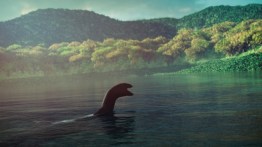
I suspect some readers might be too cool for this lovely book, partly because, despite its gothic horror set-up, it sets out unashamedly to lift the spirits; and partly because historical novels are sometimes derided as escapist, as if they’re only a fallback for authors who can’t keep up with, say, immigration or the internet. It takes place over a single year in the 1890s, in an Essex village where — if the rumours are to be believed — a monstrous sea creature skulks in the estuary, blamed for horrors from disembowelled livestock to a man’s corpse washing up on the marsh, his neck snapped. Up from London amid this panic is Cora, a wealthy amateur naturalist, liberated by the death of her abusive husband.

The Redeemer

From our UK edition

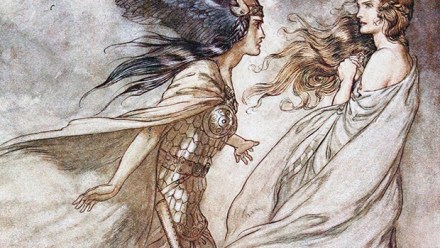
The political trigger for the Ring was the 1849 Dresden uprising, when the young freedom fighter Richard Wagner financed the hand grenades and debated ethics with his co-revolutionary Bakunin. According to Bernard Shaw, the Russian stood model for Siegfried, the Ring’s hero who would overthrow the old order and install a new realm of personal and political freedom. God was dying; nationalism killing Goethe’s enlightened neo-Hellenism. For Wagner, loss of faith in the divine and the divinely remote ancient Greeks demanded another route to meaning. He found it in pre-Christian Germanic texts, using them to shape the new cosmology of the post-Christian world.

Hacks and robbers

From our UK edition

Readers of advanced years like me will almost certainly remember the bow-tied figure of Edgar Lustgarten, star of any number of ‘True Crime’ B movies which were an integral part of a visit to the cinema, or ‘flicks’, when we were young. Some of us also remember his catchphrase when describing the downfall of a murderer, if only because it was a favourite of The Spectator’s one-time political columnist Alan Watkins: ‘It was then that he made his first big mistake.’ As it happens The Spectator features in Lustgarten’s own story, one of many to be told in Duncan Campbell’s very entertaining new book about crime reporting past and present.

Park life

From our UK edition

Petrichor. Coined as recently as 1964 but redolent of Eden onwards, the word appears in neither of these volumes but they are suffused with it. In denoting that tang which arises after rain has fallen upon dry ground, petrichor can make a stroll through park or hillside headier than any parfumier’s establishment. Down the centuries, as people moved into populous cities, such relish of open, green space has become all the more acute, with one man’s wild meadow another’s ‘development opportunity’. With a steadily lengthening shelf of books that are threnodies for seaside holidays, the Routemaster bus, vinyl records, the transplanted London Bridge and now public parks, Travis Elborough is becoming a latter-day Alan Bennett.

Into a cloud-scratched sky

From our UK edition

There have been a number of attempts to graft the style of the so-called new nature writing onto the novel: works such as Melissa Harrison’s Clay, for instance, or Amy Sackville’s Orkney. Tom Bullough’s Addlands is a very creditable contribution to this genre. The form does have an intrinsic problem: how does one dramatise seeing? The solution here is that the characters — the reserved Idris Hamer, his stoical wife, Etty, and their son Oliver, a principled bruiser — are farmers in the Welsh borders. Their livelihood depends on being attuned to changes in the environment. The novel has an elegant structural conceit.

Missing in action

From our UK edition

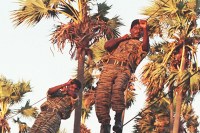
‘Missing in action is the worst state to which we can lose a human being,’ avers Commodore (Ret.) Ajith Boyagoda — and he should know. A not especially academic young chap from the hill country, Boyagoda joined the then Ceylonese navy for the glamour of it; progressed fair-to-middlingly; saw Southampton, Suez and South India; and, in September 1994, on his final voyage, found himself in command of the Sagarawardene, Sri Lanka’s biggest warship, on the night that it was sunk by the Liberation Tigers of Tamil Eelam.

Get over it!

From our UK edition

As someone who managed to move from enfant terrible to grande dame without ever being a proper grown-up, I must say the menopause passed me by. I make a practise of having mostly much younger or male mates so I don’t have to hear old birds banging on about it, but occasionally my bezzie (who seems to have been undergoing the unfortunate process since the EU was the EC) will start feeling hot — then the next minute, she’s moaning about the British weather and pining to go somewhere warm. Women! My main thought as I pushed, tank-like, through mine was that as a broad who has lived her life in a bid to show that arch-bitch Mother Nature who’s the Daddy, defying her at every turn, I was damned if I was going to cry ‘Uncle!’ at the eleventh hour.

Cervantes the seer

From our UK edition

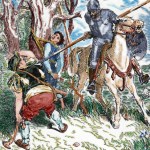
William Egginton opens his book with a novelistic reimagining: here’s Miguel de Cervantes, a toothless old geezer of nearly 60, on his way to the printers with his new manuscript. On a hot August day in 1604, a man walked through the dusty streets of Valladolid, Spain, clutching in his right hand a heavy package. In the absence of any authentic portraits, we must trust his own words to know that he was brown-haired and silver-bearded, with an aquiline (but well-proportioned, he adds) nose and cheerful eyes partly hidden behind a pair of smeared spectacles resembling, in the words of one of his literary rivals, badly fried eggs. By the time Cervantes published Don Quixote, he’d done a lot of living.

Win some — lose too many

From our UK edition

In this centenary year of the Somme, it is refreshing to read a book about the Great War that is not yet another dreary recital of the tragic and over-familiar facts, but successfully gets to grips with the dilemmas facing the commanders and politicians mediating the gargantuan conflict. Historical debate about the war now boils down to two views. Either the conflict was conducted by bone-headed generals guzzling champagne in their chateaux while sending a generation to certain death against chattering machine guns and impenetrable barbed wire. Or the said generals have been much maligned, and eventually achieved a stunning victory after intelligently using tactics learned in a very hard but sadly necessary school of battles.

Lives of gay abandon

From our UK edition

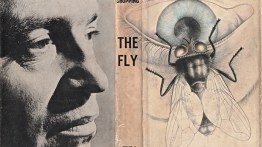
Somewhere I have a couple of neat letters from the artist Richard Chopping, politely declining my requests to interview him about Ian Fleming. ‘Dicky’ is best known for the trompe l’oeil dust jackets he painted for nine of Fleming’s James Bond novels. Because of this patronage, an accomplished second-division artist gained wider prominence, becoming at one stage, according to the New Yorker, the world’s highest paid book designer. It didn’t make him happy. He was involved in a long, bickering relationship with his fellow artist Denis Wirth-Miller, who was wilder and more experimental, but whose reputation, despite a close working association with Francis Bacon, has not endured so well.

She’s the top

From our UK edition

This book is the latest in Yale’s series of Jewish Lives — though in this case Jewish Loves might be nearer the mark. Neal Gabler adores Barbra Streisand. He purports to have written a critical biography, but pretty much the only bad thing he has to say about Streisand’s 50-odd-year career (and counting — who would bet against her returning to the White House to carol the Clintons come next January?) is that Peter Bogdanovich’s picture What’s Up, Doc? is ‘junk’. Actually it’s a work of genius, with Streisand at the top of her considerable comic game – though that’s a judgment you mightn’t want to trust any more than Gabler’s. Because when it comes to movies and records I love Barbra too.

Tales of Mr Tod

From our UK edition

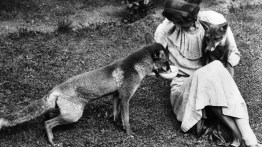
Have you ever considered tying a fox’s penis to your head? Well no, nor have I, but if you suffer from migraines, perhaps you might give it a shot. The fox, in fact, was thought to be a cure for any number of maladies in the 1600s. Fox ashes dunked in wine were recommended as a cure for asthma, their brains were thought to be useful in treating epilepsy, and making a necklace of fox testicles for a child was billed as a surefire cure for toothache. It sounds like quite the fashion statement. This book — Lucy Jones’s first — is a fascinating discussion of the history of our attitude to the fox, and if you want to know more about the red creature that wakes you at 3 a.m. with its baby-like screaming, then this volume is sure to keep you occupied for a while at least.

Love for sale

From our UK edition

The premise of Kat Banyard’s Pimp State is a familiar one: sex work — a phrase the author rejects as pure euphemism — is formalised sexual exploitation, synonymous with sexual abuse and therefore both ‘a cause and a consequence of inequality between men and women’. It follows, then, that if you’re in favour of gender equality, or simply a decent human being who disapproves of sexual violence, you must oppose the sale of any and all variations of sex. If you’re not part of the solution — well, you know the rest. You don’t have to be especially interested in feminism to have heard this before.

A terrible beauty | 9 June 2016

From our UK edition

It was only when I left Western Australia for university in England that I understood how vast and dangerous my homeland is. In freshers’ week, a group of us had spent a happy afternoon at a waterside pub. As we traced the pollen-dusty river back to Oxford, my friend Anish was overcome with joy (some might say cider) and capered into a field of long dry grass. Summer left me. I yelled for him to stop — stand still now, or he would die. When my friends stopped laughing, they assured me that the only way to be harmed by English nature is if you put your face up to a consumptive badger and it sneezed. That this field, all fields, weren’t full of tiger snakes was a novel relief. And so I joined Anish, whooping in the grass. Western Australia is one of the last frontiers.

One country, two worlds

From our UK edition

In October 1964, Charles de Gaulle visited Brazil. The country was six months into its military dictatorship. In April of that year, there had been a relatively bloodless coup against the sitting president, João Goulart, who one morning found a tank pointing its muzzle at his residence in Rio. The ensuing military regime lasted for two decades,and routinely tortured its dissidents. One of those tortured was a 22-year-old female member of a militant guerrilla group who was arrested in 1970 and subjected to paddle beatings and electric shocks to her ears, feet, breasts and thighs. Today, she is president. This is Brazil’s fairy tale.

Scarred by the past

From our UK edition

In Indonesia in 1965–6 half a million communists and supposed communist sympathisers were murdered by a range of civilian and paramilitary organisations under the direction of the army. This is the setting for Louise Doughty’s grim, ambitious novel. John Harper is a young operative in Jakarta, working for a Dutch private intelligence operation, providing information for corporations and doing covert work for various governments, chiefly the American. The title refers to the polluted water of Jakarta’s canals, but also to the water of the country’s paddy fields. To the news-attentive reader there is also the echo of the Blackwater private security operation that got into trouble in Iraq.

So much for education, education, education

From our UK edition

‘Your old man’s barking!’ I remember hissing indignantly at my then best friend Toby Young way back in the 1980s after his father, Michael, had spent the evening patiently explaining his famous 1958 essay, The Rise of the Meritocracy, over ‘supper’ at the somewhat grand family home in, of course, Islington. I’d obviously been thinking about something more pressing all those times we’d discussed the classic text in GCSE Sociology — probably about which order I’d ‘do’ Pan’s People in, should the opportunity arrive in suburban 1970s Bristol — but of course I’d presumed that ‘Lord’ Young (dead giveaway) would have favoured the rise of a meritocracy, being a man of humble origin himself.

The sport of kings

From our UK edition

Queen Victoria disapproved heartily of the racing set and of her son Bertie’s involvement in the sport. But she must have noted a dinner conversation with Bismarck reported to her by Disraeli. The German Chancellor had asked if racing was still encouraged in England. Never more so, said Disraeli, to which Bismarck responded: There will never be socialism in England. You are safe so long as the people are devoted to racing. Here a gentleman cannot ride down the street without 20 persons saying to each other, ’Why has that fellow a horse and I have not one?’ In England the more horses a nobleman has, the more popular he is.