Book review

Too much American angst

In ‘A Prize for Every Player’ — one of 12 stories in Days of Awe, a new collection by A.M. Homes (Granta, £14.99) — Tom Sanford, shopping with his family in Mammoth Mart, soliliquises (loudly and nostalgically) about the America he remembers, and finds himself with an audience of shoppers who nominate him as the People’s Candidate for President. Absurd? Not quite so absurd perhaps as in pre-Trump days. Days of Awe (the title comes from Rosh Hashanah, the ten days of repentance in the Jewish calendar) is Homes’s third collection and her first book since winning the Women’s Prize for Fiction in 2013. The stories balance on a narrative tightrope between reality and absurdity, taking the anxieties of the American elite to a satirical extreme.

The play that goes on giving

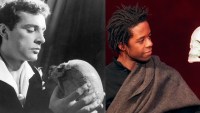
The role of Hamlet is, Max Beerbohm famously wrote, ‘a hoop through which every eminent actor must, sooner or later, jump’. In this book, and in its online supplement, Jonathan Croall charts the flight through that hoop of pretty well all of the ‘eminent actors’ — male and female, young and not so young, white and black — who have taken the leap in British performances, from Michael Redgrave with the Old Vic company in 1950 to Andrew Scott at the Almeida in 2017. The trajectory of the actor’s flight is of course different in every production.

A barbarous view of modernism

When I was younger, one of my favourite books was James Stevens Curl’s The Victorian Celebration of Death. His latest is much less cheerful. Like one of those innocents who re-enact the Civil War in embarrassing costume on Bank Holidays, Curl has been time-travelling backwards into a pre-modern world. He returns from the past with a crude message that has been familiar since Reginald (Menin Gate) Blomfield told us in the 1930s that modern architecture is a godless conspiracy of foreigners, Jews and Bolsheviks to eradicate an established culture of building, patiently evolved over three millennia. This is less than a half-truth. Yes, modernist principles, misunderstood by unimaginative planners, often led to atrocious results.

The witching time

From our UK edition

All Among the Barley, Melissa Harrison’s third ‘nature novel’, centres on Wych Farm in the autumn of 1933, where the corn fields are ‘acres of gold like bullion, strewn with the sapphires of cornflowers and the garnets of corn poppies and watched over from on high by larks’. Our narrator, 14-year-old Edie, has finished school and her older brother Frank tells her: ‘Something will happen next, and you should choose it.’ In Edie’s provincial life, her choices are limited. Essentially, she can stay at home and help on the farm, marry like her older sister and ‘push out a baby a year’, or become a teacher — she is sufficiently clever, but finds children ‘exasperating’.

The woman in the shadows

Despite his having one of the most famous names in the world, we know maddeningly little about William Shakespeare. His private life was lost in the swirling debris of the early modern world. Buildings such as the Globe or New Place (the house he retired to in Stratford) were demolished in the centuries after his death. Not a single letter survives, no first drafts of the plays have surfaced and it is disputed whether his portraits even look like him. Scholars are forced to find other ways of peering into his soul. Some look to the plays and sonnets, boldly presenting fictional and contradictory poetry as concrete evidence. Others examine the objects he may have owned, but the results are hardly the stuff dreams are made on.

You can’t go home again | 16 August 2018

If the 20th century popularised the figure of the émigré, the 21st has introduced that of the returnee, who, aided by a combination of Skype, social media and cheap air travel, doesn’t so much exchange countries as exist between them. ‘I was an émigré. I had left. Now I’d returned,’ announces Andrei Kaplan, somewhat incredulously, in Keith Gessen’s vigorously funny second novel. An inverted Pnin, Andrei is a Russian-American academic, making a living by moderating online discussion groups for a professor who, in due course, compares Pushkin, Gogol and Dostoevsky to Kanye West. Failing to find a tenured job, Andrei moves to Moscow, where he was born, to care for his ailing grandmother. The city is unrecognisable.

The attributions game

From our UK edition

Many art historians have written their own story of the making of an aesthete: Ruskin, Berenson and Kenneth Clark to name just three in the Anglo-Saxon world. The pattern varies, but typically it might include being bullied at school, a mentor, an epiphany in Italy, and the de rigueur discovery of Piero della Francesca. The Eye has all the possibilities of being an appealing book in the same tradition — but for the author’s grating references to himself and his vocation as the ‘Eye’, as if this were some higher calling, a Glasperlenspiel in which the priesthood spends all day attributing Florentine paintings. ‘The Eye,’ we are informed, ‘is a miniature Christopher Columbus who roves over the world of art, alert to any surprises.

From Troy to the Troubles

From our UK edition

Recently there has been a spate of retellings of the Iliad, to name just Pat Barker’s The Silence of the Girls, focusing on the female slaves, and Colm Tóibín’s take on the aftermath of the Trojan war, House of Names. For his second novel, Michael Hughes attempts something more literal and more challenging: to transpose the narrative of Homer’s war epic as closely as possible to the Troubles. The story concerns Achill, a disenchanted IRA sniper, and his paramilitary boss, who fall out over a girl. Pig is just as unappealing as Agamemnon; Helen is local beauty Nellie; Hector is SAS man Henry; and Patroclus pleasingly, becomes Pat, Achill’s young protégé but not bed partner.

The lure of a well-tailored uniform

From our UK edition

Anita Leslie knew how to tell a story. Arranging to sit for a portrait six months before she died, she planned to borrow a khaki shirt on which to pin her second world war decorations, the Africa Star and the Croix de Guerre. The portrait was never commissioned, but it is clear that Leslie — the only woman to have been awarded both these honours — wanted to be remembered as a war heroine, as well as a biographer, memoirist, witty and well-connected socialite, and cousin of Winston Churchill. Leslie’s war work certainly merits greater attention, so it is a shame that Penny Perrick’s Telling Tales: The Fabulous Lives of Anita Leslie focuses so much more on the ‘low-down on the high-ups’ than her subject’s actions on the front line.

Fraud and forgery

From our UK edition

This is a well-written, scrupulously researched and argued account of an enduring mystery that neatly illustrates the haphazard interactions of politics, bureaucracy and history. In 1924 Grigori Zinoviev was head of the Communist International, the propaganda arm of the Soviet regime. A letter in his name, dated 15 September and addressed to the Communist Party of Great Britain (CPGB), urged comrades to foment insurrection in the armed forces and among munitions workers while publicly supporting the ratification of an Anglo-Soviet trade treaty and a large loan to Russia. Both were controversial issues for Ramsay MacDonald’s first-ever Labour government, elected in January of that year.

Obscure object of desire | 16 August 2018

It is always interesting to see what art historians get up to when none of the rest of us is looking. It is hard to know what the inspiration for The Mummy’s Foot and the Big Toe can possibly have been, but if this very short book offers the kind of approach that will go down well in the enclosed world of the academic conference, Alan Krell might find the common reader a tougher nut to crack. Having said that, however, those with a taste for such things will probably find plenty to enjoy in a book that ranges from the bare foot as symbol of freedom to the foot as ‘fetish and fancy, object of desire and of abjection, and vehicle for the comic, the absurd and the empowering’ in the context of literature, art, sport and film.

In two minds | 16 August 2018

‘I have a very poor opinion of other people’s opinion of me — though I am fairly happy in my own conceit — and always surprised to find that anyone likes my work or character.’ This admission by Robert Graves — made to his then friend Siegfried Sassoon in the mid-1920s — goes to the heart of his character as a man and a poet. It projects a powerful mixture of defiance and neediness, which in his personal life produced a series of highly disruptive assertions and reversals, and in his writing life an equally striking set of commitments and walkings-back. Jean Moorcroft Wilson, who has previously published fluent biographies of Sassoon and Edward Thomas, is a reliable guide to all these contortions.

The way things were…

From our UK edition

Across the fields from the medieval manor house of Toad Hall, and the accompanying 16th-century timber-frame apothecary’s house which Alan Garner dismantled and moved 17 miles to join it in Blackden in rural Cheshire, sits Jodrell Bank Observatory. Here huge telescopes scour the cosmos, seeking radio waves from distant planets and stars. This juxtaposition between past, present and future, all existing in harmonious symbiosis on land that Garner’s family have lived on for 400 years, seems the perfect metaphor for the creative output of this most singular of English writers.

A tale of two addictions

From our UK edition

China, wrote Adam Smith, is ‘one of the richest, that is, one of the most fertile, best cultivated, most industrious and most populous countries in the world’. It was an obvious exemplar for a man who was trying to write An Inquiry into the Nature and Causes of the Wealth of Nations. In the late 18th century, when Smith published his seminal work, Britain had not only already begun to build an empire; it was about to learn from the experience of losing parts of it too, as the colonies in North America detached and went their own way. Despite the shock of the US Declaration of Independence — in the very same year that The Wealth of Nations was published — it was Asia that was much more important, lucrative and interesting than the Americas to the British.

Hitchcock without a murder

A girl at a window, hidden behind curtains, watches three women in a dimly lit drawing room in the house across the road as they sit silently smoking, hands and faces pale against their dark clothes. She invents identities for the trio: they are criminals or abandoned spinsters. Sinister or pathetic. Curiosity grows into obsession: she imagines them as painted saintly icons, golden against a dark wall, ‘flies crawling across their faces... the first threads of a spider’s web spun from their eyes’. People in the Room is set in the early 20th century in the affluent Buenos Aires neighbourhood of Belgrano, where the author lived as a child.

Family fallout | 2 August 2018

From our UK edition

Savi Naipaul Akal’s publishing house is named after the peepal tree, in whose shade Buddha is said to have achieved enlightenment. The author’s industriously detailed memoir reveals nothing quite so brilliantly life-enhancing but presents persuasive statements in favour of family loyalty, domestic order and higher education, while allowing herself opportunities to express resentment of a disturbing sibling rival. She was proud when her brother Vidiadhar Surajprasad Naipaul was awarded the 2001 Nobel Prize in Literature, but dismayed when his acknowledgement of it failed to mention Trinidad, the land of his birth. He called his prize ‘a great tribute to both England, my home, and India, the home of my ancestors’.

… and soon will be

From our UK edition

Edmundsbury, the fictional, sketchily rendered town in which the action of this novel takes place, is part of a social experiment — its inhabitants lab rats for a digital overhaul that goes beyond surveillance. Everything they do is measured, tracked and recorded in exchange for treats, such as heightened security and increased download speeds. Sam Byers focuses on a handful of characters who are aware, to varying degrees, that something is badly wrong. Displaced Londoner Robert is a journalist with fading ethics, striving for ‘clickbait gold’, but needled to distraction by a persistently critical below-the-line commenter calling herself Julia. Quickly we discover that Julia is a persona adopted by Robert’s girlfriend, Jess.