Book review

A Colder War, by Charles Cumming – review

From our UK edition

The title of Charles Cumming’s seventh novel is both a nod to the comfortable polarities of Cold War and also a reminder that our modern world is in some ways even chillier and less stable than the one it replaced. Once again, the central character is Thomas Kell, the MI6 agent who was trying to claw his way back from unmerited disgrace in Cumming’s previous novel, A Foreign Country. Even now, Kell is still on unpaid leave — which, though tiresome for him, is convenient for Amelia, the current ‘C’. They are old colleagues and, up to a point, friends, and she knows him for what he is: a fine intelligence officer caught between his own demons and the shifting, often ruthless expedients of his job.

From Anthony Trollope to Meryl Streep: the theatre of politics on stage and screen

From our UK edition

On 1 October 1950 the BBC broadcast a seemingly innocuous little play by Val Gielgud. A light-hearted and critically unremarkable political comedy, Party Manners carried a number of pointed criticisms of Labour policy, taking pot shots at egalitarianism, tax-and-spend and big government. With Clement Attlee’s party enjoying only the slimmest of parliamentary majorities and a fresh election in the offing, some BBC executives feared that Party Manners might swing the balance in the Tories’ favour. Lord Simon of Wythenshawe, chair of the BBC governors and a Labour party member, cancelled a planned repeat showing, unleashing a storm in the House of Lords.

Why is ‘loo’ slang? Because Simon Heffer says so!

From our UK edition

Did Simon Heffer’s new book come out on St George’s Day? If not, it probably should have done. If we ever needed someone to defend what’s left of our national culture from the massed armies of lefties, foreigners, proles, riff-raff, illiterates, young people, thin people and David Cameron, he would be our man. For three decades he has fought the good fight, a squat colossus of unquenchable fury, his red hair forever threatening to burst into flames, just because it can. He is one of the marvels of the age and, I now discover to my shock, exactly four days younger then me. We Cancerians have to stick together — although my moon is in Aries and his is in Taurus, which I’m told makes all the difference.

Patrick Leigh Fermor and the long, daft tradition of Brits trying to save Greece

From our UK edition

Twenty-odd years ago, while on holiday in the deep Mani at the foot of the Peloponnese, I got into conversation with an old and only partially reconstructed Greek communist shop-owner. I had been showing him a bit of pottery I had found on the sea bed at Asomati, and he wanted to know what had brought me to the Mani in the first place and was it Patrick Leigh Fermor? I said no — not strictly true — and he seemed pleased.  Leigh Fermor, he said — and he was not prepared to elaborate — had not been good for Greece.

Baghdad’s rise, fall – and rise again

From our UK edition

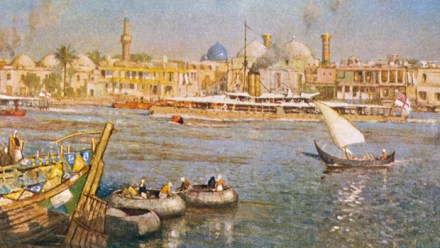
The history of Baghdad more than any other city mirrors the ebb and flow that has marked Islamic history and civilisation. The rise and fall of empires and dynasties, the splendours of Islam’s high culture and its decline, the periodic tensions and ease that affected relations between nations and peoples, sects and faiths have all been played out in the teeming neighbourhoods, palace precincts, market areas, great mosques, educational centres and military compounds of this remarkable city. Unlike its rival Damascus, the capital of the first Muslim empire, the Umayyads, which had been established for centuries before the arrival of Islam into Syria, Baghdad was pre-eminently a city of the Islamic era.

The American who dreamed of peace for the Arabs – but was murdered in their midst

From our UK edition

‘Arabist’ is fast becoming an archaism. Perhaps it is already one. These days the word conjures up enchanting visions of racy manuscripts examined over sharbat in the great domed residences of sympathetic chargés d’affaires and lone camels bumping along like single-masted cutters on a sand-dune ocean. At the age of six I dreamed of becoming one after watching David Lean’s great film for the first time. (A few weeks later I saw Jurassic Park on video and decided that I fancied palaeontology instead.) It is tempting, even for those of us who take an Israeli line, to think that had the creation of a massive pan-Arab state followed the Paris Peace Conference, the last 100 or so years would have been much the better for it.

The yes-no-maybe world of Harrison Birtwistle

From our UK edition

For better or worse, we live in the age of the talking composer. Some talk well, some badly, a few — the strong, silent types — keep their mouths shut, or have to have them prised open. Harrison Birtwistle belongs, by nature, to this last category. I once, a very long time ago, interviewed him for a radio programme, mercifully pre-recorded. Each tedious enquiry would be greeted by a long silence ending with a yes or a no or an ‘I don’t understand the question.’ Nothing would persuade him to contribute to my attempts at fitting him into some preconceived image of British music in the late 1960s. Fitting them in is of course precisely what talking to composers is supposed to do. Harry quietly — very quietly — declined to cooperate.

My desert island poet

From our UK edition

If I had to be marooned on a desert island with a stranger, that stranger would be John Burnside. Not that he’s a literary Ray Mears: I rather doubt that catching fish with his bare hands or lighting a fire without matches are among his skills. Nor would he be an easy companion, since by his own account he is a brooder and an insomniac and a craver of solitude. He is the erstwhile resident of a mental institution. He also has complicated feelings about women. But he’d be my perfect companion, still. For one thing, the isle would be full of sounds and sweet airs that give delight, because Burnside is the finest poet writing in Britain today.

No one would want to live in Jane Gardam’s stories – but they’re an amazing place to visit

From our UK edition

In the world of Jane Gardam’s stories the past is always present, solid and often unwanted and always too big, like a heavy antique sideboard crammed into a modern retirement flat. Her characters are easily imagined surrounded by such furniture, among them ex-pats returning after careers in Hong Kong or India, their houses full of the sad paraphernalia of former empire: elephant’s foot umbrella stands or old watercolours of Bengal. Many are seeing out their days in some poverty and solitude, occasionally visited but seldom comforted by their resentful grown-up children. There is no saccharine here. Relations between offspring and parents are marked by mutual disdain and almost wilful misunderstanding, lit up from time to time by flares of bewildering love.

The fairytale life of Hans Christian Andersen

From our UK edition

It has long been my habit, when approaching a new biography, to read the account of the subject’s childhood first, then jump to the deathbed, before settling down to the main narrative between. It was rather disconcerting, therefore, to find that Paul Binding’s life of Hans Christian Andersen eschews the deathbed and ends with the author’s last, not very cheering, written words rather than his last breath: The brewer is dead, Auntie is dead, the student is dead, him whose sparks of ideas ended up in the rubbish bin. Everything ends up in the rubbish bin. It is only in the chronology that we learn that Andersen’s 70th birthday was internationally acclaimed and that his funeral a few weeks later was attended by the King of Denmark and a multitude of admirers.

Piketty’s decaff Marxism would be just as oppressive and intrusive as the old variety

From our UK edition

If a title works once, the chances are it will work again. Half the punch of Marx’s masterwork is in its name. Better in German of course, with the kick of the K and the ominous echo of Kaput. But even in English when blocked out in red caps on a  fat spine, CAPITAL sends a thrill along any bookshelf. Its fond midwives at Harvard can scarcely have expected to sell 200,000 copies of a 600-page treatise by a French economist unknown in the English-speaking world, but that only shows we must never underestimate the beauty of telling the target audience what it wishes to hear — in this case, that Marx is back in town. This, though, is certainly not the first impression you get from the book.

The wit, wisdom and womanising of Constant Lambert

From our UK edition

We owe Constant Lambert (1905–1951) a huge amount, and the flashes of brilliance that survive from his short life only suggest the energy with which he established the possibilities for English culture. What we remember about this extraordinary man are some delightful pieces of music, especially The Rio Grande; the funniest and most cultivated book about contemporary music ever written, Music Ho!; and a few surviving recordings of his work as a conductor. Before his death, aged 46, from chronic alcoholism and undiagnosed diabetes, he had established the Sadler’s Wells Ballet with Ninette de Valois and Frederick Ashton; in the trio, he was not only the conductor and musical expert, but someone who was acutely alive to the possibilities of stage design and drama.

Wealth is no guarantee of happiness. Look at the Sackville-Wests

From our UK edition

When Robert Sackville-West was writing Inheritance (2010), his history of Knole and the Sackvilles, he was ‘struck’, as he recalls in his new book, by the way that Sackvilles have ‘tended to take Italian or Spanish dancers as mistresses’. The most notable of these was Josefa Duran, the flamenco dancer known as ‘Pepita’. A barber’s daughter, she was born in 1830 in the backstreets of Málaga — ‘Oh such a slum it is!’ observed her grand-daughter Vita Sackville-West, who wrote a biography of her, Pepita (1937). By the 1850s she was the toast of Europe, and in 1852 she began a liaison with Lionel Sackville-West, later the 2nd Lord Sackville, which lasted until her death in 1871.

Mid-life crisis, 13th-century style

From our UK edition

The word delicate is seldom a compliment.  I once threw a saucepan of hot soup out of a fifth storey London window because a boyfriend said it had a delicate flavour, by which he meant none at all. This novel, though, is delicate in an entirely good way: it is fine, intricately wrought, understated. It imagines the life of the 13th-century Chinese scholar-artist Wang Meng, whose misfortune it was to live in interesting times, during the closing years of the Mongol invaders’ Yuan dynasty. Much of the time Wang spends staring at mountains and rivers and discussing the finer distinctions of Tao and Buddhist philosophy. He believes that ‘the good and gentle side of life was stronger and more permanent than the bad’.

Judge a critic by the quality of his mistakes

From our UK edition

What the title promises is not found inside. It is a tease. John Sutherland says he has ‘been paid one way or another, to read books all my life’, yet he does not regard himself as well read in the genre of novels. With two million languishing in the British Library vaults, nobody could be, he insists. And although the publishers have given it the subtitle ‘A guide to 500 great novels and a handful of literary curiosities’, the author declares in his admirably succinct preface: ‘This book is not a guide.’ He’s right. It is an engaging game, or a compendium of games (as the Gamages Christmas catalogue used to describe a chess board with snakes and ladders on the back). I started off by seeing what the Prof thought of some of the books I like.

Exclamation marks, no; aertex shirts, yes!

From our UK edition

Jonathan Meades, the architectural, food and cultural commentator, appears on television in a pair of retro shades and a trademark Blues Brother suit. He looks like a poseur, and indeed studied drama at Rada. Lynn Barber, the ‘celebrity interviewer’, is the self-acknowledged scourge of pomposity and pretension. (Melvyn Bragg, among others, has felt the lash of her schoolmarm tongue.) Like Meades, Barber grew up in early 1950s middle-class England. An only child, she found a way out of the bridge/ canasta tea parties and sherry-tippling of Twickenham, her childhood home, to become a staff writer on Penthouse girlie magazine; her first book, published in 1975, was a sex manual entitled How to Improve Your Man in Bed (which, incidentally, my wife has still not read).

Look again – the first world war poets weren’t pacifists

From our UK edition

If the poets of the first world war probably enjoy a higher profile now than they have done at any time in the last 100 years, it has not been a smooth passage. When Wilfred Owen was killed in the last week of the fighting he was still virtually unknown, and even 25 years later in the middle of another war, when the ludicrous Robert Nichols — the man Edmund Gosse had once seen as a new Keats and Shelley combined — brought out his anthology of first world war poetry, there was still room for only four poems by Owen and none at all by Isaac Rosenberg, Edward Thomas or Ivor Gurney.