Books and Arts

The radical networks that hijacked the 1970s

Airplane hijacking, like the mode of transport itself, became common in the 1960s. A practice largely confined to the United States, it was invariably a means for ordinary criminals to extort ransom money or flee to Cuba. In 1968, the hijacking of an El Al flight by the left-wing Popular Front for the Liberation of Palestine revealed the political utility of the act: in exchange for the safe return of its plane and passengers, Israel released 16 Arabs from its prisons. Encouraged by this outcome, the PFLP launched a spate of similar operations. One such mission, the hijacking of a TWA flight in 1969, revealed that prisoner exchanges and ransoms weren’t the only upside of this new tactic.

Keith McNally: ‘big-name’ stars are wrecking Broadway

“WAITING FOR GODOT IS A RUBBISH PLAY.” So declared Keith McNally in an Instagram post that caught my eye. “I urge you not to see Waiting for Godot.” Accompanying the statement was an image of the two stars who headlined this fall’s production at Broadway’s Hudson Theater, Keanu Reeves and Alex Winter. The play is the latest in what regular theatergoers and visiting tourists may have started to recognize as a recurring theme in New York’s theater scene: an overwhelming number of big-name Hollywood screen actors dotting their playbills. These players are here to make their bones and increase their prestige as “true” thespians, often by attaching themselves to tired and familiar productions. This has certainly not been lost on McNally.

mcnally

My Name is Orson Welles was illuminating

Orson Welles (1915-85) considered the notion of posterity vulgar, but he knew that he’d be loved once he was dead. That death came suddenly, just over 40 years ago, on October 10, 1985. There was a poignancy to the way death took him – sitting at his typewriter after appearing on Merv Griffin’s talk show. By then, the co-writer, director and star of the greatest film ever made, Citizen Kane (1941), hadn’t finished a film since 1973’s ignored but now quietly loved F for Fake. At the end of his life, he may have been better known as the guy in Paul Masson wine commercials than as a cinematic genius. To commemorate the 40th anniversary of his passing, Paris’s Cinémathèque Française last fall arranged the illuminating exhibition My Name is Orson Welles.

orson welles

Inside the mind of Cheryl Hines

This book shouldn’t work. A memoir written by a 60-year-old actress – who, frankly, has never threatened to become a major movie star – hardly sounds promising. Then there’s the author’s personal baggage. Since 2014, Cheryl Hines has been married to Robert F. Kennedy Jr., the raspy-voiced Health and Human Services Secretary who served as one of Donald Trump’s chief surrogates during his last presidential campaign. Rarely has a book so straddled the worlds of Hollywood and conservative politics, let alone those embodied by the current administration. Yet, against all the odds, Unscripted is an enthralling read. To address the burning topic first: no, not all of Hines’s friends were entirely happy with her husband’s appointment, nor with his views on Dr.

Jane Austen: Rise of a Genius is projecting

Which is your favorite Jane Austen novel? OK, maybe not a conversation prompt appropriate for every setting, but a reliable one, I find, to break the ice at DC dinner parties where I’m not well acquainted with my fellow guests but spy someone who seems likely to know her work. I also ask it of younger fiction writers who come looking for advice about plot construction. I once resorted to it with a stranger, a woman of a certain age, to distract me from my irritation, sitting on an Acela train inexplicably halted outside Wilmington, Delaware, for two hours. She chose Persuasion, Austen’s elegiac account of late-in-life love.

The secrets of Henri Rousseau

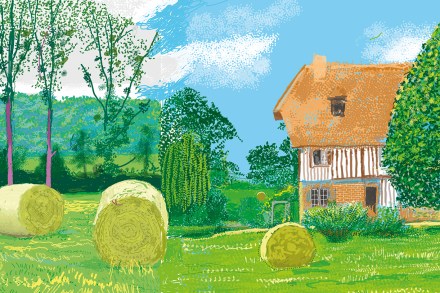
Henri Rousseau (1844-1910) was so earnest that it landed him in jail. When a former student asked him to use forged identity papers to open a bank account, Rousseau, who was then in his sixties, was happy to help out his old acquaintance. He seemed unaware that he was doing anything more than a favor, let alone committing fraud. To prove the painter’s innocence, his lawyer brought one of his canvases before the jury and declared: “You do not have the right to condemn a primitive.” The works that result from such legendary naivety are on view at the Barnes Foundation in Henri Rousseau: A Painter’s Secrets.

The Adventures of Elektronik is not your average children’s comedy

For people from the former Soviet Union, the holiday season brings with it two certainties: mayonnaise and movies. Mayonnaise, because no winter festivity is complete without the traditional mayo-infused salads with such evocative names as “herring under a fur coat” and “Olivier,” which are eaten for days straight. These calorific concoctions are best accompanied by a dozen or so cult films from around 1965 to 1985, which are ritually rewatched every year by Homo Sovieticus and his descendants. Of these classics, one of the most beloved is the musical The Adventures of Elektronik (1979). Adapted from the novels of the science-fiction writer Yevgeny Veltistov, the movie tells the story of a young robot named Elektronik.

How the West can win

It is no overreaction to look at the current state of western culture, through academia and the arts alike, and to feel that Rome has fallen all over again. Whether it’s a crowd chanting in support of terrorists at Coachella, or a horrific political assassination on a university campus, cheered by some, we are witnessing something far more sinister than a mere surge in political violence. We are watching the collapse of the fundamental preconditions that make civil society possible, as a civilization tears itself apart. Many are of the opinion that it is already too late: that the unique and unprecedented advances in western culture over the past three millennia cannot be furthered.

Jon Fosse’s Scandi-lit revival

Jon Fosse, the Norwegian novelist who won the 2023 Nobel Prize in Literature, has sat center stage in the recent revival of interest in Scandinavian literature. Fosse’s one-time creative-writing student Karl Ove Knausgård became the very definition of a publishing sensation when the first volume of his six-part memoir Min Kamp (“My Struggle”) – in which he dragged all his family skeletons out of the closet for all to see – was published in 2009. Danish novelist Solvej Balle’s seven-part On The Calculation of Volume, of which only the first three parts have been published in translation, has caused a similar stir in the past two years.

The great, underestimated Richard Yates

When the novelist Richard Yates, who was born in February 1926, was interviewed by the magazine Ploughshares in 1972, the conversation turned to the neglected writers of his generation. Yates, a man of remarkable acuity and taste, was typically incisive about the likes of Evan S. Connell, Brian Moore and Edward Lewis Wallant – and, just to show that he was no misogynist, he saluted Gina Berriault, saying that she was “an absolutely first-class talent who has somehow been left almost entirely out of the mainstream. She hasn’t quit writing yet, either, and I hope she never will.” If these words struck something of a cautionary note, then Yates’s conclusion was even more concerning.

Have Americans lost their sense of humor?

Humor has become serious business. A nation of anxious primates trapped in a silicon casino of likes, retweets and dopamine-soaked drudgery, America is suffering from what the comedian Norm Macdonald called a “crisis of clapter.” Terrified of saying the wrong thing, needing punchlines to be spoon-fed – what was once the funniest place on Earth has become a tight-lipped, tongue-twisted society where jokes are rewarded with polite applause instead of genuine laughter. It’s the old stink of a well-mannered aristocracy, and very un-American indeed. From his beginning, the ugly American – wild-eyed and rabble-rousing – rankled the Old World.

humor

In defense of Renoir’s pretty pictures

Those who think it’s chic to dismiss Renoir have a rethink coming, courtesy of the absorbing, highly informative exhibit Renoir Drawings, now on view in New York. Not so long ago, the idea of ousting Pierre-Auguste Renoir (1841-1919) from the canon of western art sparked a movement of sorts. “RENOIR SUCKS AT PAINTING,” proclaimed a protester’s sign at the Museum of Fine Arts in Boston in 2015. The performance artist Max Geller had organized the demonstration to condemn Renoir as a purveyor of “treacle.” His female nudes objectified women, it charged; even when clothed, they smiled and blushed too prettily. Indeed, Renoir’s work held value only for the unsophisticated and its popularity represented the triumph of the cliché.

renoir

What monuments stand to teach Americans about themselves

Why do we raise monuments? Why do we tear them down? These questions hover over MONUMENTS, now on view at Los Angeles’s Museum of Contemporary Art and the Brick. The premise is straightforward enough: gather the remains of America’s shattered sculptural conscience – decommissioned Confederate statues and their graffiti-marred plinths – and display them alongside contemporary works on racial topics. This comparison is supposed to reveal something about America’s nature and history, and it certainly does: it shows us just how attached we are to grievance. Both the raising and the destruction of monuments nourishes convictions on either side, ensuring that the argument can never end.

monuments

Arcade Fire extinguished

Amid the many disappointments and commercial flops the music industry saw this year, perhaps the most egregious was the complete failure of Arcade Fire’s album Pink Elephant. The failure represents not merely the probable end of the band, but also the death of Obama-era rock. Pink Elephant received dismal reviews and didn’t even chart on the Billboard 200. Given that their last album, We, reached #6 as recently as 2022, and their previous LPs, Reflektor and Everything Now, topped the charts, this is a near-unparalleled fall from grace for a once-mighty act. That the married pair who compose the nucleus of the band, Win Butler and Régine Chassagne, announced their separation a few months later was the particularly rancid icing on the already-stale cake.

arcade fire
wikipedia

The Seven Rules of Trust sees Wikipedia as a blueprint

Everybody criticizes Wikipedia, but everybody uses it. Having spent my childhood cross-legged on my carpet reading dictionaries and encyclopedias, I found it a revelation and refuge from the get-go. Google could never emotionally compete. While some AI products have become useful knowledge tools, there is still nothing like Wikipedia’s hyperlink paradise, which allows nights to slip away as you click through slices of world history or science. Now its co-founder Jimmy Wales has written a book (with the help of author Dan Gardner) about what enabled this impossible project to become one of the world’s favorite utilities. When reading The Seven Rules of Trust, two things jump out at you.

louis ck

Louis C.K. fails to follow in Faulkner’s footsteps

The Great American Novel is a holy obsession – the Everest every writer dreams of summiting. For most, that dream begins and ends with William Faulkner, whose winding sentences and sunburned Southern landscapes birthed prose that seemed to breathe. His words marched; crookedly, yes, but always with purpose. Louis C.K., a would-be Faulkner disciple, trudges into the same swamp in Ingram, minus the map, the bearings and any sense of control. What was presumably intended to echo the Mississippian’s hypnotic disarray becomes instead a masterclass in incoherence. The story, told in long and sweaty first-person narration, follows a boy wandering through a Texan landscape of mud, hunger and half-formed memories. The intention is noble; the execution is catastrophic.

mitfordmania troublemaker

Mitfordmania in Carla Kaplan’s Troublemaker

I won’t attempt to explain Mitfordmania; we’d be here all night. Suffice it to say that fascination with the British sisters – Nancy, Pamela, Diana, Unity, Jessica and Deborah, born to the 2nd Baron Redesdale between 1904 and 1920 – shows no sign of waning. This year alone, the six have inspired Outrageous, a lavish (and fatuous) multi-episode television drama available on BritBox; The Party Girls, a play by Amy Rosenthal; and Do Admit: The Mitford Sisters and Me, a graphic novel by cartoonist and fangirl Mimi Pond. Now comes biographer Carla Kaplan’s Troublemaker: The Fierce, Unruly Life of Jessica Mitford. I did wonder if there was anything left to say. Famous for the muckraking classic The American Way of Death, Jessica also wrote two well-received autobiographies.

Why are Lawrence Osborne’s novels suddenly popular in Hollywood?

The film Ballad of a Small Player opens with a blast of classical music, a shot of the Macau skyline and Lord Doyle (Colin Farrell) waking up in a hotel suite littered with Champagne bottles, cigarette butts and designer loafers that are starting to show their wear. While he dresses and shaves, a voice-over informs us he has three days to live. A sharp observer might notice he seems to have considerably less than that. Either way, for the next 100 minutes, director Edward Berger (All Quiet on the Western Front and Conclave) treats us to a sumptuous vision of one English con man’s final spree before oblivion. It will take an even sharper-eyed observer to catch, as the final credits snap past, that they have just watched an adaptation of a Lawrence Osborne novel.

Michelle Obama’s new book about style lacks substance

First lady is a strange role. Even when your husband is the first black president, and you’re a Princeton and Harvard-educated former corporate lawyer, America still projects its most regressive ideas about gender onto you. So I understand that Michelle Obama, like Hillary Clinton before her (skipping Laura Bush, a more classical first lady, along with, more recently, Jill Biden and Melania Trump), might have felt constrained, faced with expectations she could never satisfy. I don’t doubt that being black added enormously to that burden. Yet there is nothing more irritating than the person of Michelle Obama complaining. And she is always complaining.

michelle obama