
Everybody criticizes Wikipedia, but everybody uses it. Having spent my childhood cross-legged on my carpet reading dictionaries and encyclopedias, I found it a revelation and refuge from the get-go. Google could never emotionally compete. While some AI products have become useful knowledge tools, there is still nothing like Wikipedia’s hyperlink paradise, which allows nights to slip away as you click through slices of world history or science.
Now its co-founder Jimmy Wales has written a book (with the help of author Dan Gardner) about what enabled this impossible project to become one of the world’s favorite utilities. When reading The Seven Rules of Trust, two things jump out at you. The first is that even though Wales attempts to use Wikipedia’s exceptional story as a recipe that other platforms and organizations can use to foster trust and collaboration, his book does not address the actual future of online – and thus offline – epistemology, which will be largely AI-driven, in terms of both knowledge creation and fact-checking. Large language models already use Wikipedia as a source; Wikipedia editors have undoubtedly been using LLMs for at least two years to make their contributions better.
Wherever you stand in the AI debate, it is undeniable that humanity has entered a new era of knowledge-formation. Wikipedia was the clear winner of a previous time – we now use the generic term “wiki” for any knowledge directories. I want Wikipedia to survive, and for that to happen it needs to deal with the spread of AI content. If it can, this book does not explain how.
The second thing that will surprise you is that while Wales rightly celebrates the startup PR revolution, his book doesn’t go for the public transparency pioneered by the likes of Airbnb. I had the feeling I was reading a history and appraisal of the great online encyclopedia written by an external party, rather than by its founder. I would have loved a more personal account. Granted, this is a very readable and interesting journalistic record of a super-successful internet product, the genesis of which was both unlikely and fortunate. But after two decades of treating Wikipedia as the default infrastructure of curiosity, the reader is startled to realize how anomalous it really is.

Wales revisits the founding lore: the failed expert-only Nupedia; The Colbert Report’s recurring 2006 “Wikiality” segment that crashed Wikipedia’s servers; the hoax in which an unregistered editor created a false article about the journalist John Seigenthaler, thereby exposing how dangerous open-access information can be. These stories frame Wales’s larger argument that Wikipedia works for reasons that, theoretically, it shouldn’t.
The book’s most eye-catching claim is that Wikipedia’s trustworthiness is entirely engineered. Wales lists seven principles that enable the system to cohere: make it personal, assume good faith, define a clear purpose, give trust to get trust, enforce civility, guard independence and be transparent about process. On Wikipedia, these are not just guidelines but structural constraints. A “neutrality disputed” banner is not an admission of malfunction; it is evidence the system is still self-correcting.
But can this “truth as workflow” principle apply to other organizations? Wales believes it can. Universities, platforms, NGOs and governments could adopt similar norms: structure disagreement, make epistemic boundaries legible and so on. Nonetheless, the question of exceptionalism isn’t easy to ignore. Wikipedia’s defining conditions are basically unreproducible. It is a nonprofit with no advertising, no venture capital, no algorithmic manipulation – all of which makes it a culture formed before the social-media mob era – not to mention having a volunteer army willing to maintain it for free.
An Atlantic article recently claimed that “[an ideal] entry should lay out multiple sides of a controversial issue.” Ideal matters here. Wikipedia does not embody perfection. It stands for process – rituals of self-correction that hope to keep neutrality possible. As a millennial, I remember the hopeful beginnings of open source and Creative Commons, as well as the early days of social media and the sharing economy. Reading Wales’s book, I kept wondering if Wikipedia only seems miraculous because standards elsewhere have collapsed.
Wales acknowledges his platform’s flaws, but lightly. A more robustly self-critical approach might have strengthened his argument. Even so, his thesis remains clear: Wikipedia’s resilience comes not from an absence of bad biases but from the presence of good mechanisms.
Ultimately, his book proposes that trust is an institutional engineering problem. Institutions fail not because humans are beyond help but because those structures can’t absorb ordinary human behavior. Wales’s idea of trust is conflict management. If trust is to be rebuilt, it will come from constructing systems which remain intelligible under strain. Structures can bend, argue, self-correct and still continue the work – the good work – the next morning.
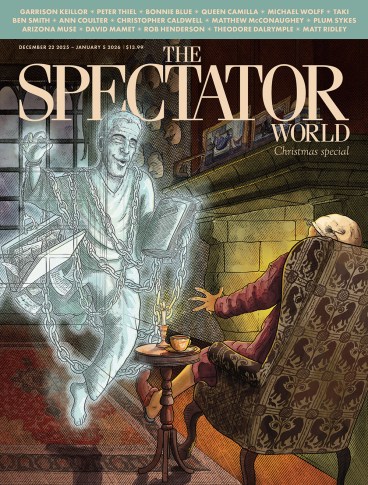
This article was originally published in The Spectator’s December 22, 2025 World edition.




Comments