

For people from the former Soviet Union, the holiday season brings with it two certainties: mayonnaise and movies. Mayonnaise, because no winter festivity is complete without the traditional mayo-infused salads with such evocative names as “herring under a fur coat” and “Olivier,” which are eaten for days straight. These calorific concoctions are best accompanied by a dozen or so cult films from around 1965 to 1985, which are ritually rewatched every year by Homo Sovieticus and his descendants.
Of these classics, one of the most beloved is the musical The Adventures of Elektronik (1979). Adapted from the novels of the science-fiction writer Yevgeny Veltistov, the movie tells the story of a young robot named Elektronik. Designed by the Soviet scientist Gromov, Elektronik is what we would call today artificially intelligent: he learns and processes information incredibly fast but is unable to experience emotion.
The film anticipates the future but is also a nostalgic, rose-colored window into the lost world of the Soviet Union
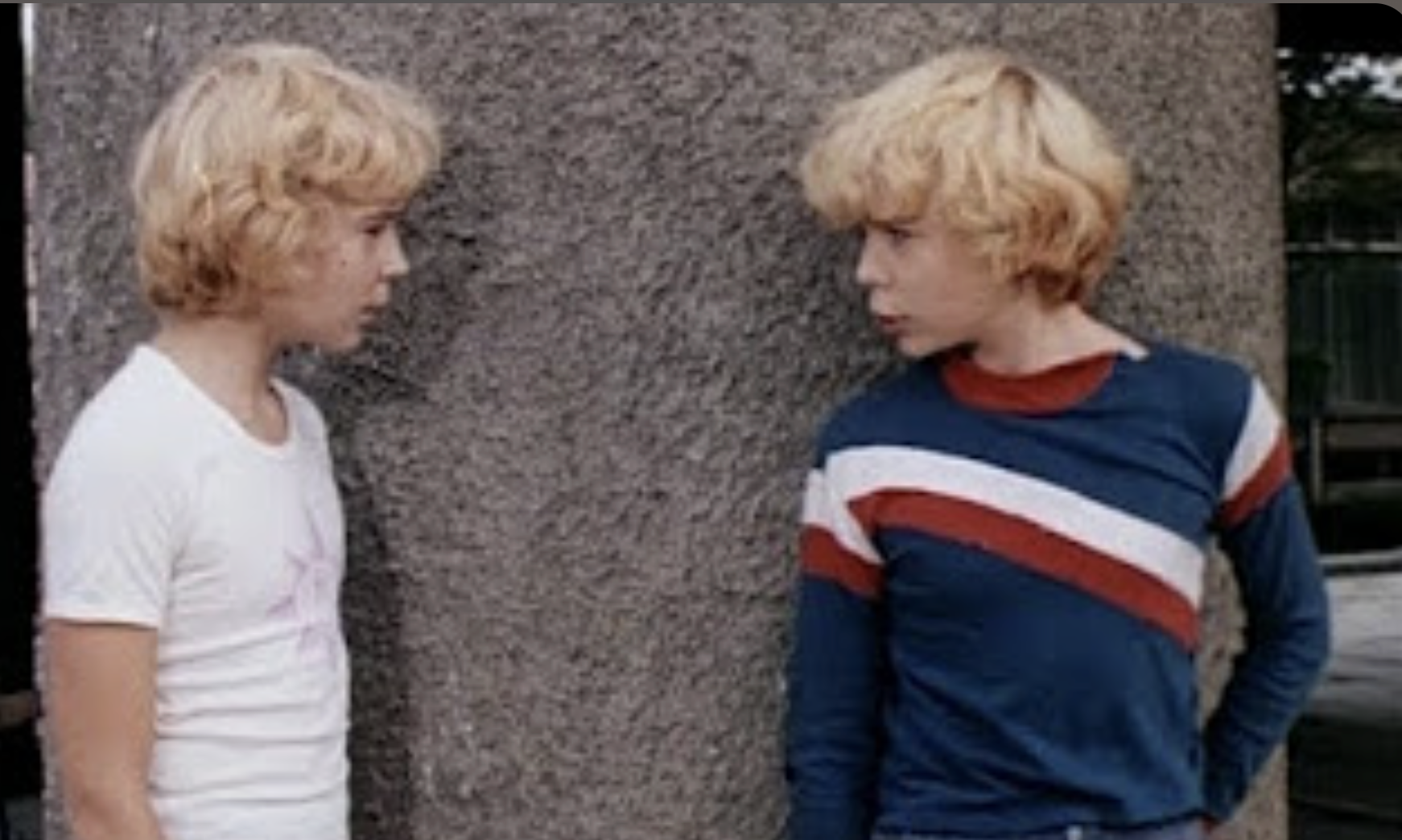
At the start of the film, he escapes the kind professor’s apartment and goes on a quest to become human. By chance, he encounters Sergei Syroezhkin, the boy on whom he was physically modeled; in fact, the two are indistinguishable and were played by actual twins. They become fast friends. Meanwhile, a gang has been tracking the development of Elektronik, and a thief is dispatched to kidnap the robot and use him for nefarious purposes.
The Adventures of Elektronik is a children’s comedy, but like all great films of that genre, it speaks to all ages. The film’s treatment of artificial intelligence is most striking today.
The movie starts with Elektronik playing chess against his inventor, Gromov. When Elektronik beats him, the professor is shocked but delighted, crying out, “This is victory!” That statement prompts the robot to ask Gromov if the triumph means he could now become a chelovek – a capacious Russian word meaning “human,” “man,” and “person.” The scene foreshadows the era-defining series of matches that the Russian chess grandmaster Garry Kasparov played against the IBM super-computer Deep Blue in 1996. Although Kasparov ended up winning, he told the New York Times: “For the first time I saw something approaching artificial intellect.” Today, computers can easily beat any grandmaster.

Another prescient aspect of the film is its central focus on “the great replAIcement.” When Syroezhkin realizes what his double is capable of, both physically and intellectually, he starts sending him to school on his behalf to do his assignments and presentations for him. The movie is at its most insightful here in showing the consequences of this outsourcing of learning: at first, Syroezhkin is delighted with his newfound freedom, as he lazes about for days on end in an abandoned garage and sings a song called “What heights progress has reached!” Soon, however, this freedom turns sour. As Elektronik replaces him ever more completely, Syroezhkin, who admits he is overly “hooked on progress,” becomes literally locked out of his own life, unable even to enter his own apartment. He cries out in frustration, “Am I to just disappear entirely? Am I not a chelovek?”
That question of what it means to be a chelovek lies at the core of the film. Early on, there’s a remarkable moment when Syroezhkin and Elektronik, having just met but already wearing identical outfits, start whirling around, holding up a mirror, gazing into their reflection. Suddenly, the mirror falls and shatters. The scene introduces the ancient theme of recognition in the eyes of the other, which is central to the human experience. As his creator Gromov says, if Elektronik, on his quest to become human, is not recognized, he will perish.
There are other surprisingly profound insights. One of the many now-proverbial lines from the film is, “Figure out where his button is!” which the gang leader Stump screams over a walkie-talkie at Urrie, the kidnapper he has sent to abduct Elektronik. When Urrie reports that Elektronik doesn’t come with a button with which he could be controlled, Stump remarks that every person has his own button, whether it be vanity, greed or pride.
Although The Adventures of Elektronik anticipates the future, for many today it is also a nostalgic, rose-colored window into the lost world of the late Soviet Union. The film’s most Soviet trait is the characters’ unshakable optimism about scientific and technological progress. Elektronik’s powers are quickly taken for granted as merely the latest example of Soviet scientific achievement. At the same time, however, the film points to disillusionment with the Soviet experiment.
As the AI arms race between the American-led West and a revived Russo-Chinese eastern bloc heats up, perhaps it’s worth reflecting on a line that the school principal, seemingly channeling the director Konstantin Bromberg, says about Syroezhkin at the end of the film: “It’s extremely easy to lose your place in life, but it’s very hard to win it back.”
This article was originally published in The Spectator’s January 19, 2026 World edition.






Comments