Theatre

Glorious farewell

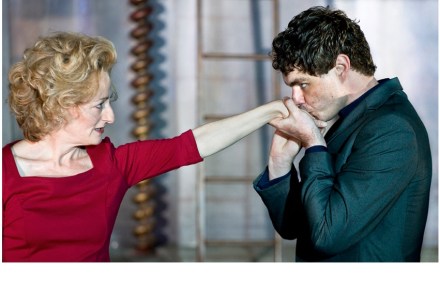
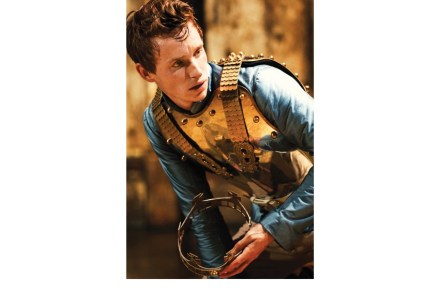
Michael Grandage says farewell to the Donmar with a farewell play. Richard II tells of a glorious but profligate king compelled to hand over his realm to a workmanlike, Steady Eddie successor. Entirely devoid of romantic interest, and with only teeny-weeny roles for women, this is not a show-stopping Shakespeare favourite. It appeals to specialists who note that it marks the Bard’s transition from medieval thriller-writer to dramatic philosopher. Grandage rises to this level and puts on a production that will satisfy the most ardent purist. Richard Kent’s ecclesiastical set is ravishing. The clever split-level arrangement of arches and tracery creates a versatile warren of spaces that are entirely practical but also fully evocative of religious awe.

A laughing matter

Barry Cryer, defiantly old-fashioned in a dinner suit and red-velvet waistcoat, sits in a director’s chair and addresses his audience as if they are devoted friends. Most of them are: every joke he tells is met with affectionate laughter of a kind given only to national treasures. Butterfly Brain, which is currently touring, is structured around the alphabet, but each letter is simply a starting point for masterly flurries of unconnected comedy. Some of these, such as ‘My Old Man’s a Dustman’ sung to the tune of ‘Heartbreak Hotel’, come directly from I’m Sorry I Haven’t a Clue, on which Cryer has appeared ‘since before sound’. Others are anecdotes collected across a lifetime of listening to backstage stories.

Indefatigably British

My German grandmother never understood the point of pantomime. She’d lived in England for more than half her life, spoke English like a native (actually, a good deal better) and had a sound appreciation of English humour, from Lewis Carroll to The Good Life. However, she was happy to admit that the panto bug had completely passed her by. She knew that pantomime was the one art form that was indefatigably British, and that no foreigner could ever hope to decipher it. Of course she was absolutely right. No other entertainment sums up our innate Euroscepticism quite like panto. And no British Christmas is complete without a chorus of ‘Oh, no you’re not!’ or ‘He’s behind you!’ That’s not to say, though, that we actually enjoy it.

Not strictly panto

My friend Robin, a retired financier, is a fine comic actor but he’d be the first to admit he has a problem with lines. He bursts on to the rehearsal stage in a huge grey wig and launches into an anarchic approximation of his part as the Magistrate at Calcutta in Around the World in Eighty Days — my adaption of Jules Verne’s classic, and this year’s Christmas show at Helmsley Arts Centre in Yorkshire. Robin is off-piste from start to finish, but with gusto and style. The sentences he imposes on Phileas Fogg and Passepartout (for the latter’s failure to remove his hat and shoes in the pagoda of Malebar, you may recall) are rarely the sentences, in either sense, that Verne or I wrote.

Those I have loved

It is one of Kenneth Tynan’s most-quoted observations. After seeing the first night of Look Back in Anger at the Royal Court Theatre in May 1956, the mustard-keen young critic could not contain his enthusiasm for John Osborne’s play. ‘I could never love anybody,’ he wrote, ‘who did not want to see Look Back in Anger.’ On reflection it says rather more about Tynan’s eagerness to be recognised than about the play’s merits, but the phrase has entered the language. From this distance Look Back in Anger does not look particularly lovable. It was important, certainly, in the sense that there were English plays before, and after, and they were not the same. Tynan was the first man to spot Osborne’s talent, and wanted others to know it.

Dollop of woe

Juno and the Paycock is a slice of documentary realism from the earliest years of the Irish Free State. The skint Boyle family are living like a gang of hobbits in the leprotic ruins of a grand Dublin townhouse. The paint blisters and peels. Diseased mortar crumbles into scabby flakes. The plaster-work centrepiece on the ceiling is like a charred meringue the size of a cartwheel. It’s grim. Money’s tight, food is scarce. Everyone’s depressed. There’s no work. The pride of the family, young John Boyle, would probably give his right arm to get a job if it hadn’t been blown off during the civil war. Then a glimmer of hope. Cap’n Jack Boyle inherits a small fortune from a forgotten cousin. Hooray! The happy times are here. The Boyles go bananas.

Knock-off news

The Onion is a comic giveaway American newspaper that satirises the awfulness of most American newspapers. ‘Doofus Chilean miner stuck down there again’ is one of their recent headlines, along with ‘Parents honor dead son by keeping up his awful blog’. Now we in Britain can watch the television version, Onion News Network (Sky Arts 1, Saturday). It is the latest spoof of 24-hour news. The first, and probably the best, was Armando Ianucci and Chris Morris’s much-too-brief The Day Today back in 1994. You may remember the hopeless Peter Hanrahanrahanrahan. Morris used to duplicate those cosy chats between reporter and presenter except that in this case he would tear Hanra’s reports to shreds.

Conjuring with morality

You can see why Harold Bloom, in his marvellous book Shakespeare: The Invention of the Human, should have called Measure for Measure one of Shakespeare’s most ‘rancid’ plays. But it’s also one that he greatly admired, though it takes a good production like Roxana Silbert’s new one at Stratford to show you just why. Bloom’s rancidity resides in the unpleasantness of the characters, and in the way in which even the seemingly virtuous go about their morality. Wisely eschewing any overly specific setting, Silbert lets the costumes do the work.

Geometry lesson

It’s the usual old muddle. You take a Shakespeare classic and you time-travel it to an alien century, usually the present one, which has no connection with its historic setting. The plan, we’re always told, is to generate that supremely irrelevant attribute, ‘relevance’. Director Dominic Cooke has fast-forwarded The Comedy of Errors to modern London and I have to confess it works extremely well. For once, it’s OK to have wrong-era costumes and juggled chronologies and a visual setting that’s out of whack with the literary context because Cooke is simply mimicking Shakespeare. The Bard nicked a Roman favourite, The Menaechmi of Plautus, and dolled it up in the culture and lingo of London’s red-light district, Southwark.

Power games

Plays used to end in marriage. Then they anatomised the highs and lows of life as a couple. Now — at least in Neil LaBute’s latest London première — the relationships are all either over or heading that way fast. Reasons to Be Pretty (Almeida, until 14 January) gives a spot-on depiction of those no-man’s-land months following a break-up, when relations between exes are loaded with an electric ambiguity, and contradictory feelings alternate with bewildering rapidity. After an apocalyptic row in the first scene, estranged Greg and Steph keep bumping into each other about town.

Anatomy of an uprising

They can’t even be bothered to think of a decent title. Good thing too. The Riots, at the Trike, is a rush job, a gripping and pacey attempt to analyse the disturbances that engulfed Britain last August. Cops, criminals and community leaders have been interviewed by Gillian Slovo, who fashioned their statements into a dramatic investigation. The riots might never have happened if more prudent tactics had been used at the start. The family of Mark Duggan, shot dead by police on 4 August, staged a demonstration outside Tottenham police station two days later. Police refused to speak to them, claiming that the independent investigation into Duggan’s death obliged them to remain tight-lipped. The family didn’t believe this.

Forthright to a fault

Her mother was Ellen Terry, the most admired actress of the day. Her brother was Edward Gordon Craig, the celebrated stage designer. Little wonder then that Edith Craig was overshadowed for most of her life by two such towering figures. Yet her theatrical achievements were substantial. She was a talented costume designer and maker, the founder of the radical theatre group the Pioneer Players, and an indefatigable producer and director of countless plays and pageants. She was also an important figure in the suffrage movement, staging many feminist plays, and lived in a famous artistic lesbian ménage-à-trois.

Historical knockabout

It’s a palace drama with all the trimmings. Trevor Nunn’s new production, The Lion in Winter, plunges us into the court of Henry II and his spurned wife, Eleanor of Aquitaine, as they struggle to decide which of their three sons should inherit the throne. Eleanor, held prisoner in a deluxe royal fortress, has been granted leave to join the family at Christmas. ‘Thanks for letting me out,’ she says, on their first meeting. ‘It’s only for the holidays,’ jokes Henry. Clearly a king who locks his wife in the broom cupboard won’t pay much heed to her views on the succession. So there’s an emotional and dramatic illogicality here right from the start. And, right from the start, the playwright couldn’t give a stuff. Which helps.

Bishops and ploughboys

The delectable drama student who served dinner beforehand in the Rooftop Restaurant told us she’d much enjoyed Written on the Heart but that it was a bit intellectual. As David Edgar’s new play is about the making of the King James Bible, this wasn’t altogether surprising. How do you make a play about the deliberations of some 54 bishops and scholars who fine-tuned William Tyndale’s English translation of c.1525–34 into the KJB of 1611? One place to start is to have the scholars haggle over ‘delectable’ or ‘very pleasant’ as alternatives for Na’ ameta li meod in II Samuel 1: 26, not that they’d glimpsed our waitress in the restaurant.

Sheer madness

‘I’m off to see a play about a man who kills his dad,’ I told my five-year-old as I left the house. ‘Because he didn’t give him any ice-cream?’ he said. Mmm, I wondered, it’s possible that Hamlet harboured some childhood grudge against Claudius over a Mr Whippy refusal episode. But such meta-textual speculation is extremely perilous. And when I reached the Young Vic I realised just how grave the danger can be. Ian Rickson’s bumptious show sets the play in a loony bin. Banana yellow walls. Tannoy announcements. Leering staff wearing canvas security uniforms. Claudius, in a three-piece suit, setting chairs in a semi-circle for Hamlet, Gertrude and the court. Visually this is clear enough but narratively it creates disorder.

Blood-stained humour

I take no pleasure in saying this but the director of the National Theatre, Nicholas Hytner, appears to have lost his sense of propriety. Or possibly the balance of his mind. He’s asked John Hodge (author of the Trainspotting screenplay) to write a sitcom about the Great Terror. And, rather than bunging it in the nearest skip, Mr Hytner has decided to direct it at the Cottesloe. The blood-stained gag-fest begins in 1938 when a secret policeman orders Russia’s leading satirist, Mikhail Bulgakov, to write a play about Stalin’s early life. Bulgakov meets the Great Leader and Teacher and finds him keen to assume personal control of the scriptwriting. So Bulgakov takes over Stalin’s day job, running Russia. This inspires many hilarities in the horror-slapstick genre.

Fantasy auction

Have you ever felt the urge to rush backstage, brushing aside the objections of minders, and introduce yourself to a favourite actor? Or perhaps you’ve fantasised about dressing up in the old clothes of a Hollywood star? Don’t blush and walk away! We can reveal exclusively that you have nothing to be ashamed of. On the contrary, the future of British theatre could well be in your hands… Starting out as a producer of big commercial shows like Yes, Prime Minister or South Pacific is a hazardous business. It takes not just an eye for a good idea, and a firm managerial hand, but a hefty capital investment to boot. And if putting money into new arts projects seems foolish to private investors at the best of times, at times like these it can easily appear deranged.

Splendid dereliction

Long may it lie in ruins. Wilton’s Music Hall, in the East End of London, is a wondrous slice of Victoriana which exploits its failing grandeur to the max. All visitors are implored to find a couple of quid for the restoration effort. But decay and dilapidation are the best things about it. Every wrinkled façade, every petal of tarnished gilding, is like a tear shed for an age that will never return. It’s wonderful. The administrators have realised this, too. Ruination is their main selling point. The cover of the brochure shows a heart-rending image of the terracotta entrance flaking and declining beautifully. If the renovation campaign were to find enough loot for a proper facelift, the place would go bust overnight. No one wants a squeaky-clean music hall.

Birmingham Royal Ballet

Contrary to general belief, there is little glamour in the professional life of a dance critic. What there is, though, is a considerable amount of time spent confronting painfully unsuccessful attempts at making art or, at least, making something worth seeing. What makes one digest those endless stretches of choreographic drabness is the promise — sometimes the mirage — of rare moments of pure bliss. Which is what I experienced last week when, for the first time in years, I struck it lucky and sat through three superb performances in a row. Signs that the Birmingham Royal Ballet’s brief run at Sadler’s Wells was going to be a hit were evident from the moment the curtain went up on its Autumn Glory programme.

Marat/Sade

Peter Brook’s 1964 staging of Peter Weiss’s Marat/Sade for the RSC was one of the most enjoyable experiences of my life as a young journalist. The magnificently titled Persecution and Assassination of Marat as performed by the inmates of the Asylum of Charenton under the direction of the Marquis de Sade was a knockout. With Patrick Magee as de Sade, Ian Richardson as the Herald (later as Marat) and Glenda Jackson as Charlotte Corday, the play’s argument between de Sade’s belief only in the warts and all of one’s own self and Marat’s faith in utopian socialist revolution made spellbinding theatre, the dialectics irresistibly packaged with song and dance routines and the brilliance of Peter Brook’s production.