More from Books

Short stories: Life-changing moments

On a recent Guardian podcast, Chris Power — who has written a short story column in the Guardian for a decade — recognises the tendency of reviews of the form to begin with ‘an obligatory paragraph on “The Short Story” in capital letters, rather than talking about the work’. Power’s debut collection is itself a

An electrifying genius

Nikola Tesla, the man who made alternating current work, wrote to J. Pierpont Morgan, the industrialist and banker. It was 1902 and Tesla was broke. ‘Am I backed by the greatest financier of all time? And shall I lose great triumphs and an immense fortune because I need a sum of money? Are you going

Endless petty squabbles

I wrote foul-mouthed marginalia throughout Benjamin Markovits’s A Weekend in New York. Not because Markovits is a bad writer — he has a deserved reputation for excellence. But because this study of a privileged American family reaches for a significance it doesn’t achieve, and leaves a self-consciously literary novel with a surfeit of detail. There

Approaching mild panic

For a brief moment in 2011, standing among thousands of people occupying Syntagma, the central square in Athens, it looked as though social media would change the world. A row of laptops set up next to the subway entrance became the beating heart of an anti-austerity movement that promised to go well beyond simple protest

A labour of loathing

The titans of the podium, a late 19th- and 20th-century phenomenon, a species now extinct, have on the whole been well served by their biographers, with Peter Heyworth’s Otto Klemperer: His Life and Times as the ideal. Wilhelm Furtwängler, by far the greatest of them all in my and many other people’s opinion, has not

Trouble for Lucia

In 1988, James Joyce’s grandson Stephen destroyed all letters he had from, to or about his aunt Lucia Joyce, the novelist’s daughter. Many saw the destruction of documents pertaining to Lucia, who had spent the majority of her life in asylums and had been close to her father, as the destruction of keys to understanding

When voters lose faith

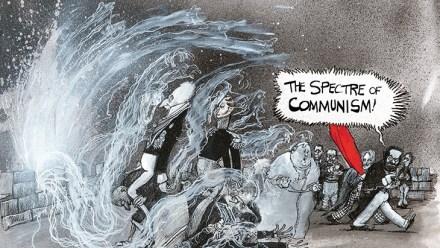
If social media manipulation has influenced elections, and dark money has influenced our elected representatives, then we are already on the road to unfreedom, as Timothy Snyder, the well-known historian of Russia, argues in his new book. He sees threats to democracy in Europe and America as following the Russian model of oligarchic takeover: ‘The

Miss Marple to the rescue

Girl with Dove is a memoir by Sally Bayley, a writer who teaches at Oxford University, of growing up in a squalid, dilapidated house in a Sussex seaside town. It contains her mother Ange, her aunt Di, her grandmother, an unspecified number of siblings and a variety of temporary inhabitants who joined the Zion-seeking cult

Coming of age in Nazi Germany

The distinguished historian Konrad Jarausch’s new book is a German narrative, told through the stories of ordinary people who lived through his chosen period. Six dozen Germans — mostly from the generation born in the 1920s — testify through their memoirs to how it was to be Christian or Jewish, working-class or upper- middle-class, a

Soaked in blood and symbolism

We’re in Virginia, in the 1850s. A girl called Emily is tormenting her dog, Champion, and her father’s teenage slave, Rawls. Seeing this, Emily’s father, Bob, beats her with his belt and kicks the dog. Of Rawls, Bob says: ‘Now leave him be so he can get about my business!’ A girl, a dog, a

Stories about stories

I wonder what your idea of a good novel is. Does it embody the attributes of solid plotting, characterisation and an impermeable membrane between invention and reality — the novel, that is, being a box from which nothing can leap out, and into which nothing, except what the author has chosen to put there, can

How to infuriate the French

Fine wine rarely makes it into the public consciousness, but one event in 1976 has proved of perennial interest: the so-called Judgment of Paris. It heralded the arrival of wine from the New World, but also tapped into popular prejudice. Who can resist French wine snobs being made to look foolish? So these memoirs by

Fast and furious | 14 June 2018

This new collection of John Edgar Wideman’s short stories comes across the pond as one of four handsomely packaged volumes from Canongate. Little known in this country, he towers large in his native States; a MacArthur Genius fellow, a PEN/Faulkner Award winner twice, winner of the Prix Femina Etranger last year, endorsed by Richard Ford

Lessons from the Great Cham

The most irritating of recent publishing trends must be the literary self-help guide, and Henry Hitchings’s contribution to the genre will join a shelf now groaning with accounts of how Proust can change your life, how Adam Smith can change your life, what W.H. Auden can do for you, what Montaigne can tell us about

A sobering tale

The Recovering by Leslie Jamison, novelist, columnist, bestselling essayist and assistant professor at Columbia University, makes for bracing reading. Clever, bold, earnest and sometimes maddening, it is chiefly an account of the author’s alcohol addiction and the various stages of her recovery. It is also an examination of the lives and works, in so far

Abominably elusive

In 1969 the body of an ape-like creature, preserved in ice inside an insulated box, came to light in Minnesota. Its provenance was unclear, but the rumour went round that it was a Bigfoot, the North American equivalent of the Himalayan yeti. After two days peering through the box’s glass cover, the Belgian zoologist Bernard

A spy in la-la land

In 1940, the British Security Coordination sent an agent with an assistant to a Hollywood film studio to help promote the British war effort in America. This is the inspiration behind Louise Levene’s enjoyable new novel Happy Little Bluebirds. Here, though, the assistant — Evelyn Murdoch, who was working at the Postal Censorship department in