More from Arts

Voices of protest

It was a bit surprising to find a programme marking the 62nd anniversary of the bombing of Hiroshima and Nagasaki on Radio Two (Tuesday), not Radio Four. The stations are changing, morphing into each other as they seek ever more urgently to catch that elusive thing, a dedicated listener. Next we’ll find Terry Wogan putting on the selected hits of Pierre Boulez. It’s also why we’re all being constantly persuaded to listen again, download and podcast — it’s another way of boosting audience figures. Power to the People, for example, was scheduled for broadcast at 10.30 p.m.
Perils of Poddery

Oh, to be an Early Adopter. They are the marketing man’s friends. Oh, to be an Early Adopter. They are the marketing man’s friends. Early Adopters buy only the latest thing, they are up to the minute, maybe even up to the second, these crazed opinion-formers whose reckless compulsion to spend all their money on rubbish keeps the global economy ticking over. You can’t compete with an Early Adopter, and who would want to? Myself, I am a Late Adopter. I don’t own a mobile phone, I can’t drive and I only acquired a DVD player last Christmas. (And didn’t plug it in for six weeks.) In July it was my birthday. What did I want? An iPod, of course.

Dying of love

‘I fear the opera will be banned — unless the whole thing is parodied in a bad performance — : only mediocre performances can save me! Perfectly good ones will be bound to drive people mad, — I cannot imagine it otherwise.’ So Wagner famously wrote to Mathilde Wesendonck, his muse while he was composing Tristan und Isolde, when he was writing Act III. If he’d seen the Glyndebourne production, first unveiled in 2003 and now revived with a largely identical cast, he would not have worried about the dangers of experiencing what everyone agrees is a uniquely intense work, unique both in kind and in degree.

Musical gazumping

Why do people spend their lives doing something which makes them nervous, even to the point of making them sick? I have watched musicians go on stage so frightened that it has been obvious to everyone present that they could not possibly be about to perform as well as they could. They look pale, they may be physically shaking, they are swallowing hard. What lies ahead of them seems like sheer hell. How can they bear to put themselves through this every time they want to ply their trade? They remind me of sportsmen. In fact at one level the two ways of life are quite closely linked by gesture and terminology.

Artistic harmony

If you are planning a holiday visit to Shakespeare country and fancy a change of mood and visual pace from the usual round of sightseeing and theatre-going, Compton Verney is a splendid alternative destination. Besides the remarkable permanent collections of paintings, Chinese bronzes and English folk art, there is a programme of changing exhibitions which make something of a virtue out of contrasting the historic with the contemporary. Thus an older master will be shown side by side with a modern (a previous grouping was the sculptor Messerschmidt with Van Gogh and Francis Bacon) in order to strike new resonances from each by this unexpected juxtaposition.

Move over, Monet-maniacs

On 30 January 1999, not long after the Royal Academy had mounted its second Monet exhibition, The Spectator published my first exhibition review. It was about a renewal of Cubism in the sculpture of Ivor Abrahams and began as follows: ‘The end of a century, like a wedding, notoriously calls for something new. A millennium apparently calls for New Impressionism, although in a recent speech at the Royal Academy Gordon Brown made a special point of not claiming Monet for New Labour, despite his admiration for the great man’s credentials, such as his stance on the Dreyfus case.

Brimming over with music

‘Hello, Gavin. Have you got the sackbuts with you?’ Administrative magician Rebecca Rickard is dealing with what is, for her, a fairly ordinary sort of phone call in the greater scheme of things. As it turns out, Gavin (Henderson) has indeed got no fewer than three sackbuts, and is planning to bring them with him the following morning on the London to Totnes train. Three musicians in this, the first week of the 60th Dartington International Summer School, will no doubt be duly grateful. The Summer School is a unique gathering point for musicians of every possible description and of varying standards of ability.

Birth of the seaside

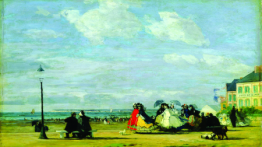
If we must have frequent Impressionist exhibitions, and it’s clear from the public’s insatiable appetite for them that we must, then at least let’s have good ones. The current show at the Academy is a well-conceived and enjoyable expedition into a theme. All too often themed shows seem forced — the art selected to illustrate an idea, rather than the idea helping us to focus on key works of art. Impressionists by the Sea is both interesting and revealing, and it includes a good percentage of high-quality art into the bargain. An excellent show for those who prefer the idea of the seaside to the actuality of overcrowded or rain-despoiled beaches.

Fount of all gardens

According to an Hellenic historian, Nebuchadnezzar built the Hanging Gardens of Babylon in the 6th century BC to make his wife, who was from a mountainous region of Iran, feel at home. In fact, he and other rulers of Mesopotamia before him (the first such gardens were probably at Nineveh) were seeking to impress a much wider audience, and the Babylon version made it on to the list of the Seven Wonders of the World. The archeological evidence is limited, but these gardens very probably occupied a series of terraces of an enormous ziggurat that would have been visible from miles away.

Boundless passion

L’Amore dei tre Re; Macbeth Montemezzi’s L’amore dei tre Re has had a puzzling history. It was first performed at La Scala in 1913 and was quite successful; far more successful under Toscanini at the New York Met, until after the second world war, and a fair number of performances elsewhere, often as a vehicle for one of the great lyric sopranos. In 1952 it suddenly disappeared from the repertoire, and revivals since have been increasingly rare. As so often, Opera Holland Park has come to the rescue. With what seems to be a guaranteed audience, it can stage what it likes, and it likes so-called verismo operas, though the label is absurd almost whenever it is applied, and certainly in this case.

How to feel young again

The older I become, the easier I find it to sink into that old-gittish state of believing everything has got worse with the passage of time. In my childhood there was the hippie movement, when young people felt that peace and love and expanding your mind might be a nice idea, helped along by the occasional mild, non-psychosis-inducing joint. Nowadays, the drug of choice is cheap booze, with rampaging chavs turning town centres into a Hogarthian nightmare of vomiting and violence fuelled by alcopops and super-strength lagers. Then there are South West Trains, which drive me to the brink of apoplexy almost every day of the week.

Midnight’s children

Yet another rash of programmes has erupted marking the anniversary of yet another of Britain’s disastrous foreign policy decisions. At midnight on 14 August it will be 60 years since Nehru, as the prime minister of newly independent India, pronounced those fateful words, ‘A moment comes, which comes but rarely in history, when we step out from the old to the new, when an age ends, and when the soul of a nation, long suppressed, finds utterance.’ Yet another rash of programmes has erupted marking the anniversary of yet another of Britain’s disastrous foreign policy decisions.

Misleading the public

I was fascinated to watch the low-key struggle the other day between BBC and ITV executives, and members of the Commons culture committee. The television people said they were appalled by the chicanery revealed in various programmes — premium-rate phone-ins, the show about the Queen, for example — and would take urgent steps to make sure it never happened again. Mark Byford, the BBC’s deputy director-general, seemed to be in a state of anguish. One member of the committee said afterwards that he feared he might demonstrate his contrition by slitting his wrists in front of them. The MPs were rather sceptical, especially about the BBC’s decision to make 16,000 employees attend a course to teach them how to avoid misleading the public.

Wish fulfilment

Which super power would you choose? When I was young, the one I quite wanted was invisibility. I imagined myself sneaking into the bedrooms of all the girls I fancied and persuading them that I was an incubus come to satisfy their every desire. An ability to arrest time with a stopwatch would be a handy power too, as would being able to fly or teleport. But the impression I get with super powers is that you’re not allowed to be too greedy. I was trying to think which low-level super power I’d accept today and I realised how unambitious I’ve become. Being able to go to the loo without ever again needing to wipe your bottom — I’d be quite happy with that. Always going to sleep within 30 seconds of one’s head hitting the pillow, that would be even better.

Bowled over

Adorable, sensational Joseph. I was bowled over by this show, not just by the slick vitality of the 60-strong cast, not just by the teasingly satirical hippy-trippy lighting effects, not just by Preeya Kalidas’s gloriously stylish Narrator, and not just by the Mel Brooksian chorus-line of high-kicking Jewish shepherds, no — by the material. Talk about genius from nowhere. The script originated as a 20-minute end-of-term sketch for the pupils of St Paul’s in west London. Its charm and its technical brilliance were noticed immediately and the show, once expanded, launched its authors heavenwards. Tim Rice’s lyrics are joyously witty.

Making connections

In idle mood — perhaps prompted by the news of terrible further flooding — I’ve just listened for the first time in many years to Peter Grimes. In idle mood — perhaps prompted by the news of terrible further flooding — I’ve just listened for the first time in many years to Peter Grimes. Idleness scarcely survives the excitement that involves the listener from the opening bar. It’s difficult to understand Britten’s later disclaimer to a young admirer embarked on his own first opera — ‘but Grimes is full of howlers!’ — for everything now, 60-plus years after, has long since seemed so absolutely right. These six decades have consolidated the work as a permanent cornerstone.

Family favourites

As you’d expect — doh! — The Simpsons Movie has some glorious lines in it. Lisa to Marge: ‘I’m so angry.’ Marge to Lisa: ‘You’re a woman. You can hold it in for years.’ Bart to Homer: ‘This is the worst day of my life.’ Homer to Bart: ‘No, son. This is the worst day of your life so far.’ No one, by the way, says: ‘When writing about the Simpsons, there will always be a “doh!” so get it out the way quick’ but you will note that I have been clever enough to do so, all the same. There are no flies on me. Yes, yes, yes...almost since day one back in 1990 The Simpsons has proved itself a masterpiece and at some level you could even say that I now live according to Simpsonian wisdom.