Mark Glazebrook

Love of queens and princes

From our UK edition

Watercolour: only a medium but what a medium! It’s so versatile, and when painting the landscape it can respond with lightning speed to changes in the weather. Watercolour: only a medium but what a medium! It’s so versatile, and when painting the landscape it can respond with lightning speed to changes in the weather. The latter’s unpredictability has made it our most predictable national topic and the English have long taken watercolours to their hearts, both as practitioners and as collectors. Indeed, Queen Victoria (a watercolourist herself) presided over no fewer than two comparable organisations, the Royal Watercolour Society (RWS), founded in 1804, plus the Royal Institute of Painters in Water Colours (RI), which became Royal in 1885.
Treasure trove

From our UK edition

Qatar’s Museum of Islamic Art Islamic art is a fast growing subject of study. Too many countries are involved for it to be categorised like French or Japanese art. In New York and London Islamic art tends to be confined to a section of an institution such as the Met, the British Museum or the V&A. Similarly, in the capital of United Arab Emirates, the Louvre Abu Dhabi will show art from all eras and regions, including Islamic art, when it opens in 2012. Meanwhile in Qatar, the peninsular state further up the gulf to the west and north of UAE, a more specialised institution has just opened its doors — namely the Museum of Islamic Art in Doha, MIA for short. It’s not a disappointment.

Seduced by Klimt

From our UK edition

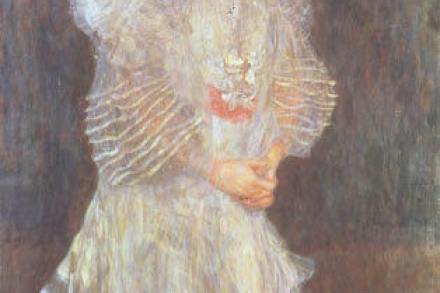
Art Nouveau, or Jugendstil as it was called in Germany, came rather late to Austria, where it was sometimes called Sezessionstil. Gustav Klimt was a leading light in the breakaway Austrian Secession movement founded in 1897. Only a fool would deny that he was an exceptionally gifted artist. He absorbed in turn 19th-century Realism, Symbolism and Impressionism. He drew so beautifully that only prudes will be shocked by his sensuality. (Indeed, it is to be hoped — or hoffentlich as they say locally — that his erotic images of ladies pleasuring themselves, rendered in soft and not so soft pencil, may have educated and liberated Freud’s neurotically uptight Viennese patients.

Bridge over troubled water

From our UK edition

Within the expanding aquatic metropolis that is Istanbul, two late-20th-century bridges straddle the continents of Europe and Asia. These traffic-laden steel bridges, spanning high above the ferries and other boats which ply the busy waters of the Bosphorus below, are visibly useful links between two civilisations. They are also symbols, perhaps, of the noble dream of bringing the mentality of the Muslim world closer to that of the non-Muslim world in a spirit of mutual admiration and respect. A cultural event like a Rodin exhibition is worthwhile for its own sake. Held in a Muslim country, it may also nurture such a noble dream.

City revival

From our UK edition

‘What are you going to be when you grow up?’ an inquisitive adult asked during the break for tea at a tennis party given by my parents in the Vale of Clwyd, North Wales, c.1948. ‘A cotton broker,’ I replied, wishing to follow in the ancestral footsteps. Then my father’s head shook from side to side, slowly, silently and solemnly at the head of the table. And so it came to pass that I joined the postwar Liverpool diaspora — to London, in my case — while remaining proud that both my father and grandfather had been presidents of the Liverpool Cotton Association, the latter about 100 years ago when more cotton came to Liverpool than to any port on earth.

Portrait of a director

From our UK edition

Mark Glazebrook talks to Sandy Nairne, who explains why the NPG is part of the life of London David Piper, director of the National Portrait Gallery 1964–67, was a brilliant historian and museum director who, while writing a book called The English Face, found that there’s no such thing. It vanished like the smile on Lewis Carroll’s Cheshire cat. Piper himself was disinclined to mastermind the much-needed radical reform of a musty old institution — a challenge successfully embraced by his young colleague and successor, Roy Strong. Strong’s Cecil Beaton show, a first for photography, drew previously undreamed of crowds. Today, attendance figures have risen to 1.6 million per annum.

Lifting the spirit

From our UK edition

Olaf Street sounds as though it should be in some Scandinavian city or other. No doubt there’s a street so named in several Norwegian towns, but there is also an Olaf Street in London W11, of mysterious origin. Could King Olaf II of Norway, fresh from asserting his suzerainty in the Orkneys, have decided to celebrate by keeping an English mistress in what was to become West Kensington a thousand years later? For those who can’t always afford taxis it’s an area which is now served, if somewhat erratically, by Latimer Road Underground Station and the 295 bus; but, whatever its beginnings, Olaf Street, London W11 is still off the beaten track and it’s a very surprising place in which to come across a large and exceptionally elegant modern art gallery.

Magnificent six

From our UK edition

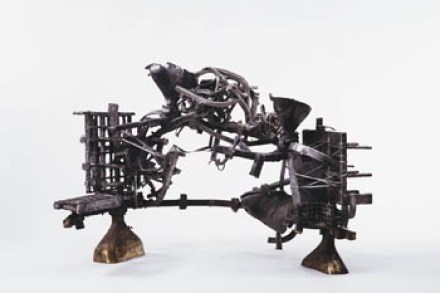
Anyone who goes into the Annely Juda Gallery in Dering Street expecting something like those light, airy, weight-denying abstract steel sculptures, painted bright red all over perhaps, like the Tate’s song-evoking ‘Early One Morning’, 1962, is in for a big surprise. All works shown here stand with absolute, resolute, broad-based firmness as if to proclaim that they are what they are. ‘Jupiter’, for example, made in 2005, boasts some nine points of contact with the floor. Caro famously shed the need for a pedestal over 40 years ago and this decision continues to add a certain strength of identity to his sculptures. Self-contained strength is what most of his recent works assert. There is often a delightful individuality but there are sombre elements as well.

Move over, Monet-maniacs

From our UK edition

On 30 January 1999, not long after the Royal Academy had mounted its second Monet exhibition, The Spectator published my first exhibition review. It was about a renewal of Cubism in the sculpture of Ivor Abrahams and began as follows: ‘The end of a century, like a wedding, notoriously calls for something new. A millennium apparently calls for New Impressionism, although in a recent speech at the Royal Academy Gordon Brown made a special point of not claiming Monet for New Labour, despite his admiration for the great man’s credentials, such as his stance on the Dreyfus case.

Can artists save the planet?

From our UK edition

Given his interest in the merging of blue with green, David Cameron would presumably feel at home in the United Arab Emirates while Sharjah’s 8th Biennial is on. The Biennial’s title and theme is Still Life: Art, Ecology and the Politics of Change. I imagine that the first two words refer not only to the historic painting genre — a genre which reminds us of our mortality on the occasions when it includes the depiction of a human skull. The two words may also suggest sentences such as ‘Despite man’s destructive tendencies there’s still life on planet earth but we can’t take it for granted.’ Whether or not there is a double meaning here, the Sharjah theme is serious, responsible, apt and perfectly timed.

At one with nature

From our UK edition

Yorkshire Sculpture Park is the first and best of the breed in the British Isles. Since 1977 it has activated 500 acres of undulating land between Barnsley and Wakefield in a unique way. A man-made upper and lower lake, with a weir and cascade at the narrow junction between the two, runs through the middle of the Bretton Hall estate â” a widening of the River Dearne at the bottom of a valley. An 18th-century manor house survives. Farming continues in a professional way but as part of another focus, which is, of course, aesthetic. Andy Goldsworthy was YSP’s Artist in Residence in 1987. Since then he has worked and shown in Japan and North America among other places.

‘Culture’s still a low priority’

From our UK edition

For a hundred years or so, the director of the Tate Gallery has normally been a major figure in the art world. Sir Norman Reid, director in a dynamic period between 1964 and 1979, increased the Tate’s exhibition space and acquired, for example, an important group of paintings by Mark Rothko. Sir Alan Bowness (1980–8) made many significant additions to the collection. He helped father both Tate Liverpool (a precursor of Tate St Ives) and the Clore Gallery at Millbank. He also initiated the Turner Prize. A comparatively minor figure was the bibulous bohemian J.B. Manson, theoretically responsible between 1930 and 1938.

Wonderfully mad

From our UK edition

Everyone knows about the magnetism of Paris and New York in the annals of modern art, but Belgian painters such as Van de Velde, Toorop, Van Rysselberghe, Evenepoel, Khnopff, Rops, Magritte, Delvaux and Permeke are remarkably significant. The galleries of satellite cities such as Brussels (now only two and a quarter hours away from London by Eurostar) always repay study. On the other hand, actual works of groundbreaking art were often executed far away from large urban centres. They were produced in sleepier and more outlandish locations. Aix-en-Provence, Arles and Tahiti will conjure up the names of Cézanne, Van Gogh and Gauguin. The Belgian port of Ostend is currently conjuring up the unique and outstanding figure of James Ensor (1860–1949).

Carr’s coup

From our UK edition

Dawson Carr is the approachable but authoritative curator of Later Italian and Spanish Painting at the National Gallery. Talking to him you soon sense a total engagement with his work. He was born in Miami and worked at the Getty Museum in Los Angeles for 16 years. Armed with a tape recorder I met him mid-morning in a quiet corner of the Gallery’s Sainsbury Wing restaurant. I knew that he had studied stage design and written a book on Mantegna. He also curated the National Gallery’s recent show of late Caravaggios, an event which attracted a quarter of a million visitors. It is surely a crowning moment in his career that he is currently the curator of the major Velázquez exhibition which opens on Wednesday — the first ever to be held in Britain.

Lest we forget

From our UK edition

Visitors to the once devastated but now completely reconstructed and rather charming little town of Ypres will find themselves bowing the head to 54,896 dead soldiers of the Salient, as the front-line arc became known. These men fought for our freedom but have no graves. Their names are inscribed on the inside walls of the Menin Gate of 1927, the classic Roman memorial arch, designed by the traditional English architect Sir Reginald Blomfield. The fundamental message of John McCrae’s poem, which begins In Flanders fields the poppies blow Between the crosses, row on row... is that we must not break faith with the dead. I looked especially hard at the list of Welsh Guards dead, therefore, because it was my regiment during national service.

Mismatch of two masters

From our UK edition

I hope that I am second to none in my fondness for Dutch art galleries — normally, at least. A candlelight evening in the Franz Hals museum, over 40 years ago, memorably transported me straight to 17th-century Holland — or so I imagined. The unmissable Vermeer exhibition in The Hague in 1996 reinforced this magical experience. Just over ten years ago, reviewing a Hockney exhibition in Rotterdam, I discovered that the Museum Boijmans van Beuningen had organised a race for ‘teckels’ (the Dutch for dachshunds) in honour of the artist’s famous pets. Simultaneously, vodka, samovars, blinis, borscht and waitresses in colourful Russian costumes were laid on in the museum’s restaurant to enhance an exhibition of the Tsar’s treasures.

Quest for self

From our UK edition

Over a year ago my six-year-old grandson Henry Flynn rushed home from his multi-ethnic south London school playground in Streatham with a solemn but urgent question for his father, an art historian, as it happens. So far as is known, incidentally, mainly Anglo-Saxon and Celtic blood flows in young Henry’s veins. ‘Am I a Muslim, dad?’ he asked. Now, at the well-planned eight-year-old Sharjah Art Museum in the United Arab Emirates until the end of February, there is a British Council travelling exhibition involving 22 artists from nine separate countries which is also about the quest for identity.

Fitting Tributes

From our UK edition

We live in a Post-Modernist age, or so we are told. Within it the legacy of Modernism clings on. The Modern movement in art, of course, based itself on the rejection of many typical 19th-century ideas, values and images. Post-Modernism is pluralistic and capable of accommodating revivals, however. One of the many possible positive readings of Marc Quinn’s ‘Alison Lapper Pregnant’ on the empty plinth in Trafalgar Square is that it is a revival of Neo-Classicism, inspired by the Venus de Milo. The maquette for it is also a revival of Realism by direct casting from the human body — more Madame Tussaud than Michelangelo, perhaps.

Northern lights

From our UK edition

The Edinburgh Festival started in 1947 as essentially a music festival, the brainchild of Glyndebourne’s John Christie. The capital was soon turned into a magnet for fringe theatre and other events. It is said that dour natives fearing success left town in a hurry in order to escape the culture-tourist influx. Meanwhile public and private galleries rose to the occasion with special exhibitions, despite the fact that the visual arts have never been part of the official International Festival. Douglas Cooper’s threat to resign his curatorship of a major 1960s Arts Council Delacroix show because some loans had been refused was a sign, among other things, that standards were of the highest. This year the National Galleries of Scotland offer no fewer than three superb exhibitions.

Singular dualism

From our UK edition

Mark Glazebrook applauds Gilbert & George’s latest work at the Venice Biennale When I was learning some art history by teaching it, at Maidstone College of Art some 40 years ago, there was a student who invariably raised his hand after each lecture, no matter what the subject or period. ‘Excuse me, sir, but what is art?’ he used to ask. I appealed to his common sense, but to no avail. I referred him to the Oxford English Dictionary, which leads with ‘skill as a result of knowledge and practice’, but without success. ‘Try thinking of it as what is produced by those who are called artists at any given moment in history,’ I hazarded, but this did not satisfy him either.