Features

Pilgrimage’s progress

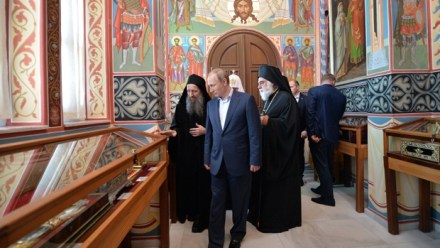
If Christian Britain is fading away, what will survive of it? One answer seems to be pilgrimage. In the past decade, 30 pilgrimage routes have been created or rediscovered; holy places have seen a 14 per cent growth in visitor numbers since 2013. These figures are recorded by a new organisation, the British Pilgrimage Trust, which wants to ‘revive the British pilgrimage tradition of making journeys on foot to holy places’. The BPT stresses that not all pilgrims are religious: ‘Bring your own beliefs’ is the slogan. Guy Hayward, who co-founded the BPT with Will Parsons, observes: ‘We have to tread very carefully around the language of spirituality and religion.

Olympic shames

 Rio de Janeiro, Brazil ‘Welcome to hell’ was printed on a banner written in English at Rio de Janeiro’s international airport recently. ‘Police and firefighters don’t get paid. Whoever comes to Rio will not be safe,’ the message concluded. It’s fair to say not everyone is feeling the Olympic spirit ahead of the Games that start here next month. Bad news abounds. The city’s mayor made headlines by declaring the security situation ‘horrible’, and body parts were reported to have washed up near the Olympic beach volleyball venue. Then an investigation by Human Rights Watch exposed an alarming number of murders by Rio policemen. Earlier in the month a baddie was-busted out of hospital by his gang mates.

Cops and killers

 Washington, DC Considering how heavily its citizens are armed with pistols, hunting rifles, shotguns, military semi-automatics, crossbows and nunchucks, considering how ethnically diverse and historically divided the place is, and considering that it is home to a third of a billion more or less rootless people, it is surprising Americans don’t kill each other more. The United States is well policed, even if it has been hard to say so lately. In the space of a couple of days in July, black men were shot dead by policemen in two separate incidents in Louisiana and Minnesota. Video flew round the internet.

‘I had to step up’

On the way to interview Michael Gove, we meet a government minister, an Old Etonian, who suggests we ask him, ‘How can anyone trust you ever again?’ Just a fortnight ago, proposing such a question would have been unthinkable: the Justice Secretary had a reputation for being one of the most consistent, decent and honourable men in the cabinet. When Gove agreed to back Boris Johnson’s leadership bid, the pair seemed a dream team. But on the morning of their campaign launch, Gove announced that Johnson was unfit for the job, so he’d stand himself instead. Then, he was knocked out by Conservative MPs who were still recovering from the drama.

Sleepless by the strait

In my novel Three Daughters of Eve, a well educated housewife with kids looks at her motherland, Turkey, and thinks: ‘They are not that different. My own life and this land of unfulfilled potentials.’ I wrote this novel in English first. It was then translated into Turkish by a professional translator, after which I rewrote it with my own rhythm and vocabulary. It’s a bit crazy, this constant commute between English and Turkish. There are things I find much easier to express in English — e.g. humour, irony, satire — and others I find easier to say in Turkish — melancholy, loss. The book is published in Turkey this summer before being published in the UK in winter. So I fly from London, where I live, to Turkey for a week long book tour.

Imperial ambitions

Early on the morning of Friday 24 June, Darren Gratton went into his butcher’s shop in Barnstaple and changed his wall signs, which at this time of year are mostly about barbecue packs. Emboldened in the Brexit dawn, he deleted all references to ‘kg’ and replaced each one with ‘lb’. Tempted to do the same to the labels inside the display cabinets, he decided not to, for fear of a threatening call from Trading Standards. But that small act of wall-chart insurrection was enough to spark an article in the local paper, which triggered a deluge of emails from other shopkeepers across the country in support of his brave action with the squeaky pen.

Downwardly mobile

Last year, I found a pair of trainers in our communal recycling bin: Nike Air Max in black and grey size 10, very smart and hardly worn. I’d been wearing them a week when the teenager who lives in the flat below pointed at them and laughed. He told me that he’d discarded them because they were scuffed. This is where I’ve got to, I thought: wearing trainers that I found in a bin on a council estate. Such foraging isn’t un-usual for us. The sideboard in our kitchen, the bookshelf in the hall and the big mirror in our bedroom were all found on our street. I worry that we might be dropping out of the middle class entirely. Our daughter, who goes to the local primary school, now has a strong south London accent.

Give us a break!

As Boris Johnson will know from his love of Greek tragedy, hubris leads to nemesis. And it is Boris’s own hubris — in playing cricket with Lord Spencer the weekend after Brexit, and not finishing his leadership speech on time — that supposedly led to his downfall. I well know from working with Boris at the Telegraph that prompt timekeeping is not his forte. For five years, my Wednesday nights were destroyed as Boris regularly missed the 7 p.m. deadline for delivering his column. ‘It hasn’t arrived,’ I’d say to him over the phone at 7.01 p.m. ‘Ah, Christ, sorry,’ said Boris, ‘Bloody internet! It must be pinging its way down those threadbare copper wires as we speak, old man.

Frexit – oui ou non?

In France, Brexit has provoked resentment and shock. For many years-Britain has been seen in both Paris and-Brussels as the European ‘bad boy’, out for what it can get and intending to give as little as possible in return. The first news was greeted with headlines such as ‘Can Europe-survive?’ but there was also a note of relief: ‘End of 40 years of love-hate’. Even before the referendum, Emmanuel Macron, the finance minister, had denounced the British record in Europe, claiming that the-United Kingdom had hijacked the great project and diverted the Union from its political destiny in order to reduce it to a single market.

So will it be Boris?

The Tory party is in a deeply emotional state. Remain-supporting MPs cry tears of rage when they discuss the referendum. Bitter emails and text messages have been exchanged. Leave-supporting MPs have been accused of unleashing dark forces that they cannot control, of putting immigrants in Britain at risk. Yet the leadership candidates who have so far emerged seem strangely united in their vision for post-Brexit Britain. All want to heal the divide between rich and poor that the referendum has exposed. It is tempting to concentrate only on the division in the party, the fear that David Cameron’s resignation has injected even more poison into the Tory system than either the downfall of Margaret Thatcher or the Maastricht debate.

Sturgeon’s bluff

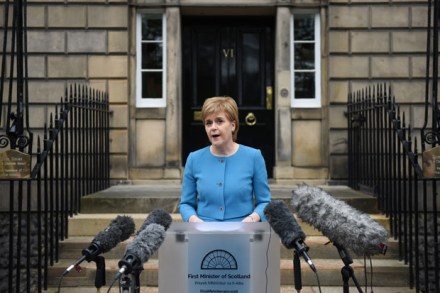
It ought not to be a surprise that Alex Salmond, Scotland’s former First Minister, has declared that the vote to leave the European Union is the trigger for a second referendum on Scottish independence. Salmond thinks everything is an excuse for another go. If a new Bay City Rollers album suffered poor reviews south of the border, or an English football pundit failed to declare Archie Gemmill’s wonder goal for Scotland against Holland in the 1978 world cup the best ever, Salmond would be right there on the UK’s television screens, chortling at the brilliance of his own wit, before intoning gravely that this insult is surely the final straw for the United Kingdom. Salmond has been demanding a second Scottish referendum almost from the moment he lost the last one.

Reasons to be cheerful | 30 June 2016

Noel Malcolm It may sound both Pollyannaish and paradoxical to say this, but leaving the EU will enable us to have stable, friendly, cooperative relations with all our EU neighbours. Being cooped up in a dysfunctional system, where so much depends on backroom arm-twisting and competing for favours in a zero-sum game, doesn’t produce stable friendships. For those of us who feel (as I do) like real Europeans, it will be so much better to be the friendly next-door neighbour than the unwanted in-law in the quarrelling family home. Noel Malcolm is a Senior Research Fellow of All Souls College, Oxford.

La bomba Britannica

In Italy, media coverage of the triumph of Brexit has been wall-to-wall as Italians worry about the collateral damage and wonder if they too dare… So far La bomba Britannica has hit the Milan stock market much harder than the London one. On Friday, Milan fell by 12 per cent against the FTSE-100’s 3.5 per cent. Italy’s banks — too numerous, too small, undercapitalised and saddled with alarming levels of toxic debt — took the biggest hit. New eurozone rules that ban government bailouts for big depositors have turned them into sitting ducks. Shares in Monte Paschi di Siena (bailed out once already in 2013 by Italy’s central bank) fell by more than 13 per cent. In the past six months, Italy’s banks have lost 56 per cent of their share value.

Project Hope

Boris Johnson famously said that Winston Churchill would have voted for Brexit. The wartime leader’s grandson — staunch Remainer and Tory grandee Nicholas Soames — dismissed such claims as ‘appalling’ and ‘totally wrong’. This bad-tempered referendum rift between two traditionalist, Old Etonian Conservatives symbolises, somewhat incongruously perhaps, the broader state of the nation. Deep and traumatic divisions have been drawn between friends and families everywhere — and, of course, within political parties. David Cameron’s dignified resignation speech has quickly given way to a grim determination to ‘Stop Boris’ from taking the Conservative crown and the Premiership.

Pakistan’s great leader

There have been three great captains of Pakistan. The first was A.H. Kardar, the country’s first Test captain. Born in Lahore, and talent-spotted by the senior Nawab of Pataudi, Kardar played for India before Partition. He led Pakistan to victory over India in its second-ever Test match in Lucknow in 1952, and even more famously over England at the Oval Test in August 1954. Uniquely, Kardar won at least one Test match in Pakistan’s inaugural series against each other country. Pakistan’s next great captain was Imran Khan, the all-rounder who inspired his country to a famous World Cup victory in 1992, and now has honourable aspirations to become Pakistan’s prime minister. The third is Misbah-ul-Haq, and he has a claim to be the greatest.

Not thick or racist: just poor

The most striking thing about Britain’s break with the EU is this: it’s the poor wot done it. Council-estate dwellers, Sun readers, people who didn’t get good GCSE results (which is primarily an indicator of class, not stupidity): they rose up, they tramped to the polling station, and they said no to the EU. It was like a second peasants’ revolt, though no pitchforks this time. The statistics are extraordinary. The well-to-do voted Remain, the down-at-heel demanded to Leave. The Brexiteer/Remainer divide splits almost perfectly, and beautifully, along class lines. Of local authorities that have a high number of manufacturing jobs, a whopping 86 per cent voted Leave. Of those bits of Britain with low manufacturing, only 42 per cent did so.

Our antidote to Trump

Is Donald Trump an idiot or a genius or a mad idiot genius? He seems driven by some demented force that even he doesn’t understand. What else made him come to Scotland on Friday last week? The ostensible reason, and probably the motive in Trump’s head, was that he wanted to reopen one of his golf courses. That’s weird enough in itself, given that he is the Republican Party’s presumptive nominee, and in a few months could be leader of the free world. What’s he doing still jetting about promoting his businesses? What’s even weirder is that The Donald landed on Brexit day, of all days.

Britain’s great divide

In Notting Hill Gate, in west London, the division was obvious. On the east side of the street was a row of privately owned Victorian terraced houses painted in pastel colours like different flavoured ice creams. These houses, worth £4 million to £6 million each, were dotted with Remain posters. On the west side was a sad-looking inter-war council block, Nottingwood House, which had dirty bricks and outside staircases and corridors. No posters there. But that is where my fellow campaigners and I headed — down to the basement entrances with their heavy steel gates. We looked up the names on the canvassing sheets and rang the bell of one flat after another until we found someone who would buzz us in. This was the hunting ground for the Leave campaign.