Features

Uncommon knowledge

So farewell, then, to the Common Entrance Exam, bane of a million schoolchildren’s lives since it was introduced in 1904. Three of the biggest public schools — St Paul’s, Wellington College and Westminster — are giving up the exam. From 2021, they will do the pre-test: verbal and non-verbal reasoning, maths and English, taken at the age of ten and 11. Common Entrance was a more gruelling thing, involving up to 14 exams over three days. It’s under-standable that schools want to ease the strain on over-examined children. But all the same, it’s the latest blow to the Great British Eccentric Exam Question. I still cherish the eccentric questions from my own Westminster entrance exam in 1984:   1.

These otherworldly birds stopped breeding in Britain centuries ago. Now they’re back

The RSPB regularly gets calls from people who have seen ‘a funny bird’. ‘It’s got a red head and it’s feeding from the bird table.’ ‘That sounds like a goldfinch.’ ‘No, no — it’s standing on the ground and feeding from the bird table…’ Cranes can stand as tall as a man. They became extinct as breeding birds in this country and stayed that way for damn near half a millennium. But astonishingly they’ve come back, and of their own accord.

Don’t tell the parents

How can we help transgender children? This is a question greatly exercising politicians and many are confused about what to do. In Scotland, children are now expected to ‘demonstrate an understanding of diversity in sexuality and gender identity’. The Scottish government supports a new classroom resource that tells primary school children that they may consider themselves to be a boy, a girl, or neither. ‘You know who you are,’ it explains. What guidance are teachers given? I found out two years ago when I was one of the 3,000 teachers and classroom assistants from across Scotland dispatched for training by LGBT Youth Scotland, a campaign group.

The march of trans rights

Your 13-year-old daughter tells a teacher that’s she’s uncomfortable with her body. She prefers trousers to skirts, football to ballet. She says she thinks she’s a he and wants to be treated as a boy at school. Would the teacher tell you your daughter wants to change gender? Your 11-year-old granddaughter comes home from school upset. Changing after gym, another girl stood watching her undress and playing with her penis. (The girl in question is transgender, so yes, she has a penis.) When your family complains to the school, what happens? In the first case, no, the teacher wouldn’t tell you.

Jean-Luc Mélenchon isn’t the future of socialism, he’s an irrelevance

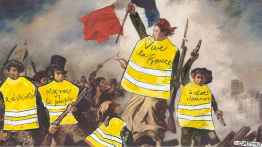
Jeremy Corbyn is promising to forge closer ties with his French counterpart Jean-Luc Mélenchon, the leader of the hard-left La France Insoumise party. The pair met at the Labour conference in Liverpool, and some commentators have hailed the start of a beautiful partnership. The conceit is that this pair of pensioners are together somehow the future of European socialism. Well, Corbyn might become Britain’s prime minister for all I know, although I prefer to doubt it. But should there be any doubt whatsoever on the corollary subject, I am able to assert with absolute confidence that there is a better chance that the French would elect me than Mélenchon.

The joys of Neglexit

The new political buzzword is ‘Neglexit’: the state of being in which, because the government is so wrapped up in Brexit negotiations, Britain is barely being governed. No big, visionary new policies are being launched. Gone are the days when every parliamentary session included an NHS Bill, a Criminal Justice Bill or an Education Bill. ‘The UK is stuck in political and bureaucratic torpor. The country — as an administrative entity — has virtually stopped working… ministers just don’t have the time to attend to the needs and ambitions of ordinary citizens,’ said a report from Bloomberg Businessweek.

Behind the irony curtain

The comedy of Ruslan Boshirov and Alexander Petrov, the two glum Russian ‘tourists’ who denied on television that they were involved in the poisoning of Sergei Skripal, seems set to run and run. The Moscow press tells us that Russia’s ‘Golden Brand’ has offered them a brand name for a company specialising in tourism, women’s clothing, and chemicals for the scent industry. The two tried to persuade the world that they had come to Britain simply to admire Salisbury cathedral, its 123 metre-high steeple and its ancient clock. Alas, they lamented, luck was against them. First they were driven back by snow. (Really? Russians can cope with snow. Russian trains, unlike British ones, continue to run even when the snow is an inch deep.

‘She will decide’

David Lidington is the most powerful minister you’ve never heard of. He is Theresa May’s de facto deputy, tasked with both supervising the domestic agenda and solving the trickiest Brexit conundrums. Much of government business is, nowadays, done through committees of cabinet members: he chairs seven such committees and sits on another 20. ‘I am the man who stands on the stage spinning plates on the top of poles,’ he says cheerfully. ‘Every now and then the PM gives me another plate and I have to keep that going as well.’ That’s hardly a metaphor that inspires much confidence in the running of the government, but everybody will know what he means. Lidington was Europe minister under David Cameron and a committed Remainer in the referendum.

A taste of Brexit

Supermarkets have always moved with the times. After the recession we wanted affordable luxury, so we got M&S’s ‘Dine in for two’ and its various imitators. These promised us a restaurant-quality meal and a nice bottle of sauvignon blanc for a tenner. Well, now the times they are a-Brexit, and retail giants are adapting accordingly. Last week Tesco opened Jack’s. Partly it’s a response to the explosive growth of German rivals Aldi and Lidl. Partly it’s an attempt to create a new, patriotic shopping experience for a nation trying to go its own way. Tesco bosses swear Jack’s is ‘nothing to do with Brexit’. But the clue’s in the name.

Clerical error

Next month the Islamist preacher Anjem Choudary will be released from prison, having served just half of his five-and-a-half-year sentence. He was jailed for his role in encouraging Muslims to join Islamic State. At the time of his sentencing in 2016, the judge described the hate preacher as ‘calculating’ and ‘dangerous’. The Justice Secretary, Rory Stewart, echoed that verdict earlier this month, calling Choudary ‘deeply pernicious’ and a ‘destabilising influence’. His views remain the same; his status as a martyr — at least in the eyes of his followers — is assured; and his hatred of Britain is more ferocious than before. He will emerge as a greater menace than when he was locked up.

Politics trumps trade

‘What the hell is going on?’ That anxious wail of economic incomprehension has been heard ever since President Trump decided last January to impose tens of billions of dollars of tariffs on China and other countries, including Canada, Mexico and the member states of the EU. The wail went up another octave last week as the White House announced a further $200 billion in tariffs. Among the politicians and think tanks of Washington DC, where I have spent the past few days, there is talk of little else; talk rendered more feverish by the prospect of midterm elections in November. A hundred billion here, a hundred billion there — pretty soon we could be talking real money.

Corbyn’s our fault

As Labour gathers for its conference in Liverpool this weekend, the Conservatives will be watching with trepidation, rather than the schadenfreude with which they initially treated the rise of the hard left. Underestimating the appeal of Jeremy Corbyn was one of the biggest mistakes the Tories have made in the past two years, and the party has had plenty of time to ask why Labour ended up doing so well. James Cleverly, the party’s deputy chairman, believes that he has the answer. ‘A big, big chunk of that was our fault,’ he says when we meet at Conservative Campaign Headquarters. ‘The Prime Minister, as we know from all the time she’s been in parliament, is a grafter. She is focused on detail.

Deep and meaningless

Walking down the street on my lunch break, I sometimes pass a delivery man wheeling a large handcart of Japanese food. The cart bears a striking message: ‘Creating a world where everyone believes in their own authenticity.’ It raises some immediate questions: for instance, what does it mean to believe in your own authenticity? How would you go about creating a world where everyone does? And what’s it got to do with Japanese food? It’s unfair to single out the delivery service. Today, brands big and small have a Profound Statement to make. On my way home I pass a 30ft electronic billboard which displays a young couple embracing beneath a glowing night sky. The left side is filled with a portentous message: ‘Your time in the universe is finite.

The wrong right

To the inhabitants of the British Isles, the nations of central Europe have always existed in a semi--mythical space, near enough to be recognised as somehow European, but too distant to be taken seriously. Neville Chamberlain dismissed them as ‘faraway countries of which we know little’; Shakespeare gave landlocked Bohemia a coastline. In British school textbooks, Poland appears for the first time in 1939 and then vanishes again, just as abruptly. In the feverish politics of the Brexit era, central Europe has once again returned — and, once again, it is in a semi-mythical form. This time, the region is playing the role of an imaginary alternative Europe, one perfectly suited to the needs of Brexiteers.

The real Cromwell

One of the many pleasures of writing the life of Thomas Cromwell was to reach out behind the various versions of his life published in the past few years and glimpse the real man lost for so long: a complex, often admirable statesman who set England and Ireland and their successor-kingdom on to new paths. From page one, the story needs rewriting. The great opening of Hilary Mantel’s modern-classic novel Wolf Hall is the boy Thomas reeling under blows from his father. This dark picture of the bad pub landlord Walter Cromwell is good fiction, but not history: in fact, it’s Victorian fantasy, cheekily made up by a 19th-century antiquary.

The hard centre

The Conservative party has to move beyond Brexit and leaders: what is it going to be about? I suggest it has to be about healing capitalism. Capitalism is the only system that is capable of delivering mass prosperity, but it cannot be left on autopilot. Once every few decades it veers off track and requires active public policy. In the mid-19th century, the old Tory party was revolutionised by Disraeli’s ‘one nation’ agenda, correcting the social catastrophes of early industrialisation. In the 1930s, there was no Disraeli: indeed, no political party rose to the challenge of mass unemployment, which was addressed as an inadvertent by-product of rearmament.

Causes without a rebel

One of the better plays at the National Theatre in recent weeks has been about a 21st-century banker, Judy, who quits her job to become a 1950s-style housewife. In Laura Wade’s Home, I’m Darling, Judy ditches her corporate wardrobe for a kitchen pinny and feather duster. She could have stepped from the Good Housekeeping domestic guide my mother was given after her wedding in 1954. Judy scorns modern technology and she dislikes coarse language. She is, at initial view, a faux-nostalgic figure, to be mocked. Yet the word used for her stance is ‘rebellion’ and by the end of the play she may, to a small extent, have made us re-examine today’s assumptions about work and happiness. Judy, though slightly mad, is fresh.