Features

Europe’s blind spot

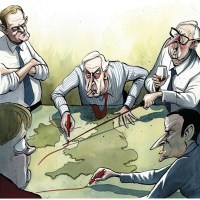
In Paris in December, I sat with a journalist friend in a café on the Boulevard Auguste-Blanqui and listened to him explain to me why a no-deal Brexit would be a catastrophe for Britain. It had to do with an article his newspaper had published about the Mini. You might think they were typically British cars, he said, but the plant where they were made in Cowley belonged to BMW! The steering wheels were assembled in Romania! The tail lights came from Poland! So? I asked. Brexit was about leaving the EU, not making globalisation un-happen. Who do you think wants to close the Mini plant? Britain does not want to damage its export sector any more than Romania or Poland wants to shut down a factory that provides the livelihoods of thousands.

Drunken confessions

I have always found the parable of the Prodigal Son sickeningly unfair, and I felt this again while driving a close relative down a motorway in a frightful gale at night to a residential rehab. -That morning I’d had an emergency consultation in London on behalf of the said relative, with the head of the rehab place, who I’ll call Dr X. Throughout, I’d had the uneasy feeling that Dr X was subtly trying to make me feel at fault for not being sympathetic enough to my relative’s situation. Actually, I have suffered for years from his wild and selfish behaviour while on cocaine and alcohol, and have often tried to help him. Dr X is an expert on addiction, and a self-confessed addict (though not to drugs or drink).

Old flame

It was a close-run thing for my friend who’s having a new kitchen installed in her house in Chiswick. After a persuasive campaign by her eloquent architect, who has an induction hob in his own house and loves it for its clean lines and hyper-efficiency, she had got as far as ordering one for herself. Having placed the order, she couldn’t sleep. She tossed and turned, worrying about the imminent change to her cooking life that the induction hob would (literally) induce, let alone the need to buy a whole new set of ‘induction-ready’ pans. No more knobs to turn a fraction to the left while frying an omelette, ever again? Just a plus and minus touch-screen sign to jab with the ball of the index finger, 9-8-7-6-5-4 and down to 3?

Judge not

When I was called to the Bar in 1967, the aim was to be appointed as a judge to the High Court. It was the destination to which all ambitious barristers not only should but would aspire. The job offered security, the conventional knighthood, an avenue to public service and a modicum of public power. But there is now an unprecedented and growing shortfall in candidates of adequate quality. Where did it all go wrong? This development hasn’t appeared from nowhere. When I was a member of the Senior Salaries Review Body (SSRB), which independently reviews judges’ pay, we noted in 2002 that: ‘Top legal practitioners who in the past would naturally have progressed to the bench are increasingly questioning whether they wish to do so.

Tofu truths

Last week’s Lancet report and its ‘planetary health diet’ of next to no red meat will have bolstered the egos of vegans who claim that they are doing the Earth a favour. But just how environmentally friendly are many of the alternatives favoured by vegans? Fancy a bowl of quinoa, a grain stacked with amino acids, magnesium, phosphorous and iron, which in 2013 enjoyed the endorsement of the UN as a ‘superfood’? Not so fast. Quinoa is traditionally grown in the Andes, spanning parts of Bolivia, Peru and Ecuador, where thin soils are replenished with llama dung. Or at least they were. In the first decade of this century, quinoa production increased forty-fold as western consumers took it up with relish.

The great carniwars

As January — the month of penitence and tax returns — grinds towards its close, it would be foolish to imagine we can go back to a life of thoughtlessly eating, drinking and making merry. Dry January might give way to Wet February, as grateful drinkers furtively crack open the rioja, but the intense passions aroused by Veganuary now seem set to continue all year round. Veganism — the shunning of meat, fish and all dairy products — was once regarded as a harmless but inconvenient hobby. Vegans got used to the mild panic they triggered at other people’s houses if the host hadn’t been pre-warned: the alarmed mouthing of ‘They’re vegan’ and the desperate rooting in the fridge for something, anything.

Mugabe mark II

Ten days ago, Zimbabwe’s President, Emmerson Mnangagwa, hiked the price of petrol by 250 per cent, making it the most expensive in the world. There had been an acute fuel shortage for months and this move was supposed to ease the situation — presumably by making petrol beyond the reach of most in this impoverished country. Mnangagwa then jetted off to Russia and Kazakhstan, a warm-up tour for his gig at Davos. He left his deputy, Constantino Chiwenga (until recently head of the army), to cope with the fallout. And fallout there was. Trade unions led stay-aways in protest. This developed into the blocking of roads, looting of shops and some arson, mostly by unemployed youths — which most youths there are.

Justin Welby’s reformation

Justin Welby is working in Thomas Cranmer’s old study in Lambeth Palace, a room that looks as if it hasn’t changed at all since the Book of Common Prayer was written here almost six centuries ago. It feels like a mini-monastic retreat: there is a desk, a crucifix, several Bibles and not much else. The 105th Archbishop of Canterbury studies and prays here, deciding how best to lead a national church whose Sunday services are now attended (according to its own figures) by barely 1 per cent of England’s population. These are new times — and require new tactics. When he was enthroned six years ago, he was seen as just the man to provide the new tactics. He’s a convert, who was ordained in his thirties after a career as an oil company executive.

Boles’s crazy plan

At first, it seems fanciful. A backbench MP, Nick Boles, proposes to take power away from the government and place it in the hands of MPs, to prevent a no-deal Brexit. Can one backbencher usurp power in this way? It’s ambitious. But under the British system, government reports to parliament, not the other way around. Usually the distinction is moot, because government can control the Commons. But when that control collapses, every kind of mischief becomes possible. Until a couple of months ago I was director of legislative affairs under Theresa May in No. 10, where it was my job to look at parliamentary procedures. It’s quite a minefield.

The frozen swamp

 Washington, DC As a prison worker in Florida put it, 'Trump's not hurting the right people' Washington is supposed to be recession-proof: when times are bad, the government just hires more. But the city isn’t shutdown-proof. There are more than 360,000 federal employees in the DC area, and many are among the 800,000 across America who last week received a salary bank transfer that said zero dollars and zero cents. A number of foodbanks have opened here, offering free meals to anyone with federal identification. Whole Foods, the upmarket supermarket, has gone a step further. It is serving spaghetti dinners to anyone who is hungry.

The rebel alliance

Straight after the government’s epic defeat in the House of Commons on Tuesday night, the Chancellor, Philip Hammond, the Business Secretary, Greg Clark, and the Brexit Secretary, Steve Barclay, held a conference call with business leaders to try to reassure them. The principal worry was about ‘no deal’. The Chancellor’s message of comfort was revealing of where power has shifted to. He emphasised how backbenchers are manoeuvring to stop no deal. In other words, they needn’t take his word that it wasn’t going to happen; they should take parliament’s. It was an admission that the government is no longer in control of Brexit.

Renter’s paradise

On turning 50, I realised I’d never own my own home. What bank would agree to give a mortgage to someone with no regular source of income? Even if I did somehow hold down a job, I would have just 15 years until retirement age. For a while, I was depressed. Owning your own home is the British dream. Why else would all those property shows I drool over be so popular? I won’t have anything to hand down to my kids. What sort of loser am I? Then I remembered: I live in a five-bedroom Victorian terrace in Islington, which is owned by the council. At £650 per month, our rent is far less than what private tenants might pay for a flea-infested bedsit in the same area.

Pirates of the Caribbean

Brian Austin, a fisherman from the small village of Cedros in Trinidad, is struggling to describe the men who robbed him out at sea last year. ‘They had guns, they wore T-shirts and hoods.’ Then he brightens: ‘Have you ever seen Somali pirates? They looked just like that.’ I have indeed seen Somali pirates, as it happens, and rather closer up than I’d have liked. Ten years ago, a bunch of them kidnapped me for six weeks while I was out reporting. That was in Somalia, though, a failed state where anything goes. I never expected to be writing about a plague of pirates here in the Caribbean. The last lot of Caribbean Blackbeards were hunted down by the Royal Navy about 300 years ago, bringing to a close the so-called ‘golden era’ of piracy.

Pale imitations

You can tell something about national character from the way a country clears its cupboards. In the States they have the yard sale. The American dream remains a detached house with a front and a back yard, all enclosed by a white picket fence. Daughter selling lemonade, son playing catch, consumer goods spread on the lawn. The French have the vide grenier — the emptying of the attic. The Frenchman in his romantic soul still imagines he is a poet or a painter starving for love and art in a bare, unfurnished room. The English have the car-boot sale. We take a picnic, waterproofs, stop at a stone circle on the way, and when we are ready to pack up and leave, we leave. Back in Blighty after a year in France, I have been finding homes for my attic trufflings.

The dragon vs the bear

At the height of the Cold War, as the West faced off against Red China and the Soviet Union, people used to joke that optimists learnt Russian while pessimists learnt Chinese. Today, the debate about which of these two great powers represents the biggest threat to our way of life is once again in full swing — though with new battle lines. And it’s not clear that Britain knows what to make of it all. For some commentators, the main challenge still comes from Vladimir Putin’s resurgent Russia. Those who once scoffed at Mitt Romney’s 2012 claim that Russia was the principal enemy of the United States now need no persuading that Moscow wants to unravel the post-Cold War international order. The Salisbury poisoning was just the latest reminder.

A class act | 10 January 2019

The English love a story of posh people behaving badly, especially one that involves sex, drugs or drink — preferably all three at once — in some stately home or Mayfair pad. In 1963, following the Profumo scandal (yes, the one involving Christine Keeler) the nation was gripped by tales of sex parties involving prostitutes, pimps, peers and cabinet ministers. And then there was the infamous photograph of the Duchess of Argyll with something in her mouth that definitely wasn’t a silver spoon. The Denning Report — Lord Denning’s 1963 inquiry into what he referred to as ‘perverted sex parties’ — was a smash hit, selling more than 4,000 copies in the first hour of its publication.

Project Fact

Food shortages, diabetics going without insulin, outbreaks of salmonella and swine flu: a no-deal Brexit has become a dystopia of the imagination that gives even the Old Testament a run for its money. To lend it extra credence, the doomsayers are not muttering men with long white beards but business leaders and figures from respectable-sounding thinktanks. Yet in just 11 weeks’ time, a no-deal Brexit could become a reality. Will we really be impoverished, hungry and living in fear of infectious diseases? Or is it just Project Fear, ratcheted up to a new level by those who see the clock ticking down and have become ever more desperate to persuade the public of the foolishness of its decision to vote for Brexit? Some dismiss the predictions of chaos as mere scaremongering.

Quiet terror

They don’t like to use the ‘Q’ word in counter-terrorism. It’s a bit like blurting out the name of the Scottish Play in a theatre. At Christmas parties, members of the security agencies insisted they had never been busier but once the year had turned and they were no longer tempting fate, they were prepared to admit that 2018 was a bit ‘quieter’. There were, for instance, far fewer arrests for ‘attack planning’, as opposed to downloading or sharing instructional and propaganda material. Last year, there were only four foiled attacks and one unsuccessful vehicle attack on Parliament. Right at the last gasp, with three hours to go to New Year, a knifeman in Manchester stabbed a couple and a police officer, but did not kill anyone.