Society

fighting spirit

What happened to Britain’s fighting spirit?

When war is in the air, young men traditionally sign up – and they traditionally sign up, disproportionately, from the northeast of England, where I grew up. The country must be prepared for war, says Air Chief Marshal Sir Richard Knighton, head of our armed forces. But what use is all this puffed-up talk of a battle-ready Britain if we have no soldiers? In the northeast, the supply of soldiers has slowed not just to a trickle but to a drip. Sunderland, for instance, home to nearly 11,000 veterans, sent just ten men into the army in 2025. A reporter called Fred Sculthorp went to Sunderland for Dispatch magazine last month, to work out what had happened to the northeast’s fighting spirit, but all Fred found was apathy: why sign up when you can sign on?

Space travel, ancient Greek style

Apollo, Artemis, and Orion have not been named at random. The first two are brother and sister, and all three are known in myth as hunters – which is what the astronauts are. Ancient Greeks would have been very envious of them. The satirist Lucian (c. AD 125-180) had great fun with space travel. In his True History, he describes how he sets off with his companions to sail the Atlantic when suddenly a typhoon whirls them up to the Moon, but after many adventures he is able to return and describe what he saw. There are no women, but men act as wives. They produce children in the calf of the leg. The children are born dead but brought to life by breathing in the wind. Men then become husbands. Their noses run with honey and when they exercise, they sweat milk.

fuel ireland

‘People are at breaking point’: on the road with the Irish fuel protesters

A fuel protester stood on top of a tractor waving a tricolor. In Ireland, everything is about nationhood and the price of oil is being contested here like a new war of independence. I got into the middle of a scrum of farmers and haulers blockading Whitegate oil refinery, a kamikaze sort of protest, for it has been stopping tankers getting in and out to supply the country, severely limiting supplies. Here on the windswept coast of Cork, traditionally dubbed the rebel county, working men have been sending out the message that they have nothing left to lose. The oil crisis sent this lot over the edge arguably because they were already on the verge of a collective nervous breakdown over fuel costs, higher than in Britain partly due to EU carbon taxes.

The great soccer World Cup swindle

Tickets for this summer’s soccer World Cup are the most expensive in the tournament’s history. Or the history of any sporting event for that matter, with the possible exception of one-off extravaganzas like the Mayweather-Pacquiao showdown in 2015. The face value of tickets at this American tournament are a staggering five times higher that of the previous World Cup in Qatar. The most expensive seats for the final match have reached wallet-busting levels, affordable only to plutocrats and corporate boondogglers. And that’s just face value. What about the quaintly named secondary market? I occasionally peruse Fifa’s resale site, where the custodians of the game double dip from the buyer and seller to act as an official tout.

The soccer World Cup trophy sits in front of President Donald Trump

The bleak humor of Samuel Beckett

Samuel Beckett, with his quizzically peering gaze and handsome, hawk-like appearance, has long been the academic’s pin-up. Endless PhD dissertations exalt the Irish writer, who was born 120 years ago in Dublin on April 13, 1906, as an unsmiling existential hermit figure when he was really nothing of the sort. Over the 60 years of his writing career, Beckett created a memorable gallery of tramps, waifs and other "crotchety moribunds" who find a lugubrious comedy in human failings. "Nothing is funnier than unhappiness," declares a character in Endgame, while Estragon in Waiting for Godot pines for death in a dry climate where they "crucify quick." Beckett’s terminal vision was bleakly humorous – and comedy often intruded on his life.

No, the US didn’t threaten to bomb the Vatican

The first American pope does not like the President of the United States. One of the few things we knew about the Chicago-born Robert Prevost when he was elected last May was that – despite having an older brother who supported MAGA – he detested the immigration policies of the Trump administration. His private X account, now deleted, made that clear. Pope Leo has rejected the President’s invitation to visit the United States to celebrate his own country’s 250th anniversary; instead, he will visit Lampedusa, the Mediterranean island collapsing under the strain of thousands of North African migrants who have risked their lives to get there. When President Trump issued his blood-curdling threat to destroy Iranian civilization, the Pope immediately condemned him.

The Pentagon’s holy war with Rome

America is having its Golden Age, Iran is about to get blasted into the Stone Age... and Elbridge Colby wants to go back to the Late Middle Ages? According to a Free Press report by Mattia Ferraresi, the Under Secretary of War for Policy summoned Cardinal Christophe Pierre, the Vatican’s then-ambassador to the US, to a meeting in which the Avignon Papacy was invoked. (For those of you who didn’t go to Catholic school: in the 1300s the king of France had Pope Boniface VIII captured and beaten after the pope excommunicated him; a few years later the papacy moved to Avignon amid continued threats from the French crown and instability in Rome.

pope leo catholic rome pentagon

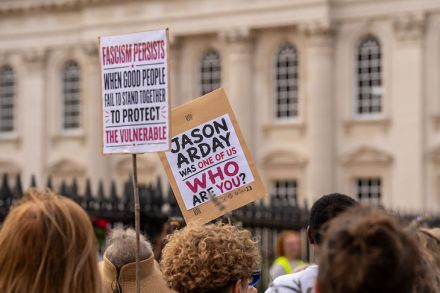
Can the chaps in chaps smash fascism?

I have spent a small portion of my time lately wondering what I would do if I thought communists were about to take over Britain. At the more civil end of things, I could see myself going on an anti-communist protest, though I would shrink away if I noticed that my fellow marchers were flying swastikas. I don’t exactly know what I would do next. Perhaps I would hope for another election soon, and do what I could to unite other anti-communists. One thing I am fairly sure I would not do would be to dance. In fact, were this country facing the prospect of Stalinism coming at us full force, the last thing I would do would be to get a DJ, book a stage in Trafalgar Square, hire some go-go dancers and rave it up.

fascism

What we really know about the first Easter

A friend who spent much of his life as an archaeologist in Israel once told me that there were three levels of authenticity when it came to Christian pilgrimage sites in the holy land. There were those that were almost certainly inaccurate but soaked in prayer. Those that may or may not be the real thing, of which there are many. Finally, those that according to most of the experts were the real thing. "No serious doubt," he said with a smile, "it happened here." It’s not altogether different when it comes to Christian history or the places and events that shaped the early church, including Easter. So, what do we know?

An appraisal of judicial vulgarity

If you follow the courts, you will certainly have come across Olympus Spa v. Armstrong. On March 12, the Court of Appeals for the Ninth Circuit denied rehearing en banc in this case, which began in 2020 when a transgender woman in Washington State alleged that a traditional Korean spa, which requires patrons to be entirely naked, refused her (or is it him?) entry because she (he?) had not yet undergone so-called gender-affirming surgery.

judicial vulgarity

What the death of my beloved son taught me about Easter

The hawthorn hedges are white with blossom; the countryside looks set for a wedding. Even in the small garden of my hospital, spring is inescapable. Cherry and magnolia bloom. Viburnum scents the air, young leaves come to the trees. Hospitals are where most lives begin, and where many end. Hospices shepherd only a small minority of deaths, about one in 20, often those of the middle aged whose diseases are more predictable. Frailty is less orderly, and the fitful hazards of age bring many to the general wards where I work. More of us die in hospital than anywhere else. What sort of spring wakes the hedgerows and the weeds, but not my boy? In the Emergency Department I met the woman who became my wife.

easter

Life on Palm Beach Island is not what it appears

When the world thinks of Palm Beach – and it does more and more because Donald Trump has his home and his club there – the world tends to think of a sybaritic sunshiny town of palm trees, sandy beaches, rich old people, easy living, bland blondes, Range Rovers, Porsches, Bentleys and Bugattis as far as the eye can see. This is not wrong but, as ever in real life, there is a little bit more to PB than that. The underlying truth is that there are two Palm Beaches, not one, and their interaction is what drives a lot of activity here.

Should America be Venice or Sparta?

Americans never tire of asking themselves whether their country is turning into Rome. A Latin motto on the Great Seal of the United States proclaims a novus ordo seclorum – a “new order of ages.” But in the poem from which that phrase is adapted, Virgil’s fourth eclogue, the words mean a quite exact replay of past events: there will be, for example, another voyage of the Argo and another Trojan War. Our new order might likewise repeat the history of Rome. One philosopher who gave a great deal of thought to new orders and Roman history as a template was Niccolò Machiavelli, particularly in his Discourses on the First Ten Books of Titus Livy.

How the Face died on the line

The Face, launched in London in 1980 by Nick Logan, was one of my first portals into subcultures that were far from my reach growing up in suburban Atlanta. The magazine introduced me to the photography of Corinne Day, Juergen Teller and David Sims. The original iteration stopped publishing in 2004 and then restarted, under new leadership, in 2019. The new version had some high points, especially an Olivia Rodrigo cover photographed by Jim Goldberg. Still, it could never capture the true spirit of the original and ownership unceremoniously pulled the plug last month. I knew the business was for sale, for a very affordable price, but they couldn’t find a buyer. I don’t blame it on the editor or contributors; I blame it on the times.

Why the keffiyeh classes have forgiven Kanye West

And there you have it. Britain is a country where a musician who says "Heil Hitler" gets to headline festivals while a musician who plays with a Jew from Israel gets canceled. Threaten to go "death con 3 on Jewish people" and you’ll be grand. Jam with a Jewish person and you’re toast. Selling T-shirts adorned with the swastika? No problem. Doing a duet with someone from the Jewish state? Don’t even think about it. In the eyes of the keffiyeh-smothered windbags of the cultural elite, praising the Nazi monster who exterminated millions of Jews is a more forgivable moral error than hanging out with a Jew from Israel That was my first thought upon reading that Kanye West will headline all three nights of the Wireless festival in London's Finsbury Park in July.

kanye west

The trials and tribulations of cowboy college

I first got a taste for it in Eminence, Missouri. Riding a horse, that is, Western style. I also got a taste for the glorious Ozarks, a striking part of the world too often overlooked by, well, erm, everyone. The fact that it was sometimes hard to get a drink put a slight dampener on things. Too many wretched “dry” counties dotted about the two states I was criss-crossing – I’m told, almost 40 in Arkansas and 30 in Missouri. Can this really be true? ‘Swing the loop like you’re putting on a cape – you know, like Zorro,’ Lori said… as I got tangled up again To Europeans, this is plain daft. I know we’re all terrible drunks, especially we Brits, but it’s nice to be able to get a proper drink whenever a thirst strikes. Just saying.

strait

A guide to Strait talking

I little thought in 2023, when writing about dire straits, that we’d so soon be pushed into them by trouble in the Straits of Hormuz. In discussions of these on the wireless, I find that even the best-informed commentators begin by referring to this geographical feature as the Strait of Hormuz but before long fall into calling them the straits. Insisting on the singular strait seems sterile pedantry. The Oxford English Dictionary has got the usage pretty straight: “When used as a geographical proper name, the word is usually plural with singular sense, e.g. the Straits of Dover, the Straits of Gibraltar.” A pleasant piece of naval slang 100 years ago was up the Straits, meaning “in the Mediterranean.