
Society

How to maintain the equestrian aesthetic

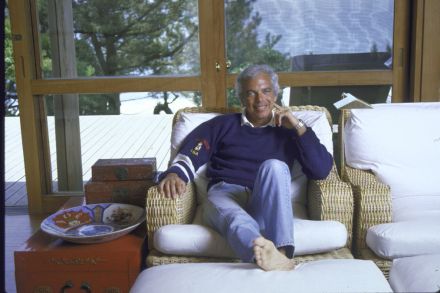
“We know what art is! It’s paintings of horses,” Alec Baldwin’s Jack Donaghy says from his elegant top-floor office in 30 Rock. George Stubbs’s masterpiece “Whistlejacket”;  “Napoleon Crossing the Alps” on his rearing warhorse Marengo, by Jacques-Louis David; English hunt scenes. Horses are a quintessential subject in European, and especially English, art. They evoke palatial country estates passed down over the centuries and the breeches, boots and hunt colors of the men who ride for sport and leisure. Yet the equestrian aesthetic is now synonymous with Ralph Lauren, who deconstructed the WASPish polo style into something modern and American, only to have his own discerning innovations copied to an endless, commercial degree.
New Yorkers don’t get DC

I was in New York all summer, making a big fuss about DC to all those sophisticated cosmopolitans. They think it’s boring. They assume it’s full of squares and policy nerds and they’re right, but that characterization doesn’t do the capital justice. It’s my job as a Washington ambassador to accurately portray the city to the snobbish coastal elites, even to sex it up a bit (though it really doesn’t need my help in this respect). Regardless, it’s a job I take seriously. The obvious hook is, of course, espionage. Espionage is chock-full of charge and my choice motifs are all borrowed from the weighty catalogs of 007 and Richard Nixon’s Watergate scandal – wiretapping, martinis, guns, honeypots.

The Democrats are both cynical and naive

At the beginning of his essay “Thank God for the Atom Bomb,” the literary critic (and World War Two Army veteran) Paul Fussell recalled a poetic advertising slogan he used to see on the sides of city buses. In life, experience is the great teacher. In Scotch, Teacher’s is the great experience. Not having tasted the potation named in the second line, I offer no opinion about the truth of the statement declaring its excellence. About the first line of the couplet, however, I must register a certain skepticism. Is experience “the great teacher” in life? An honest answer, I believe, should begin with the hoary qualification “that depends.

Midterms

In America, murder has become mainstream

September has become a murderous month. This year it marks the 25th anniversary of the 9/11 attacks and the one-year anniversary of Charlie Kirk’s assassination. And as this month began, the trial of Lindsay Clancy was under way in Massachusetts, a trial notable not only for the appalling character of the crime – Clancy strangled each of her three children – but for the appalling degree of sympathy some women have expressed for the defendant. When Kirk was murdered while speaking on a college campus last year, many left-wing Americans rejoiced – and his killing is still a cause for levity at Hasan Piker rallies today. The leftist podcaster enjoys leading crowds in an off-key, mocking rendition of an AI-written song called “We Are Charlie Kirk.

The new age of influence campaigns

Midway through a podcast appearance, my host became distracted by a flurry of social media posts claiming that he was a paid agent of the Israeli government. The host was Tim Pool; the accuser was Alex Jones, until then Pool’s friend and ally. The dispute began last month, when Pool suggested that Jones’s recent dip in online viewers had more to do with his wavering on Donald Trump than with any covert censorship. The argument quickly escalated, with Jones asking whether Pool was taking “marching orders” from Benjamin Netanyahu. I have no beef with Jones, but I doubt that Pool, who earns a healthy eight figures from his podcast, would torch his credibility for a little extra money.

Nature is an assassin

My last night in London, I met a smart journalist (not always an oxymoron) for dinner at the “original” Ivy, who explained the disastrous state of conservatism in a country that badly needs it. For openers, Boris Johnson won a landslide victory in 2019 as the champion of Brexit and a hard-ass immigration enforcer. He then proceeded to quadruple migration to the UK. So trust is low for any politician on the right. I already knew that. What I didn’t know is that Johnson is the monster who implemented Britain’s kooky ban on plastic straws. My companion seemed surprised at how aghast I was, and also the fact that I don’t believe in global warming. I pointed out that, as a late sleeper who’s awoken by light, it is impossible to keep the sun out.

The journey to Assisi, 800 years after St. Francis

“Assisi – best spiritual vibrations anywhere I’ve been, along with India,” enthused the mustached British man next to me on the bus to Florence. Pleased to find a fellow anglophone, he chatted away happily, telling me how he’d retired, sold his house in London and moved to Assisi. He hadn’t yet learned Italian but could manage enough Sanskrit to read the Upanishads. A spiritual dilettante. Wonderful. It was 7:30 a.m., I’d missed coffee, breakfast and a train, and my feet, after walking for eight days and 115 miles to commemorate the 800th anniversary of the death of St. Francis, hurt. Yet when my companion gave his verdict on how Francis had transformed his world, my cranky heart warmed to him.

wood yoga

The internet is wrong about taxis

Error sticks to the word taxi like an ant to an echidna’s tongue. I once heard a cabby on the wireless explain that the word taxi came from its German inventor, whose name was Thurn und Taxis. This blunder swarms all over the internet. “At the end of the 18th century,” goes one version, “the Thurn und Taxis family, who managed thousands of carriages and horses with which they distributed mail, decided to diversify their business, using their network and their vehicles also for passenger transport… Their name, Taxis, may have inspired the modern term taxi…” But it didn’t. The Thurn und Taxis family did run international postal services. Their family names meant Tower and Badger, but they did not invent those either.

I’m a grockle and proud

“How long have they been here?” “Three generations.” “Ah, just grockles, then.” Exchanges such as this must have taken place in countless Devon villages. A “grockle” is a Devonshire term for a tourist or incomer. I suppose it could be offensive. But being called a grockle is not usually a term of abuse and in general, the word is spoken with a half-smile rather than a grimace. Not least because, in Devon at least, ceasing to be a grockle and becoming its opposite – the local lad or girl – is a generational endeavor. I am definitely a grockle. I moved to Devon from Huntingdonshire when I was 20 to work on a dairy farm near East Worlington.

The real reason dating apps are so flawed

My father once attended a dinner for 12 where an intense argument arose over splitting the bill. After 15 minutes, a happy compromise emerged, at which point one diner, someone an order of magnitude richer than everyone else at the table, piped up with: “But I didn’t have any wine.” This is the perfect example of a valid consideration being introduced at completely the wrong point in the process. Bear this in mind, because I think there is an optimistic and relatively benign way to look at Britain’s bureaucratic sclerosis without hanging every public-sector employee from their own lanyard.

My cave house’s wonderful history

Provence Looking back on it, apart from this year’s wildfires, the stultifying heat of high summer in Provence isn’t so bad if you accept that the time to exercise is 6 a.m. and work is only possible before midday and from late afternoon onward. Holidaymakers and the better-off have pools to jump into and air conditioning to enjoy. But during the afternoons the rest of us lie almost naked on the bed under a ceiling fan, shutters closed, while the Rouge Noir varnish on our toenails melts. I’m told that Frenchmen sit in their underwear watching the Tour de France. One such afternoon about five years ago, Jeremy and I were lying side by side, inert, under the whirring blades of the fan, when we heard voices on the usually quiet public pathway below the bedroom window.

My radical plan for the House of Lords

A neighbor betrayed me to her 16-year-old son. “Lloyd knows about politics,” she told the youngster. “He can help you with your essay.” I was introduced to a spotty teenager who appraised me suspiciously through a pair of smudged NHS glasses. “What’s the essay about?” I asked. “Politics,” he said. That seemed to leave the field wide open. “Contact a few members of the House of Lords and ask them to name their greatest achievement.” He nodded. “Sounds good, thanks,” he said with an air of finality, like a chef asking a new minion to sweep the floor. I accepted defeat. My plan had been to give him a sagacious ruling from on high. “Listen, m’lad. Always do your homework or you’ll end up doing someone else’s.” But he understood that better than me.

The unsaid truth about suicide

Did you know that in the UK and the US, September is a month devoted to suicide prevention? And that on the 10th of this month, it’s World Suicide Prevention Day? No, neither did I. And neither did any of my friends. Yet we’re all aware that suicide is a serious problem. Every 90 minutes, someone in the UK or Ireland dies that way. It’s the biggest killer of men under 45. And suicides among teenage girls and young women have almost doubled in recent years. We’ve been having these suicide prevention events every September for more than two decades and yet the rates are not going down. Maybe it’s time to challenge what I’d call the suicide prevention consensus.

Tolkien knew the truth about power

One route into the thorny question of J.R.R. Tolkien’s politics comes courtesy of Giorgia Meloni. Scarcely a profile of the Italian Prime Minister hits the newsstands these days without the Tolkien references piling up like so many windfall apples: The Hobbit plays put on with fellow-members of the Movimento Sociale Italiano youth group back in the 1990s; the fixation on the Ringbearer’s sidekick Sam Gamgee (“Much more useful than Frodo”); the annual birthday tribute to a man who “brought up so many of us with his stories.” Here, clearly is a Middle-earth obsessive, Tolkien’s work a direct prompt for political action. Head a thousand miles north into the Scandinavian forests and the hard-right tocsin clangs even louder.

Are you having a 'nun girl summer'?

Are you having a ‘nun girl summer?’

20 min listen

Why are young women suddenly fascinated by nuns? From “nun girl summer” on TikTok to a wider “quiet revival” of Christianity among Generation Z, the religious life appears to be enjoying an unexpected cultural moment. But is the attraction genuinely spiritual – or are young women simply drawn to the aesthetics, certainty and tranquility of convent life? This week on Holy Smoke, Damian Thompson is joined by the Spectator's US assistant editor Margaret Mitchell and the Daily Mail’s Mimi Yates to discuss the unlikely appeal of nuns to Gen Z. They explore the joy and “slow living” of convent life, the exhaustion of the attention economy and whether retreating into an all-female religious community offers an escape from modern dating and the “manosphere.

Marine Le Pen’s Muslim headscarf ban is popular, not populist

Marine Le Pen has promised to ban women wearing Muslim headscarves if she becomes president next year. The leader of the National Rally declared on X: “I will submit to the French people, by referendum, a bill to combat Islamist ideologies with numerous powerful measures, including the banning of the Islamist headscarf in public spaces.” Le Pen may be out of step with the rest of the political class but she is speaking for a majority of the people France has led the way among European countries on the issue of conservative Islamic dress. In 2004, for example, a law was passed prohibiting the wearing of conspicuous religious symbols in schools. It applied to Christians, Jews and Muslims, but France was accused of using the bill to persecute Islam.

We are ignoring the biggest threat the world faces

In my mid-twenties, my one-bedroom in Astoria, Queens, developed a roach problem. I don’t mean the odd single scurry disappearing irretrievably beneath the fridge, either. Oh, it started that way. But I didn’t take measures when the situation was manageable because roaches gave me the creeps, and so many activities beckoned that were much more fun. Between a small shelf and the kitchen wall I stored spare brown paper bags – from which I began to detect a rustling. At some point, the bags began to move. Beside them, the wall gathered an undulating shadow that I trained myself never to look at directly; like Faye Dunaway in Little Big Man, I would “avert my eyes at the necessary moment.” One night a friend came to dinner and stared at that wall in frank revulsion.