Politics

Read about the latest political news, views and analysis

The return of Ann Widdecombe

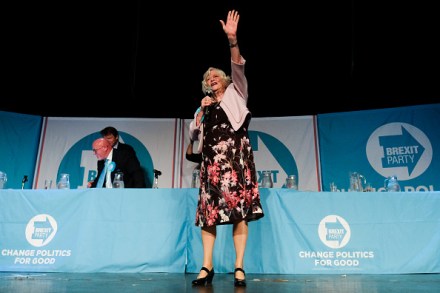
Enoch Powell famously said that all political careers end in failure. But for Ann Widdecombe, it seemed that her career had ended with Strictly Come Dancing when she entered the show back in 2010, after retiring from politics at the general election. Yet last night, Widdecombe once again returned to the frontline of politics after being elected as an MEP for the Brexit Party in the South West of England. The Brexit party won with 36.7 per cent of the vote in the region, winning three MEP seats. Here she is in her victory speech: https://twitter.com/LeaveEUOfficial/status/1132782683229229058 Mr S expects Widdecombe will be dancing all the way to Brussels after the result.
The Labour meltdown means Corbyn must choose sides on Brexit

These results are dire for both main parties: the Tories finished fifth and Labour third. Theresa May’s resignation has taken some of the sting out of the Tory humiliation, but Jeremy Corbyn finds his leadership under more pressure than it has been since the 2017 general election result. Most worryingly for him, the membership is not behind him on Brexit. The results for Labour are awful. Look at Scotland and Wales, former Labour strongholds. In Scotland, the Brexit Party came second and Labour finished fifth with just 9 per cent of the votes, down from 26 per cent last time. In Wales, the Brexit Party won in 19 of the 22 council areas. For the first time ever, Labour has finished behind Plaid Cymru.

Nigel Farage: the Brexit party is no1 in Europe. Next stop: Westminster

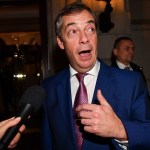
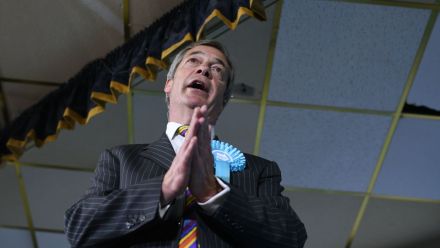
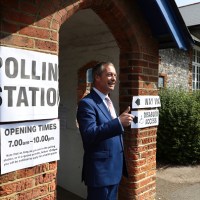
The Brexit party has emerged as the big winner of the European elections. Nigel Farage's party, formed just six weeks ago, surged to victory – winning 32pc of the votes and getting 29 of its candidates elected as MEPs. Only Merkel's CDU has as many MEPs: they're joint first. Unsurprisingly, Farage has been on a victory tour since the result came in. In his victory speech in Southampton, Farage said his new party's success ought to be a 'big wake up call to Westminster' – and reiterated his demand for his MEPs to be including in the government's Brexit negotiating team: 'We voted to leave in a referendum and we voted to do so on March 29th and we haven’t.

The complete demise of Change UK

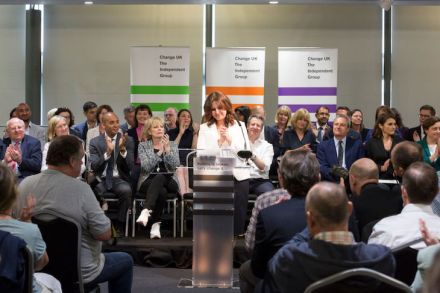
Tonight was a vital night for the fledgling Remain party Change UK. After the resurgence of the Lib Dems in the local elections, Chuka Umunna and Heidi Allen's party had to fight to justify its existence, and prove that it wasn't simply another party which was splitting the Remain vote. Alas, it appears that that party hasn't even managed to meet its own low expectations tonight - it may be that it can't even muster enough votes to justify going into a coalition with the Lib Dems at the next general election. Here are five reasons that suggest tonight could mean the end of Change UK: Number of seats: 0 As of writing, Change UK have failed to get a single seat across the entirety of the UK. Overall the party has received only 3.

Emily Thornberry: we should have backed a second referendum

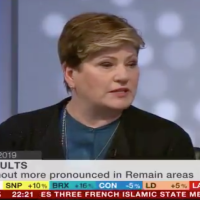
The results have begun to trickle in from the European elections tonight, and already it looks like Labour are being hammered from both sides, as they lose Leave voters to the Brexit Party and Remain voters to the Lib Dems and Greens. And with only one region announced, it already appears that the cracks are appearing in Labour unity, especially on the divisive issue of whether the party should back a second referendum.

Labour’s downfall begins

In early results on Sunday evening, the Brexit Party’s dominance in the North East of England, the first region to be counted, could be a sign of things to come. Taking 39 per cent of the vote share, Nigel Farage’s party has secured two MEPs out of the three available in the region, with Labour taking the third. This bodes well for the Brexit party at the beginning of a night of counting, and Labour should be very worried by these early results. Before tonight, Labour had two MEPs in the North East. In tonight’s results, Labour's vote share has fallen by 11 per centage points. As predicted, Conservative vote share has fallen drastically across the UK – they were beaten by the Greens in the West Midlands (where the Brexit Party took three seats).

Sunday shows round-up: Raab sets out his leadership pitch

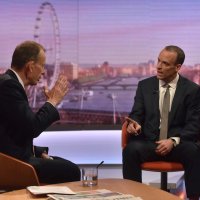
Dominic Raab -  I'm 'willing to walk away' The starting gun for the Conservative leadership race has been fired and there are currently eight declared hopefuls jockeying for position. Dominic Raab, the former Brexit Secretary, who resigned in protest last year over the government's draft withdrawal agreement, sat down with Andrew Marr to outline his bid for the top job. Unsurprisingly, the issue of where the government now takes the Brexit negotiations featured highly on the agenda: https://twitter.com/BBCPolitics/status/1132579675358674944 AM: What's going to be really different because you're Prime Minister? DR: First of all... we'd be willing to walk away from the negotiations if we don't get very finite, targeted, reasonable change.

The big Tory leadership question: what happens on All Saints Day?

If the EU is unable to make a Brexit offer that is acceptable to Parliament by the Brexit deadline on 31 October, what then? This is the big question in the Tory leadership contest and – slowly – we’re getting answers. 1. No deal back on the table, an extension not ruled out Dominic Raab this morning told Andrew Marr that if the EU does not compromise then he’d leave anyway, without a deal. In other words, the Tory 2017 manifesto position would be restored: no deal is back on the table, only this time they'd have to mean it. Boris Johnson, Michael Gove, Jeremy Hunt and Sajid Javid all agree. All would seek a compromise with the EU: modified version of Theresa May's deal. Nigel Farage says this is pointless because the outgoing Commission is intransigent.

Could my slogan have swayed the Brexit vote?

People sometimes ask what slogan could have swayed the Brexit vote: the opposite of the touchstone phrase ‘Take back control’. There are many suggestions, my own being: ‘Don’t leave — it’s what the French want us to do.’ No Europhile committee would ever have approved a jingoistic slogan, of course; yet the feelings of committed Europeans are irrelevant. Those people will vote Remain in any case. Instead you need to reach the ambivalent, sceptical or mildly hostile. This raises the central question about communication: do you want to feel good about yourself, or do you want to change the minds of others? The art of sloganeering can serve two powerful ends — persuasion or cementing tribal allegiance. Usually you can’t do both.

Tory leadership: Rory Stewart’s Pinocchio attack line

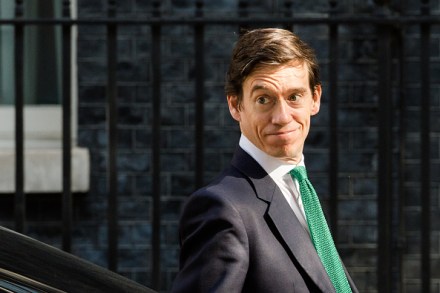
It’s one day since Theresa May set an exit date for her departure from 10 Downing Street and the leadership contest to replace her is already heating up. This morning, Rory Stewart - the International Development Secretary - performed a media round in which the Tory MP declared that he would not be able to serve in a Boris Johnson-led government. The reason? BoJo, the current favourite, would explicitly push for a no deal Brexit - something Stewart could not contemplate. Besides Stewart is planning to run himself. However, he is seen as an outside bet as someone who voted Remain and backs Theresa May’s deal. He has previously hit out at certain Brexiteers for - in his eyes - over-simplifying issues raised by Brexit.

The two sides of the Tory leadership contest

The way to think about the Tory leadership contest is—I say in The Sun, this morning—that it is like a tournament with two sides of the draw, with each side sending one candidate into the final, membership round. One side of the draw is for full-on Brexiteers. Here Boris Johnson, Dominic Raab, Andrea Leadsom, Steve Baker and Esther McVey will duke it out. The other side of the draw features the Cabinet candidates: Jeremy Hunt, Sajid Javid, Michael Gove, Matt Hancock and Rory Stewart. Whoever comes out of the full-on Brexit side of the draw will go into the final round as the strong favourite given Tory members’ views on the subject. I understand that Boris Johnson has edged ahead of Dominic Raab on this side of the draw.

35 months of May: a career in Spectator covers

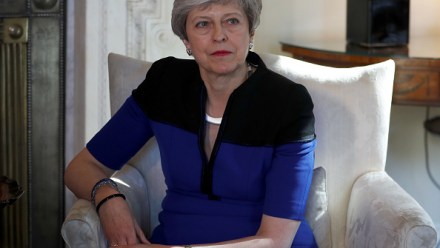
After three long years, she's finally gone. The Prime Minister decided to face the music on the steps of Downing Street yesterday, her voice audibly cracking with emotion as she announced the date of her resignation on 7 June, while her husband Philip May and her Downing Street staff watched sadly on. May’s departure should be no surprise to readers of The Spectator, however. Since she became Prime Minister in 2016, 28 of our covers have featured Theresa May.

Brexit and the new ‘paranoid style’

The politics professor Matthew Goodwin made an interesting observation on Twitter this week. He pointed out that many of the characteristics of the ‘paranoid style’ in American politics — a phrase coined by Richard Hofstadter to describe right-wing populists such as Barry Goldwater — apply to left-wing anti-Brexit campaigners. They are convinced that the 2016 referendum result was due to the machinations of sinister data-mining companies, Kremlin bot factories and Vladimir Putin. I reread Hofstadter’s 1964 essay and the parallels are striking.

Full list: the MPs backing the Tory leadership candidates

The Tory leadership has two stages: MPs will choose two finalists from what might be more than a dozen candidates, a process that should take about ten days. Then the final two will embark on a five-week campaign to win over the 125,000 Conservative Party members.  If Boris Johnson makes it into the second stage, it is widely predicted that he will be selected by local members – making the first part of the race crucial. Coffee House will be tracking which Conservative MPs are backing which leadership candidates in the race. As the number of entrants in the field reduces, expect big swings as MPs switch their allegiances once their favourites have been knocked out.

The Spectator Podcast: Corbyn isn’t working

Labour’s constructive ambiguity on Brexit has served it well since the 2017 election. But as the country votes in European elections this week, has the party miscalculated in being too ambiguous? Nick Cohen writes in this week’s cover article that Labour should have positioned itself as the party of Remain, and now it faces being picked off by the Lib Dems on one side, and the Brexit Party on the other. On the podcast, Sienna Rodgers and Nick discuss Labour's fate: And rather unlikely support for Boris Johnson’s leadership campaign comes in this week’s issue. Self-professed Remainiac Matthew Parris says that whoever is the next leader will have to tell the country that Brexit must be paused, and Boris is the best man for the job.

Watch: Steve Baker considers running for leader

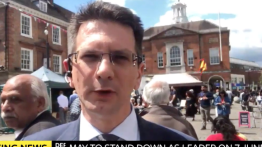
The door of Number 10 had barely closed after Theresa May's resignation statement this morning when Tory MPs began debating who would be the best person to replace her. Brexiteer and ERG deputy chairman Steve Baker certainly wasted no time today, but revealed that the candidate he was really thinking about was... Steve Baker. Asked by Sky News' Adam Boulton if he would back Boris Johnson in the upcoming race, Baker replied that he couldn't support him just yet, as: 'I can't back a candidate yet because I've had both members of parliament and members of the public, in considerable numbers, which has taken me by surprise, suggesting that I stand. And until I've fully considered what's being said to me, out of respect for those giving the advice, I won't be able to back a candidate.

The timetable for the Tory leadership contest

After Theresa May announced that she will step down on Friday 7 June as the leader of the Conservative party, the race to find her successor is due to officially commence the following Monday. Conservative party chairman Brandon Lewis, along with the vice-chairs of the 1922 Committee of Conservative backbenchers,  have issued a joint statement laying out the process for this contest. Notably 1922 chair Graham Brady's name is missing from the statement – leading to speculation he has recused himself on the grounds that the Tory backbencher may run himself. Under the new timetable, nominations will close in the week commencing 10 June. Then there will be 'successive rounds of voting' which will keep going until a final choice of two candidates remain.

The leadership contest solves nothing

Theresa May has been forced from office by her own MPs because they concluded there would be no progress on delivering Brexit, or on anything important, while she remained their leader. But if they thought her government was characterised by factionalism and chaos, they ain’t seen nothing yet. Because the big facts of her failed government – no majority in parliament, religious divisions on how to leave the EU – cannot be wished away. The Buddha would struggle to pacify and unite her fractious party. And the Buddha is unusual in not running to be Tory leader. The coming weeks of battle for the Tory crown, which officially starts 10 June but is already happening in guerrilla skirmishes, will make Game of Thrones seem as tame as Teletubbies.