Politics

Read about the latest political news, views and analysis

Unopposed: Why is Starmer making life easy for the PM?

42 min listen

Is Keir Starmer becoming irrelevant? (00:50) Do the Oscars really celebrate the best that film has to offer? (15:55) Jordon Peterson is back with his new book, Beyond Order, but is it beyond readable? (25:40)With the Spectator's political editor James Forsyth; broadcaster and former Labour adviser Ayesha Hazarika; writer Fiona Mountford; the Spectator's arts editor Igor Toronyi-Lalic; novelist Philip Hensher; and the Spectator's associate editor Douglas Murray. Presented by Lara Prendergast.Produced by Max Jeffery, Sam Russell and Arsalan Mohammad.
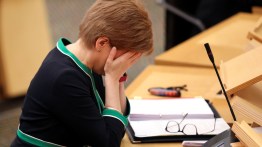
Sturgeon ‘misled’ Holyrood

The Scottish First Minister misled Holyrood. That is the conclusion of the Scottish parliamentary committee investigating her government's handling of sexual misconduct allegations against Alex Salmond.  Nicola Sturgeon gave an 'inaccurate' account of a meeting with her predecessor when she gave evidence to the committee earlier this month, according to the investigating body. MSPs voted five to four in favour of ruling that there had been a 'potential' breach of the ministerial code.  The inquiry is set to reveal it's findings in the next few days but has already made a number of key decisions, according to reports in the Scottish press.

Boris Johnson attempts to calm vaccine concerns

The message from Boris Johnson's press conference this evening was one of reassurance. Following the decision by several EU member states to suspend use of the Oxford-AstraZeneca vaccine over concerns about a potential link with blood clots, the Prime Minister said that the vaccine is safe and that 'the benefits of the vaccine in preventing Covid far outweigh any risks'.Pointing to statements from both the UK and EU regulators on its safety, Johnson said the thing that 'isn't safe is catching Covid'. Johnson was also at pains to calm concerns over vaccine supply. The Prime Minister admitted that the UK was experiencing a supply issue — but said that despite this, there would still be more vaccinations in April than there were in February.

Watch: BBC presenters mock minister’s Union Jack

The BBC is attempting today to break out of its London-centric mindset. The new Director General Tim Davie told BBC staff in a call this morning that the corporation will move 400 jobs out of the capital, and promised to make programmes that are more relevant to people who live outside the M25. Mr S wonders though if simply sending BBC staff up north will be enough, if BBC Breakfast (which broadcasts from Salford) was anything to go by this morning. On the show, housing secretary Robert Jenrick was interviewed by BBC presenters, who ended the segment by sniggering at the minister’s Union Jack in the background of his office and his portrait of the Queen on the wall: https://twitter.com/wallaceme/status/1372521185792167937?

Could Richard Tice win Hartlepool for the Tories?

The Hartlepool by-election is a big moment in British politics. If Labour retains the seat, it will take a lot of heat off Keir Starmer, whose rocky patch as leader continues. If the Tories win, it would likely be politically fatal for the Labour leader. He would either continue on, wounded almost certainly beyond repair, or Labour would get rid of him and replace him with someone much worse. In terms of red wall dominance, the Tories taking Peter Mandelson’s old seat would be highly symbolic as well. Therefore, the prize at stake here for the Conservatives is huge. Capture Hartlepool and the next general election looks to be theirs for the taking.

Is making misogyny a hate crime really a victory for women?

Misogyny will now be recorded as a hate crime by police. But is this really the victory for women’s rights that campaigners are claiming it to be? It’s absolutely right, of course, that the law is bolstered so that incidents against women are taken seriously by the police. But the wording of the policy is disappointingly woolly, relying heavily on what the victim perceives as the motivation for the crime. Speaking in the House of Lords, Home Office minister Baroness Williams said that from the Autumn:  ‘We will ask police forces to record and identify any crimes of violence against the person… where the victim perceives it to have been motivated by a hostility based on their sex.

Who pays the price for Boris governing without scrutiny?

Bailiff-enforced evictions have been banned during the pandemic. But landlords eager to give tenants the boot are finding ways around this rule. Since the start of lockdown, there has been an extraordinary increase in the number of tenants facing applications from landlords to control the terms under which people live in their homes.  Sometimes the playing of loud music is given as the reason. Other times it's because the TV is left on when neighbours are trying to sleep. Perhaps they have had visitors who slammed the front door of their block. But while the circumstances are often mundane, the effect on those who find themselves kicked out can be devastating.

Whatever happened to young Keir Starmer?

This week’s Spectator looks at the role Sir Keir Starmer has played in granting the government extraordinary emergency powers to deal with the rise of Covid. The Labour leader appears happy to maintain such restrictions on the right to protest and even tried to bolster his credentials on law and order by backing under fire Met Commissioner Cressida Dick. But Mr S has done some digging in the archives and it shows Sir Keir was not always such a fan of the police. His works from the 1980s and 1990s prior to taking silk as a QC show a strong libertarian-left streak and a disdain for authoritarian justice and a strong executive. Tony Blair might now be advising his successor but Starmer was not always so receptive to New Labour’s views on law and order.

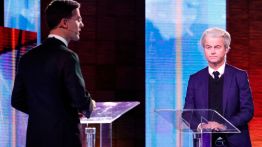
Wilders loses ground as Rutte wins again in the Dutch election

Despite a childcare benefits scandal that led to the resignation of the government en masse, much-criticised delays in its vaccination programme and national riots over a coronavirus curfew, the status quo will remain largely intact after a general election in the Netherlands. With nearly nine in ten votes counted, it looks almost certain that 'caretaker' prime minister Mark Rutte will be building a new coalition government and leading the country for a fourth time. His People’s Party for Freedom and Democracy (VVD) is expected to win another two seats, taking his total to 35 out of the 150 places in the lower house.

The politicisation of Sarah Everard’s death

A woman called Jenny Jones, now elevated to Baroness Moonbeam, or something, in the House of Lords has proposed a 6 p.m. curfew for all men everywhere. This would prevent men from killing women on the streets. Mrs Moonbeam is a member of the Green party and presumably agrees with their manifesto which insists that men who identify as women are women and there’s an end to it. In which case all I would need to do is don a wig and take to the streets — and upon being apprehended by a policeman simply explain that my name was Loretta and I’d just popped out to do a spot of murdering, I mean shopping, officer. Technically speaking, I wouldn’t even need to bother with the wig. That’s one flaw in the mad woman’s argument, then.

Europe’s reckless caution over AstraZeneca

The first smear campaign against AstraZeneca, when Emmanuel Macron falsely claimed at the start of the year that the jab was ‘quasi--ineffective’ in over-65s, did serious damage to public confidence in the Oxford vaccine across Europe. The latest concerted action by the leaders of Germany, France, Italy, Spain and the Netherlands may have destroyed it altogether. The decision temporarily to ban Astra-Zeneca originated in the German health ministry, which was spooked by reports of cerebral venous sinus thrombosis, and was blindly followed by other European leaders. This is a scandal whose roots are political, not medical, and it will have terrible consequences.

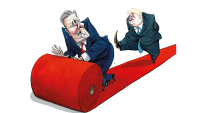
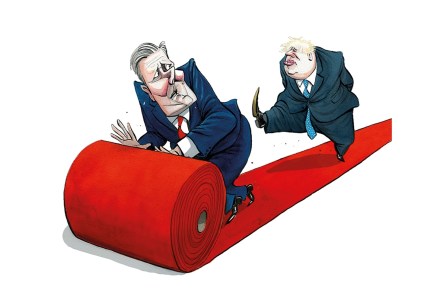
Unopposed: why is Keir Starmer making life so easy for the PM?

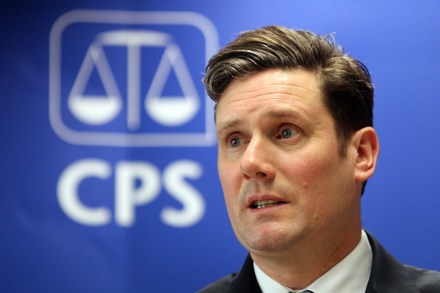
If there is one thing worse than being talked about, it is not being talked about — and this is the fate beginning to befall Keir Starmer. He is at risk of becoming an irrelevance. After not even a year of being Labour leader, Starmer finds his personal ratings on the slide: a YouGov poll this week showed his rating at minus 13, down from plus 22 last summer. Just over half of voters think he doesn’t look like a PM-in-waiting and Labour itself is consistently trailing the Tories in the polls. It’s not clear yet what Starmer stands for, and he is running out of time to make an impression on the public. There is some nervousness about the upcoming Hartlepool by-election despite the fact Hartlepool has never elected a Tory. This is telling.

Starmer’s long game: party repair comes before opposition politics

What is Keir Starmer thinking? His approach might baffle Tory MPs, who wonder if he will ever spring to life. The answer, though, is that he’s playing a long game. He hopes he will be a strong opposition leader when the time is right. For now, it is time to offer support to Boris Johnson’s government. The pandemic has created tricky terrain for the shadow cabinet. Much like in wartime, normal political rules don’t apply, because ‘people want the government to succeed’. Starmer’s supporters say coronavirus means the Labour party has been squeezed out of the conversation. It’s not as simple as Starmer not knowing what he wants, even if some Labour MPs see this as the main problem.

Public Health England’s obesity obsession

Few government agencies have had a worse pandemic than Public Health England (PHE) whose mission is ‘to protect and improve the nation’s health and to address inequalities.’ Criticisms levelled at PHE over the past 12 months include failing to expand diagnostic testing and contact tracing, discouraging the use of face masks, failing to share infection data with local authorities and overcounting the number of Covid deaths in England. It has also been slated for focusing too much on lifestyle choices at the expense of properly preparing for a pandemic. In 2018/19, some £220 million of the public health budget was spent on anti-obesity schemes – more than twice the budget for infectious diseases.

Boris Johnson undersold his security review

It was the political equivalent of Halley's comet. On Tuesday, Boris Johnson underestimated his own achievement. He claimed that the review of defence, security and foreign policy was the most wide-ranging study of those topics since the end of the Cold War. That was being too modest. It is the most important contribution since the Duncan Sandys Defence White Paper in 1957, which set out Britain's strategy for the Cold War: rethinking and re-organising our capabilities and commitments in order to contain and counter the Russian threat. But the latest review is even more radical. The Sandys paper rested on one assumption which is, alas, no longer true: that Britain was a superpower – if not a full member of the Big Three, still clocking in at two and a half.

Is Matt Hancock trying to spin a vaccine supply crisis?

Matt Hancock was tremendously smiley when he led Wednesday's coronavirus press briefing. In between beaming, he managed to tell us about the 'fantastic news' that the vaccination programme has now reached more than 25 million people having had their first dose. He was very keen to sing the praises of this programme — and indeed of his involvement in it — saying: 'I've had the honour of playing my part, we've had the honour of playing our parts, it's been a huge team effort and I've got absolutely no doubt it's the best project I've ever been involved in.' He also rather pointedly talked about 'those of us who've been involved in it from the start'.

Starmer’s prosecution campaign is misguided

On Monday evening Sir Keir Starmer tweeted an explanation for why Labour would not be supporting the Police, Crime Sentencing and Courts Bill. https://twitter.com/Keir_Starmer/status/1371547120080195585?ref_src=twsrc%5Etfw Coming from a former director of public prosecutions this was dire stuff. First, and perhaps least importantly, the word ‘statues’ does not appear in the Police, Crime and Sentencing Bill. Sir Keir knows this. What the Bill proposes is that where criminal damage is caused to a ‘memorial’ there should be no minimum financial limit before the case can be tried in the Crown Court, where the maximum sentence is ten years imprisonment.