Economy

  • AAPL

    213.43 (+0.29%)

  • BARC-LN

    1205.7 (-1.46%)

  • NKE

    94.05 (+0.39%)

  • CVX

    152.67 (-1.00%)

  • CRM

    230.27 (-2.34%)

  • INTC

    30.5 (-0.87%)

  • DIS

    100.16 (-0.67%)

  • DOW

    55.79 (-0.82%)

Why Xi thinks he has the upper hand

Taiwan is “the most important issue,” Xi Jinping warned Donald Trump. “If mishandled, the two nations could collide or even come into conflict, pushing the entire China-US relationship into a highly perilous situation,” according to Chinese state media. The contrast with Trump’s comments was striking. Trump had earlier named trade as the most important issue. In opening remarks, the American President stuck to bland flattery, saying he and Xi had a “fantastic relationship,” that Xi was a “great leader” and that “it is an honor to be your friend.” “The relationship between China and the USA is going to be better than ever before,” he insisted.

Spotlight

Featured economics news and data.

Cutting Britain’s giant welfare bill would be an act of kindness

Does having money really matter that much? There are those, usually with quite a bit of it, who want us to care less about materialism. But, unequivocally, money really does matter – not because of any status it supposedly brings, but for the freedom it buys: freedom to choose how we live and how we look after others. Considering this, it seems that the deep disillusionment with mainstream politicians in recent years stems from a protracted and ongoing period of stagnant living standards over which they have presided. But the truth is that the average person has not got poorer since the global financial crisis. They have got a little bit richer. Employment levels are still exceptionally high. And, both historically and internationally, we are a very rich country.

Is the Trump Slump over?

Tariffs would destroy supply chains and drive up inflation. Elon Musk’s savage cuts would bring the government machine grinding to a halt. And chaotic policy making would drive investors out of the United States. As the Dow, the S&P 500 and the Nasdaq all fell sharply over the last month, there were plenty of factors driving the “Trump Slump,” as it became known on Wall Street. But hold on. Sure, equities have corrected. But right now it looks as if the rout is already over, and the markets have steadied again.  Last week, US stocks finished in positive territory for the first time in a month, chalking up modest gains over five trading days. On Monday, they carried on climbing, with the Dow up by more than 500 points, and the Nasdaq by more than 300.

Trump witkoff

Can Trump fix eggflation?

"You can’t make an omelette without breaking eggs" is a maxim attributed to leaders on both sides of the French Revolution. "Move fast and break things" is today’s equivalent, emanating from Silicon Valley and amply demonstrated by Donald Trump and Elon Musk in their approach to government and geopolitics. "You can’t make omelettes at all if you can’t afford eggs" might be the next variant: inflation and scarcity afflicting America’s favorite breakfast have become a major political issue. In brief, a dozen US eggs used to cost $2 or less but by January this year the supermarket price was $5 and rising – in some places $9 was reported, rationing had to be introduced and Mexican suppliers were spotted smuggling truckloads across the border.

eggs

Recession? What recession?

The stock market, traditionally a leading indicator, entered correction territory last week. But does that indicate that a recession is coming? Well, it’s an old saying on Wall Street that the market has predicted ten of the last three recessions. Markets hate uncertainty, and no one knows how President Trump’s efforts to use American tariffs to force our trading partners to lower theirs will turn out. But foreign trade is increasingly important to all countries, so it’s likely that, after some political Sturm und Drang, deals will be struck and international trade will continue the strongly upward path it has been on since the end of World War Two. By definition, a recession is two consecutive quarters of contraction.

shares

The US has entered a bear market

Could it be that Donald Trump actually wants a bear market now? At some point, one was bound to happen on his watch — after all, US equities weren’t going to keep up their stunning gains from the past two years for the rest of his term. A market correction was inevitable, and it seems we’ve already seen that, as the S&P 500 dipped into correction territory this week. And a bear market was almost certainly coming, given that there have been 27 of them in the S&P index since 1928. Hartford Funds provides a good summary here, showing that the average decline in a bear market is 35 percent, and they typically last 9.6 months. By contrast, the average bull market lasts 2.6 years, with prices rising 110 percent. Overall, bear markets occur about every 3.

bear market

Team Trump’s incoherent plan to change GDP measurements

If there is anything that all governments watch carefully, it is GDP growth. Without substantive and ongoing increases in what GDP measures — the total monetary value of all final goods and services produced in the economy over a specific time period — societies are in big trouble. That’s one reason why recessions usually result in electoral death for whoever holds office at the time. To accurately estimate total growth in an economy, everything that contributes to GDP must be measured. That presently includes consumer spending, private domestic investment, net exports, and, lastly, government consumption and spending. Now, however, Trump officials ranging from Elon Musk to Howard Lutnick are stating that we should consider excluding the latter category.

Can the MAGA coalition survive a recession?

The color red splashed across every news channel yesterday, as Donald Trump’s seemingly blasé attitude towards a possible recession wiped $4 trillion off the United States’s stock market. All day and all night, the airwaves were dominated by talk and speculation over the future of the US economy, as the President pushes forward (and pulls back) certain parts of his tariff agenda.  It’s the sheer uncertainty that has investors spooked, leading to one of the worst days on Wall Street in years. The details of this “period of transition” for the economy that the President alluded to are so vague, and so unclear, that you can make of the comments almost whatever you want.

recession

How likely is a Trump-induced bear market?

China doesn’t like tariffs, but big money in America dislikes them even more. If one thing has become clear amid the chaos of the past week, it’s that financial markets will be what constrain Donald Trump. China’s foreign minister, Wang Yi, criticized Trump on Friday for imposing tariffs, adding that major powers “should not bully the weak.” While people in Taiwan might find that statement a bit ironic, his stance on tariffs aligns with Wall Street’s reaction. The markets don’t like it. Last week, the NASDAQ Composite index, which tracks high-tech companies, entered a “correction” — a 10 percent drop from its peak. Only one of the Magnificent Seven tech giants, Meta Platforms (which owns Facebook), is up this year.

The economic blackout movement trying to stop capitalism in its tracks

For weeks, I’ve been seeing calls for a February 28 “economic blackout” spread across my social-media feed like dandelion tufts in the wind. From midnight on February 27 to the following midnight, anyone participating in the blackout should avoid spending money at Amazon, Walmart or Best Buy. Do not buy fast food or gas, says “the People’s Union,” which is organizing the blackout. Don’t shop at major retailers. If you have to shop, make it only for essentials, like food to feed your kids, and emergency supplies, and only do it at small, local businesses. It’s possible I could participate in the blackout by accident, but I wouldn’t ever do something like this willingly. Obviously, I’m not the target audience.

oligarchy tech capitalist pigs

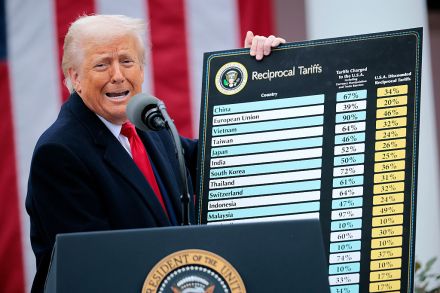
How Trump’s Mexico and Canada tariffs could change trade history

President Donald Trump has set Saturday as the deadline to impose 25 percent tariffs on Canadian and Mexican imports. From the Oval Office earlier this week, Trump explained that the move aims to push the US’s neighbors to take swift action to curtail illegal immigration and fentanyl, as well as to address growing trade deficits. The tariffs may or may not include oil, with Trump saying Thursday that determinations were still being made. Following Trump’s tariff feud with Colombian president Gustavo Petro Sunday, with the Trump forcing his Colombian counterpart to welcome deportees, his latest move signifies an expansion of his revamped “FAFO” foreign policy.

Is it worth it for Trump to buy Greenland?

"The art of the deal" is President Trump’s much-vaunted modus operandi as well as the title of his 1987 bestseller. But how smart would he be to make an offer for Greenland to the Danish government? Leaving aside issues of military sites and future unfrozen shipping routes, would the currently still-frozen north Atlantic island be worth a rich price for its mineral deposits alone? I consulted an intrepid investor who spent six years there prospecting for tantalum, a "transition metal" used in capacitors for mobile phones. His answer was not encouraging. There’s no disputing the potential to find everything from gold and uranium to rare earth elements such as neodymium and dysprosium, in demand for advanced electronics. But the operating difficulties are truly formidable.

Greenland

Tales from the crypto

I don’t gamble. But in October 2016, I made a bet. It was obvious Trump didn’t just have skeletons in his closet but a walk-in necropolis. As we stumbled toward November, the question wasn’t whether one of these skeletons would break free, but just how bad the October Surprise would be. It was supposed to be a polling-shifting, election-sealing, reputational nuclear bomb. And if you read the press, that’s what the “Pussy-Grabbing Tape” was. But to me, it was just another example of Trump being vulgar. And Trump had always been vulgar. And voters liked that he was vulgar, or didn’t care that he was vulgar, or liked that he was so unlike other politicians that he could be vulgar.

crypto

Don’t put your savings in meme coins

The Hawk Tuah girl, a young woman famous for a viral video in which she tawdrily describes a sex act, launched a meme coin this week — because of course she did. It instantly lost over 90 percent of its value. This, too, comes as no shock. But out of ignorance, stupidity and greed, many people put their real money into $Hawk and lost it all. And so, 2024 ends with assassinations in the middle of New York City, attempted coups in South Korea and @jiggadrin_ tweeting out that his $35,000 in “$Hawk is now $2,000 after ten minutes of buying,” and that “I am a huge fan of Hawk Tuah but you took my life savings.” In some replies, he tried to spin this as a joke post. But it appears he genuinely lost the money, as did many others.

meme coins

The West faces a new type of housing crisis

Throughout the West, particularly the Anglosphere, housing costs are ravaging the middle class. Homeownership, long the key to social mobility, is on the decline, particularly among younger generations and minorities. According to the Organization for Economic Cooperation and Development, house prices in high-income countries have been rising “three times faster than household median income over the last two decades,” causing the standard of living “to stagnate or decline.” Unlike previous housing crises, this one is not primarily caused by mass displacements due to wars or natural disasters or population growth.

housing

The academic legacy of Donald J. Harris

Kamala Harris is a master shapeshifter — whether through codeswitching, pandering or just being phony. One moment she’s rolling up masala dosa with Mindy Kaling on live TV; the next she’s FaceTiming the BET Awards, declaring, “Girl, I’m out here in these streets.” Donald Trump’s bumbling attempts to highlight her cultural inconsistencies briefly shifted the election focus to Harris’s race and ethnicity — and away from far more important qualities. Perhaps it’s because her actual policy ideas have been so scant and vague that attacking them directly has proven difficult. Perhaps her chameleonic history has made anything beyond a surface-level attack difficult.

harris

The one bright side of the looming debt crisis

By almost every historical indicator, the US is clearly approaching a debt crisis. The federal government’s aggregate liabilities now exceed its gross domestic product. The annual interest required to service federal obligations is greater than what Congress spends each year on defense. And projected annual deficits for the next decade are well ahead of estimated revenues by more than $2 trillion. Many state legislatures are deeply underwater as well, despite receiving generous Covid related bailouts from President Biden’s 2021 American Rescue Plan Act. California’s temporary $100 billion surplus in 2022, for example, has morphed into a projected deficit of $68 billion over the next two years.

dollar debt

Trouble in paradise: thousands of Disneyland employees threaten strike

Some 14,000 cast members at Disneyland in California voted by an overwhelming 99 percent to authorize a strike on Monday; however, a coalition of union members reached a tentative agreement with Disneyland Tuesday, mainly revolving around wage increases. The coalition, titled Disney Workers Rising, will open a vote on the agreement at Disneyland for employees on July 29. According to Disney, there are more than 35,000 cast members (what they call their employees) who work at Disneyland in Orange County, California. The terms of the agreement have yet to be disclosed, but if Disney agreed to raise wages by twenty-five cents an hour — which certain employees have hypothesized could happen, though it will likely be by much more — that would cost them more than $18 million per year.

The safest bets in Wall Street will be our downfall

It’s not often that anyone — much less an academic — writes a book that launches a revolution, but that’s exactly what Burton Malkiel did in 1973 when the Princeton economist published a short, potent book called A Random Walk Down Wall Street. As of 2023, the book is in its thirteenth edition. Malkiel famously insisted that “a blindfolded monkey throwing darts at the stock listings could select a portfolio that would do just as well as one selected by the experts,” and then he spent his entire career doing his best to prove that hypothesis.

passive

The Biden administration’s race-based tax plan is disgusting

Do you like scary stories? How about this recent report from the United States Treasury, “Advancing Equity through Tax Reform: Effects of the Administration’s Fiscal Year 2025 Revenue Proposals on Racial Wealth Inequality.”  That sleep-inducing mouthful of grade-A bureaucratese may seem anodyne, the sort of thing that requires a surgeon general’s warning. But even a cursory trip through this twelve pages of reader-proof gobbledegook will be enough to give any sentient being nightmares. For what this malodorous blueprint aims at is nothing less than the confiscation of your wealth and property. Beginning with its title, this report bristles with loaded buzzwords —“equity,” “racial wealth inequality.

In praise of Yuengling

When I was a college student in Texas, I told someone at a bar that I was from Pennsylvania. The guy’s eyes lit up. “Pennsylvania?!” the man exclaimed. “That means you get to drink Yuengling whenever you want!” Yes, I mused, with a shrug and a swig of my Shiner Bock. So what? The barfly informed me he was such a big fan of America’s Oldest Brewery — established 1829 — that he and his family would haul cases of the traditional lager, Smokey and the Bandit style, back to the Lone Star State any time they traveled east of the Mississippi. Fast-forward (just!) a few years, and Yuengling is now available in twenty-six states. Texas, my old friend would be tickled to know, was the first western state to get a taste of Yuengling back in 2021.

Yuengling

Can Mike Lynch make it out of jail?

As I’ve said before, I hold no brief for Dr. Mike Lynch, the founder of the Cambridge-based software firm Autonomy, who faces fraud charges over the $11 billion takeover of his company by Hewlett-Packard (HP) in 2011. But I watched with foreboding as US marshals bagged Lynch under the lopsided 2003 US-UK extradition treaty and flew him to California — after the then home secretary Priti Patel declined to halt the process — and a judge there changed his pre-agreed bail conditions to place him under armed house arrest. Now, having comprehensively lost the argument that as a UK citizen running a UK company he should have been tried in British courts, Lynch is pleading “not guilty” to a San Francisco jury.

Lynch