Economy

  • AAPL

    213.43 (+0.29%)

  • BARC-LN

    1205.7 (-1.46%)

  • NKE

    94.05 (+0.39%)

  • CVX

    152.67 (-1.00%)

  • CRM

    230.27 (-2.34%)

  • INTC

    30.5 (-0.87%)

  • DIS

    100.16 (-0.67%)

  • DOW

    55.79 (-0.82%)

Why Xi thinks he has the upper hand

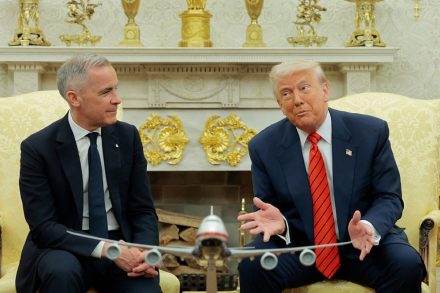
Taiwan is “the most important issue,” Xi Jinping warned Donald Trump. “If mishandled, the two nations could collide or even come into conflict, pushing the entire China-US relationship into a highly perilous situation,” according to Chinese state media. The contrast with Trump’s comments was striking. Trump had earlier named trade as the most important issue. In opening remarks, the American President stuck to bland flattery, saying he and Xi had a “fantastic relationship,” that Xi was a “great leader” and that “it is an honor to be your friend.” “The relationship between China and the USA is going to be better than ever before,” he insisted.

Spotlight

Featured economics news and data.

Cutting Britain’s giant welfare bill would be an act of kindness

Does having money really matter that much? There are those, usually with quite a bit of it, who want us to care less about materialism. But, unequivocally, money really does matter – not because of any status it supposedly brings, but for the freedom it buys: freedom to choose how we live and how we look after others. Considering this, it seems that the deep disillusionment with mainstream politicians in recent years stems from a protracted and ongoing period of stagnant living standards over which they have presided. But the truth is that the average person has not got poorer since the global financial crisis. They have got a little bit richer. Employment levels are still exceptionally high. And, both historically and internationally, we are a very rich country.

Foreign governments have themselves to blame for Trump’s movie tariffs

Donald Trump has thrown another trade grenade. His latest idea – a 100 percent tariff on all foreign-made films – is crude, impractical and potentially disastrous for his frenemies in the Hollywood industry that he has suddenly decided to champion. Announcing the tariffs via Truth Social, Trump tried to paint movies produced overseas as a danger: not just to America’s film production industry, but national security too. “WE WANT MOVIES MADE IN AMERICA, AGAIN!" he thundered. Invoking national security to justify these tariffs is legally shaky. Practically, it’s not clear how you even impose tariffs on a complex, multi-national production like a modern movie. Films shot in Croatia, edited in the UK and funded by America pose an administrative nightmare.

marvel movie

Deals, deals, deals vs China, China, China

How was your Liberation Month? It’s been almost 30 days since Donald Trump stood in the Rose Garden of the White House and announced a shocking set of massive tariffs on the world. The event caused huge convulsions in the economic universe: trillions were wiped off the stock market and, under huge pressure, Trump did agree to a 90-day pause on reciprocal tariffs. After that he exempted electrical goods, though his standard 10 percent remains, and the heads of most financial analysts are still spinning trying to figure out what it all means. Yet for all the angst and the apoplexy, yesterday the S&P 500 index closed just 1 percent down from where it was at the beginning of the month.

empty shelves

Is America in the grip of Empty Shelves panic?

The morning of President Trump’s 100th day in office brought fresh tariff melodrama with the coffee, eggs and toast, as a report emerged suggesting Amazon was considering listing the exact cost of a US tariff surcharge next to all goods purchased on the site. White House Press Secretary Karoline Leavitt immediately snarled from the podium that this was a “hostile and political act,” though it was really neither hostile nor political. Regardless, Amazon immediately rolled it back, claiming the story had been misreported by Punchbowl News.  “The team that runs our ultra low-cost Amazon Haul store has considered listing import charges on certain products,” a spokesman said.

Was ‘Liberation Day’ just shock therapy?

With Treasury Secretary Scott Bessent announcing that a trade deal between the US and India could be imminent, it once again raises the possibility that Trump’s intended outcome is not the imposition of high, permanent tariffs – but that the measures announced on “Liberation Day” were really just shock therapy aimed at the ultimate liberalization of trade. It is significant that India was one of the countries which were originally put down for some of the higher tariffs: 26 percent was going to be the blanket rate on imports from India. South Korea, another country with which trade deal negotiations seem to be in an advanced state, was going to be subject to 25 percent tariffs.

trade

Mission creep has infected the IMF and the World Bank

The following is a transcript of a speech delivered yesterday by the Treasury Secretary Scott Bessent. In the final months of World War Two, Western leaders convened the greatest economic minds of their generation. Their task? To build a new financial system.  At a quiet resort high up in the mountains of New Hampshire, they laid the foundation for Pax Americana.  The architects of Bretton Woods recognized that a global economy required global coordination. To encourage that coordination, they created the IMF and the World Bank.   These twin institutions were born after a period of intense geopolitical and economic volatility.

IMF

Will AOC be the next leader of the Democrats?

What are we to make of an America in which David Brooks, the mild-mannered moderate of the New York Times opinion pages, calls for a “comprehensive national civic uprising” to fight back against the tyranny of President Donald Trump? It’s one in which the traditional thinking about how the Democratic party can wield power has been crushed to dust. It’s one in which voters, disillusioned by repeat defeats to Trump, have felt their hopelessness turn to rage. Moderates, such as Kamala Harris, are not channeling that fury.

alexandria ocasio-cortez

Could this be the last time I ever have to pay my taxes? 

Another Tax Day has come and gone. Here I sit, all broken-hearted. The tax-industrial complex has once again swallowed up thousands of dollars that used to be mine. But this year, I found myself legitimately wondering: could this be the last time I ever have to pay my taxes?  One of the major pillars of President Trump’s economic platform is the abolition of income tax for all Americans who make less than $150,000 a year. This sounds like a fantasy, an empty chicken-in-every-pot promise, like a student council candidate winking after saying, “If you elect me, I’ll make sure we have soda in the drinking fountains.” But if Trump 2.0 has shown anything this year, it’s a willingness to set into motion seemingly impossible plans.

tax

Is Trump killing the American dream for mom-and-pops? 

He’s survived an assassination, bounced back from bankruptcy and – so far, at least – avoided all attempts to jail him. But Donald Trump’s most audacious feat is yet before him: to persuade Americans to pay more for their goods as their beloved businesses struggle – and then be grateful to him at the polls.  While tariffs threaten to raise prices across the board for consumers, small businesses with lower margins than their larger competitors are struggling. “Whether or not you support tariffs, or whether or not you think certain offices should be cut, I think overall, any kind of economic turbulence is uniquely burdensome for small businesses,” says Molly Day, the National Small Business Association’s vice president of public affairs.

What the left calls ‘chaos,’ the rest of us call ‘winning’

They never learn, the libs. Back in 2016, they provided hours of entertainment assuring themselves that Donald Trump would “never be president” (“take it to the bank,” said Nancy Pelosi, who in another galaxy, long, long ago was speaker of the House). Patriotic citizens, eager to instruct the public about the dialectic of hubris and nemesis, stitched together many joyful compilations of Hollywood celebrities, ditto-head news readers and Democratic politicians intoning that party line.  Then, after the impossible mutated into the inevitable and Trump was elected, the narrative shifted to “the walls are closing in on Donald Trump.” If it wasn’t Russia, Russia, Russia it was Stormy Daniels, putatively shady business deals or putative efforts at insurrection.

The art of the pivot

“THIS IS A GREAT TIME TO BUY!!!” President Donald Trump wrote on his Truth Social account yesterday morning. With trillions of dollars wiped off stock market value since his tariff announcements last week, this appeared to be an attempt to manufacture a silver lining. It also happened to be a literal statement. Within a few hours, the stock market was surging as Trump announced a 90-day pause on the higher “reciprocal” tariffs for most countries, while hiking the tariff on Chinese goods to 125 percent. Was this careless? Intentional? Insider trading? According to the White House, it had been the strategy all along. The President told reporters it had been “the biggest day in financial history.” Speaking to his aides beforehand, Trump noted the market was rallying.

pivot

The war on Tesla

“Don’t buy Tesla! Don’t buy Tesla!” protesters were chanting in front of the brand’s showroom in my neighborhood in the northwest of Austin, Texas, at 10:30 on a Saturday morning. The anti-Tesla resistance – “nonviolence division” – was making a stand in the city where the company has its headquarters. Somewhere between 100 and 200 people waved US flags and carried signs. “Elon: You’re Fired,” read one of them. “Deport Nazi Musk,” said another. “When you ride with Tesla, you ride with Hitler,” one proclaimed. I saw as many swastikas as I’d expect to see at an actual Nazi rally. But these were resistance swastikas, I was told, so that made them acceptable. The protesters circled the Tesla dealership but didn’t actually enter company property.

Tariff haters don’t live in the Rust Belt

There is a vacant lot at the edge of downtown Philipsburg, Pennsylvania, my hometown. Three years ago, a handsome, sturdy brick factory building stood in that lot, albeit most of the windows were broken, as it had been abandoned for years. After it closed, the building became a favorite hangout for ne’er-do-wells, whose act of arson forced its recent demolition. For decades, though, the clothing factory employed thousands of people and made downtown hum, as workers crowded the restaurants and took care of errands on their lunchbreaks. They – along with the hundreds of people employed by a cigar plant on the outskirts of town – also bought houses and rented properties here and supported locally owned pharmacies, barbers, hardware stores, grocery stores, and the hospital.

Elon wants Trump to understand how a pencil gets made

“I-Pencil,” the fable-like essay by the economist Leonard E. Reed, remains one of the best introductions to the free market. It shows the ways in which the mass production of even simple things – like the humble pencil – involves the work of numerous people, most of whom do not know each other and who are all motivated at some level by self-interest. Above all, Reed shows that this extremely complicated process occurs without someone planning it from the top-down. This is, in short, the classic argument for market liberalism. But Reed’s essay also illustrates the follies of central planning or imagining that humans can somehow live an entirely self-sufficient existence.

pencil free trade
control chaos

Trump loves chaos. What happens when he loses control?

“Don’t be a PANICAN,” the President shared on his Truth Social account this morning, as the Dow was dropping 900 points. This is Donald Trump’s new word for his tariff critics, who he has grouped together as the “new party based on Weak and Stupid people!” There is another way, the President insists: “Be Strong, Courageous, and Patient, and GREATNESS will be the result!” It’s another post in a long line of all-caps messages shared by the President over the weekend. “ONLY THE WEAK WILL FAIL!” was Friday’s update. “WE WILL WIN. HANG TOUGH,” was Saturday’s inspirational message.

Trump is playing a high-stakes game of international poker

On what he called “Liberation Day,” President Trump announced a new tariff schedule. While the markets had been up in anticipation, they are down sharply, with the Dow dropping 2,200 points, perhaps surprised by the extent of them. Basically, Trump has laid tariffs equal to about half what other countries charge on US exports, inviting them to lower theirs in exchange for reciprocity. What the final result will be is anyone’s guess, for the Trump tariffs are chips in a high-stakes game of international poker. They have already had an effect. Canada has promised retaliatory tariffs while Israel has dropped all tariffs on US goods. A tariff is a tax laid on goods passing through a port.

trump

Give Trump’s tariffs a shot

So the big question is: will it work? Will Trump’s protectionist policies, announced with some fanfare at a Rose Garden event at the White House yesterday, increase American prosperity? Or will they harm the economy?  Opinion on that matter is sharply divided. In one corner we have the free traders. They are wringing their hands and warning about higher prices, disruption of international trade and a trade war no one can win.  In the other corner are – what to call them? Most are not “anti-free traders” or “economic protectionists” (though some are).  Let’s call them “fair traders.” They like the idea of free trade – in theory. What they don’t like is the ethic of “free trade for thee but not for me.

tariffs grandeur

The grandeur of Trump’s tariffs

The first thing revealed by the high and wide-ranging new tariffs President Trump announced on “Liberation Day” is just how limited other recent American presidents have been in their thinking. Their ambition was to get elected and re-elected, then retire comfortably into a tranquil post-presidency. They would finish their days lending their names to charities and writing their memoirs (or rather, commissioning ghostwriters to fulfill their publishing contracts).   The idea of destroying and remaking the global economic order never crossed their minds. But Trump is thinking bigger. He doesn’t want to go to his grave as just another has-been ex-president.

Tariffs make sense in a world of predatory mercantilism

The classical defense of free trade, the one found in Econ 101 textbooks and Ricardo’s comparative advantage model, goes something like this: countries should specialize in what they can produce most efficiently, export the surplus and import the rest. Trade allows global output to increase, everyone gets richer and any government interference – like tariffs or subsidies – just gums up the works. But that’s not the world we live in. David Ricardo, the early 19th-century British economist who developed the theory of comparative advantage, illustrated it with a now-famous example: even though Portugal could produce both wine and cloth more efficiently than England, both countries would benefit if Portugal specialized in wine and England in cloth, then traded.

tariffs
tariffs

Could Trump’s tariffs damage the dollar?

Donald Trump says his tariffs are about liberation. But his aggressive turn toward protectionism may signal the start of a shift away from the foundations that have upheld American prosperity for decades. The dollar’s status as the world’s reserve currency has long enabled the United States to consume far more than it produces, run massive deficits without consequence, and project unparalleled geopolitical power. Trump’s decision to impose tariffs of up to 25 percent on imports could put all that at risk. When French President ValĂ©ry Giscard d’Estaing referred to the United States’s “exorbitant privilege,” he wasn’t talking about America’s central position in the post-WWII world order.

Is Trump’s tariff zeal beginning to wane?

The President can’t stop talking about his favorite word – tariffs – although this week his comments are having a new effect. Rather than plummeting, the stock market is showing signs of life – climbing by more than 1 percent – on the news that Donald Trump’s plans for “reciprocal” tariff seemed to have been scaled back significantly.  For weeks the President has been suggesting that come April 2, trade retribution would really kick in: any country that has an “unfair” trading partnership with the United States (Trump was even thinking of extending this to taxes like VAT) would see an equal import tariff imposed on the country.