Lewis M. Andrews

The one bright side of the looming debt crisis

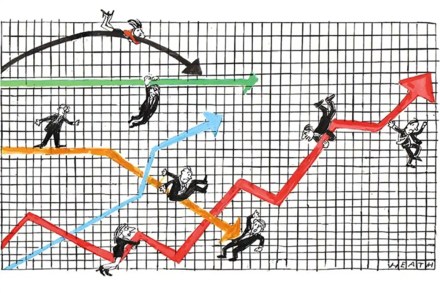
By almost every historical indicator, the US is clearly approaching a debt crisis. The federal government’s aggregate liabilities now exceed its gross domestic product. The annual interest required to service federal obligations is greater than what Congress spends each year on defense. And projected annual deficits for the next decade are well ahead of estimated revenues by more than $2 trillion. Many state legislatures are deeply underwater as well, despite receiving generous Covid related bailouts from President Biden’s 2021 American Rescue Plan Act. California’s temporary $100 billion surplus in 2022, for example, has morphed into a projected deficit of $68 billion over the next two years.

dollar debt

The good news about the left’s growing resort to intimidation

It has not escaped the attention of media observers that the current outbreak of violent campus demonstrations is but the latest in a series of disruptive left-wing movements, starting with Occupy Wall Street in 2012, followed by the Black Lives Matter riots over the summer of 2020 and now the anti-Israel protests. The right, too, has been associated with disorderly conduct — most notably during January 6 and the Charlottesville rallies — but neither of these events were as well-planned or long lasting as what progressives have been up to. And this fact has led many journalists to speculate as to why the American left has become so attached to civil disobedience.

intimidation

The secret history of the school choice left

Because teachers’ unions play such an important role in today’s Democratic Party, it is widely assumed that school choice — the policy of letting families use taxpayer dollars to educate their children as they wish — is a Republican or conservative program. And while it's true that teachers’ unions will instantly turn on any Democrat who favors public funding of non-public schools, there is in fact a long history of prominent left-wing thinkers and activists supporting school choice. As far back as 1956, British Labour Party leader Anthony Crosland wrote a controversial book called The Future of Socialism, in which he observed that the bureaucratic management of England’s newly expanded welfare programs was turning out to be almost as bad as having no programs at all.

The trouble with the progressives’ proposed wealth tax

As the level of US debt zooms past the $34 trillion mark, it has become increasingly clear that the American left has no intention of trying to help control government spending. To the extent that annual deficits must be trimmed to protect the integrity of the nation’s currency, Democrats and their allies are instead planning to go beyond the current progressive tax on income and institute a new levy on citizens’ assets. Some such as Senator Elizabeth Warren openly advocate taking the conventional idea of a property tax and applying it to everything a person owns — cash, savings accounts, stocks, jewelry and even art.

warren wealth tax

The real reason people are flocking to red states

It’s no secret that Americans are moving from blue states to red ones. According to recently released Census Bureau data, the five with the largest population loss to other states between July 2022 and July 2023 were California (-338,371), then New York (-216,778), Illinois (-83,839), New Jersey (-44,666), Massachusetts (-39,149) and Maryland (-30,905). The five states with the largest overall increases during the same period were Texas (473,453), Florida (365,205), Georgia (116,077), South Carolina (90,600) and Tennessee (77,512). The most frequently cited reason for this ongoing blue-to-red migration is taxes — or, more correctly, the opportunity to pay less and fewer of them.

red states

How progressivism locks the left into a suicide pact

For decades the American left has attempted to build a winning political coalition by convincing as many factions as possible that they have somehow been victimized by a white power structure — more particularly, by an American and European white male power structure. The goal has been to provide the Democratic Party with a large base of aggrieved voters while simultaneously giving its traditional allies in the media, academia and government a persuasive social justice (or more recently “anti-colonial”) narrative. But ever since Joe Biden’s inauguration as America’s forty-sixth president, when his promise to be the country’s conciliator quickly disappeared behind a sharp left turn, progressivism’s self-defeating internal contradictions have become increasingly apparent.

progressivism ledft

As America’s fiscal storm approaches, government prepares to save itself

It’s a familiar response whenever the National Weather Service warns of a Category 5 hurricane, a life-threatening winter blizzard or some other looming natural disaster. Government officials urge local citizens to seek shelter immediately, while promising that area police will keep guard to ensure that looters do not use the emergency to rob boarded-up homes and abandoned stores. Today, Americans are being warned to brace for another kind of storm, one involving not the weather but their personal finances.

fiscal debt

What exactly is the new space race all about?

The recent spate of articles about attempts by different countries to land vehicles on the Moon make it clear that a new space race is on. Just last month, Russia launched its first mission there in forty-seven years. And although the automated Luna-25 spacecraft spun out of control and crashed at the last minute, India’s heavily-instrumented Chandrayaan-3 landed successfully just four days later. NASA itself aims to return humans to the lunar surface in 2025 with its Artemis program. Remarkably, more than eighty countries, including Israel and the United Arab Emirates, have thus far established some kind of presence in space.

space

Biden’s green agenda pokes a big hole in America’s social safety net

With the current inflation rate still well above the Federal Reserve’s 2.0 percent target, it is only natural that critics of President Biden’s Inflation Reduction Act (IRA) treated its recent one-year anniversary as an opportunity to once again stress that the bill never had anything to do with inflation. Biden himself has finally admitted as much. But what has received almost no attention is the degree to which big spending programs like the IRA — whose estimated cost has already spiraled up from $384.9 billion to $1.5 trillion — will further erode America’s social safety net. Especially the Medicare hospital insurance fund (Medicare Part A), which its trustees say will be depleted in 2031, and Social Security, which runs out of money just three years later, in 2034.

energy green biden

How AI could shrink government

Recent advances in artificial intelligence have led many observers to worry that computers will soon replace far more jobs than imagined just a few years ago. The World Economic Forum now predicts that over 85 million positions could be lost to automation by the year 2025, many in law, medicine, accounting and other fields once thought immune to electronic substitution. Industry experts like IBM CEO Arvind Krishna argue that the worries about this dramatic change are vastly overblown. Like every past technological innovation, he says, AI will eventually create many more employment opportunities than it eliminates, producing jobs in which a person’s productivity will be enhanced by his or her ability to use smart and dexterous machines.

ai artificial intelligence

Forget electric cars: America should invest in electric roads

As President Joe Biden and House Speaker Kevin McCarthy begin to square off on a compromise debt ceiling bill, the subsidies in the so-called Inflation Reduction Act, or IRA, for the purchase of electric cars will prove a major, if not the major, sticking point. McCarthy clearly knows that Goldman Sachs, Brookings and other respected observers have predicted that these EV credits could cost taxpayers $390 billion over the coming decade — or at least twenty-seven times the original estimate. Yet the president is also acutely aware that preserving the IRA’s role in facilitating a rapid transition away from gas-powered vehicles is the reddest of lines for his progressive base.

electric roads

Will school choice destroy the Democratic Party?

Only occasionally in American history does an issue surface that challenges not only the values of an established political party but the party’s ability to function. If any such issue has emerged in our own time, it's clearly school choice. The evolution of such a diverse educational marketplace — private schooling, homeschooling and tutoring, among other options — will severely reduce the Democratic Party’s election workforce, squeeze its finances and even discredit its basic philosophy. Consider first the workforce. If nothing else, the widespread subsidy of K-12 grade schooling in venues not run by teachers' unions would deplete the enormous army of campaign workers that Democrats have come to depend upon during every election cycle.

school choice

The lack of trust in Joe Biden’s government is dangerous

The recent conclusion by the Department of Energy that Covid likely originated in a Wuhan lab is only the latest example of public officials and their media allies intentionally discrediting a legitimate news story, only for the initial reporting to be deemed correct. The list of similar attempts to repress honest journalism is disturbingly long and goes well beyond the pandemic. It includes the attacks on questions raised about the veracity of the Steele dossier (the pretext for the first impeachment of President Trump), the discrediting of the Hunter Biden laptop as Russian disinformation, and accusations of racism directed against journalists who documented the intentional opening of the southern border.

trust government

How teachers’ unions could unwittingly usher in school choice

In a surprise development, teachers' unions in eight states recently announced drives to pass legislation that would establish so-called “wealth taxes.” Working with progressive legislators in California, Connecticut, Hawaii, Illinois, Maryland, Minnesota, New York, and Washington, the unions have devised what they believe are the best ways to tap, not just the incomes, but the assets of the most successful earners. Under the bill proposed in California, for example, residents with both financial and illiquid assets would be required to file yearly reports on their holdings, obligating those worth more than a certain amount to pay 1 to 1.5 percent of the total to Sacramento, even if they move out.

The Doomsday Clock has been corrupted by ideology

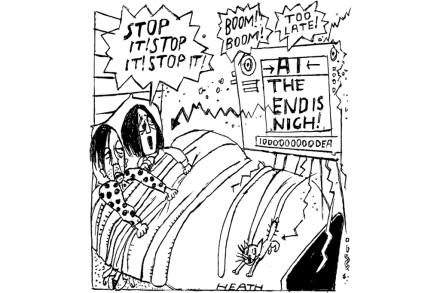
Ever since I can remember, I have always been aware of something called the “Doomsday Clock,” a symbolized calculation produced by a panel of prominent scientists of just how close humanity is to destroying itself. Published on the cover of every issue of the Bulletin of the Atomic Scientists, a journal founded in 1945 by Manhattan Project physicists, the clock’s hands would move toward or away from the dreaded midnight hour depending on how near Armageddon was believed to be. As a kid, the Doomsday Clock seemed an appropriate warning of how the conflict between the US and the Soviet Union might accidentally spin out of control.

How the population scare predicted today’s climate hysteria

Stanford professor Paul Ehrlich's recent appearance on CBS’s 60 Minutes reminds us what can happen when those with impressive academic credentials begin making end-of-the-world predictions. It was 1968 when Ehrlich published The Population Bomb, a book that declared with absolute certainty that “the battle to feed all of humanity is over.” Because so many people were living so close together and consuming so much of the world’s limited resources, the inevitable future was one of “mass starvation” on “a dying planet.” A year after the book’s publication, Ehrlich went on to say that this “utter breakdown” in Earth’s capacity to support its bulging population was just fifteen years away.

Fusion energy and the coming fight for the Moon

From our UK edition

It’s been hard to miss the excitement since the US Energy Department announced that its Lawrence Livermore National Laboratory had produced a fusion reaction, which, for the first time, unleashed more power than it took to create. Using an array of 192 lasers to superheat and compress hydrogen atoms to more than 100,000,000°C, scientists managed to release 3.15 megajoules of energy for every 2.05 megajoules their experiment required. Sounds impressive. But what exactly do these developments mean, and, more importantly, what do they foretell? Many things, certainly, including a fight for the Moon. For more than half a century, physicists have known that there are two ways to harness the power of the atom: fission and fusion.

How hating Big Oil undermines the environment

Today’s progressives like to imagine they're clever when it comes to engineering a carbon-free future. Yet when we look at the record, we see green policies yielding self-defeating public backlashes. The effort by California’s legislature to ban all gas-powered vehicles by 2035, for example, has wreaked havoc on the state’s economy. It's produced not only the nation’s highest energy prices and last summer’s rolling blackouts but the need to import expensive electricity from neighboring states. And while European governments would like to blame Vladimir Putin’s war on Ukraine for their countries’ high energy costs, angry voters know that prices began spiking years ago, when green activists forced the shutdown of coal plants across the continent.

Just how ‘over’ is the pandemic?

For all the confusion caused by President Biden’s recent declaration that “the pandemic is over,” and the familiar sight of administration officials rushing to qualify his comment, it raises a question: where does the Covid emergency actually stand? Having gone from draconian lockdowns to a summer of travel chaos in just over two years — with lots of political squabbling in between — it has been easy to lose track of both the remaining dangers and the precautions many health experts believe are needed going forward. Strictly speaking, Covid is still very much with us. The average number of daily cases in the US has floated between 50,000 and 60,000 since April of this year and the death toll remains fairly constant at 400 per day.

omicron

The culture war inside the space program

For many, the upcoming launch of NASA’s Artemis 1 (after a botched attempt earlier this week) undoubtedly seems the start of a new and exciting era in space exploration. Not only is the US finally planning to return to the Moon — this time to build a permanent outpost on the lunar surface — but in just a few months Elon Musk’s SpaceX will be sending its gigantic Starship, theoretically capable of carrying 100 astronauts, into Earth orbit. “Space is sexy again,” as astrophysicist Paul M. Sutter recently put it. “After the excitement of the initial Apollo missions dwindled into a subject only discussed by ultra-nerds, and the cool factor of the Space Shuttle gave way to the realization that it didn’t really do much, people generally lost interest in space.