Book Reviews

Our reviews of the latest in literature

The agonies of adolescence: The Party, by Tessa Hadley, reviewed

My husband and I like to play Tessa Hadley bingo whenever she has a new book out. You get a point if one of the characters is dressed in a bad outfit, which the author seems rather to admire – a purple jacket with orange tassels; a long felt skirt; a beret, maybe at an angle. You get another point if a beautiful boy-man steals the heart of the story’s older heroine; bonus points if he is unaware of his beauty, a little callous, elegant or golden-skinned. In a recent interview with the New York Times, Sally Rooney said she thought originality was overrated: that she didn’t much mind the
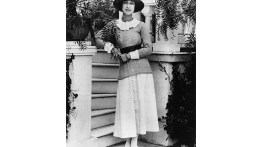
‘Life was good, very good, almost too good’ – Wallis Simpson’s year in China

Few women have had more written about them, mostly of a critical, salacious nature, than Wallis Simpson, the American divorcee for whom Edward VIII gave up his crown. Much of the gossip has fed on what became known as the ‘China Dossier’, a supposed compendium of the year Simpson (or Spencer, as she then was) spent in China in the mid-1920s while she was trying to get a divorce from her heavy-drinking, abusive, naval first husband. As Paul French sets out to prove, the story of what she herself called her ‘lotus years’ is more prosaic, but no less fascinating. The ‘China Dossier’ was said to include details of opium

Kate Bush – always quite hippy, dippy, ‘out there’

In 2019, Kate Bush felt the need to issue a statement on her website clarifying that she was not a Tory supporter. Nearly three years earlier, in an interview with a Canadian magazine, the singer-songwriter had appeared to express her admiration for Theresa May, stating: ‘I actually really like her and think she’s wonderful… It’s the best thing that’s happened to us in a long time.’ This rare foray into British politics from a performer whose reticence about her private life has bordered on the Trappist went down about as well as David (‘Scotland Stay with Us’) Bowie’s contribution to the Scottish Independence Referendum debate. Taylor Swift may have Eras,

‘If you steal this book I’ll beat your brains out’

‘I would lend you my copy, but the fucker who previously borrowed it still hasn’t given it back.’ Those precise words were uttered to me by an eminent churchman, more in anger than in sorrow, while chatting at high table about a book he believed I might find useful. Its title has long since slipped my mind, but I remember thinking at the time: who lends a book to a friend and seriously expects to get it back? Few things can be so often borrowed and so seldom returned. I must confess to having felt a shudder of illicit magic when intoning the words ‘Anathema marathana’ This new and delightfully

Playing Monopoly is not such a trivial pursuit

Which came first to the designers of chess: the rules or the metaphor? It feels impossible to prise the system from the story: a military battle between two monarchs, each with perfectly symmetrical assets and equally balanced capabilities. Yet there have been dozens of ‘reskins’ of chess, swapping the kings and their minions for characters from, say, Lord of the Rings, or The Simpsons, or even, bewilderingly, M&M chocolates. Play is the primary way in which every human first tests and explores the world  Sometimes the new metaphor imbues the game with a socio-political frisson. A recent example pitches rockers – white men in leathers holding screaming guitars – against

The spy who came back from retirement: Karla’s Choice, by Nick Harkaway, reviewed

Publishing is a business. Authors are its brands and books its products. When, as sometimes happens, one of the bigger brands inconveniently dies or retires, there’s an understandable desire to keep the brand going and to attach its lucrative name to new products. And why not? If it’s done well, everyone benefits – publishers, readers and authors’ estates. In the past 60 years, there have been few bigger brands than the late John le Carré, so it’s no surprise to find a posthumous outing with the words ‘A John le Carré novel’ plastered over the cover. Its author, Le Carré’s youngest son Nick Harkaway, is a well-established novelist in his

Saint Joan and saucy Eve: a single woman split in two

Fresh out of Hollywood High, Eve Babitz introduced herself to Joseph Heller: ‘Dear Joseph Heller, I am a stacked 18-year-old blonde on Sunset Boulevard. I am also a writer.’ It was 1960, and while her writing was the sheerest bliss, ‘Eve Bah-Bitz with the Great Big Tits’, as she was known, was herself a work of art. Beauty, she learned at school, was power and ‘the usual bastions of power are powerless when confronted by beauty’. So it was her stack (36 DD) that opened doors for her until, in 1972, her friend Joan Didion told Rolling Stone magazine to publish Eve’s first story, ‘The Sheik’. That same year, Didion

Were the Arctic convoy sacrifices worth it?

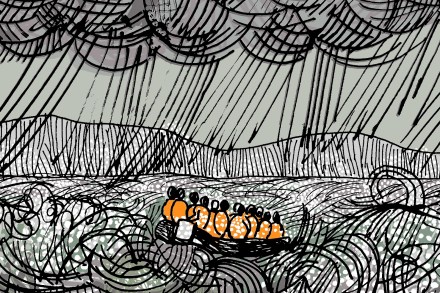
You need only mild interest in the second world war to be aware of the Arctic convoys of 1941-45, escorted by the Royal Navy through savage weather and unimaginable cold to deliver supplies to Russia. Their purpose was to keep Russia in the war; the conditions were such that storms could last nine days, blowing ships hundreds of miles apart and playing havoc with communications. That’s not to mention enemy action by submarine, air attack and large surface raiders such as the Tirpitz and Scharnhorst. Some 4.5 million tons of aid were delivered at the expense of 119 ships and 2,763 lives lost.  Was it worth it? Opinion at the

Doppelgangers galore: The Novices of Lerna, by Angel Bonomini, reviewed

Resurrection has become its own literary genre. Though hardly a new phenomenon (Moby-Dick, for example, was out of print at the time of Herman Melville’s death), the success of such ‘forgotten’ classics as Suite Française, Stoner and Alone in Berlin proved that an author’s death and/or obscurity were no barrier for readers. So publishers from Faber to Virago, from the British Library to Penguin Modern Classics are hunting through back catalogues looking for writer recommendations, searching for the next unjustly lost voice. In Angel Bonomini, Peninsula Press has found an ideal candidate. How can such a powerful story have remained un-rediscovered for so long? A contemporary of Borges, Bioy Casares

Turkish delights: the best of the year’s cookbooks

‘Recipes are like magic potions. They promise transformations,’ says Bee Wilson in her introduction to Sylvia Plath’s Tomato Soup Cake (Faber, £12.99), a collection of classic authors’ recipes. You have to pray that tinned tomato soup will indeed be transformed into something nice-tasting, or that Noel Streatfeild’s filets de boeuf aux bananas will not be as revolting as it sounds. Not much hope of that, I’m afraid – but this is more of a book to enjoy reading without tasting. Some of the writers confess to failing miserably in the food department. ‘I am a very bad cooker, as the children put it,’ warns Beryl Bainbridge, as she launches into

Freedom fighters of the ‘forgotten continent’

On 18 May 1781, Tupac Amaru II’s rebellion came to an abrupt and grisly end. Seized by Spanish forces, the Peruvian muleteer-turned-popular-revolutionary knew the game was up. Still, he refused to go quietly. After Tupac’s captors’ horses failed to wrench off his limbs, the executioner reached for his axe. ‘You kill only me,’ legend has Tupac shouting as the blade descended. ‘But tomorrow I will return as millions.’ As Laurence Blair’s Patria assiduously demonstrates, death rarely has the last word in the ‘forgotten continent’ of South America. In the case of Tupac, his narrative of a ‘Peru for Peruvians’, free from colonial oppression, would later be resurrected in radical leftist

Books of the Year II

Peter Parker The New Zealand novelist Catherine Chidgey ought to be much more celebrated in this country than she is. Do not be put off by the fact that The Axeman’s Carnival (Europa, £14.99) is narrated by a magpie; whimsy is entirely absent from this highly original, thrillingly dark and often very funny novel. The bird is adopted by the wife of a cash-strapped farmer and learns to speak, becoming an internet sensation and so providing useful income. At the same time, its guileless chatter includes picked-up phrases that inadvertently expose what is really going on in the household where it has made its home. Treat of the year was

Christopher Caldwell, Gus Carter, Ruaridh Nicoll, Tanya Gold, and Books of the Year I

34 min listen

On this week’s Spectator Out Loud: Christopher Caldwell asks what a Trump victory could mean for Ukraine (1:07); Gus Carter argues that leaving the ECHR won’t fix Britain’s immigration system (8:29); Ruaridh Nicoll reads his letter from Havana (18:04); Tanya Gold provides her notes on toffee apples (23:51); and a selection of our books of the year from Jonathan Sumption, Hadley Freeman, Mark Mason, Christopher Howse, Sam Leith and Frances Wilson (27:08).  Produced and presented by Patrick Gibbons.

From public bar to cocktail bar: books for the discerning drinker

One of the joys of getting older is the appreciation of the solitary pint. But what to do as you sip your hard-earned beer? Usually after a suitable period of contemplation I’ll start fiddling with my phone. Not Adrian Tierney-Jones; he writes books, and his latest, A Pub for All Seasons (Headline, £20), is a poetic meditation on the public house, its history and place in our culture with some memoir deftly thrown in. Most of all it’s an appreciation of what makes a pub great: the layers accumulated by decades – centuries, sometimes – of human interaction. ‘The perfect pub,’ he writes, ‘is a kind of metaphysical palimpsest which

The Book Club: John Suchet

42 min listen

My guest in this week’s Book Club podcast is John Suchet whose new book In Search of Beethoven: A Personal Journey describes his lifelong passion for the composer. He tells me how the ‘Eroica’ was his soundtrack to the Lebanese Civil War, about the mysteries of Beethoven’s love-life and deafness, why he had reluctantly to accept that Beethoven was ‘ugly and half-mad’; and how even in the course of writing the book, new scholarship upended his assumptions about events in the composer’s life (from his meeting with Mozart to the circumstances of his death).

Books of the Year I

Jonathan Sumption Barbara Emerson’s The First Cold War: Anglo-Russian Relations in the 19th Century (Hurst, £35) is an outstanding account of Britain’s relations with Russia at a time when ambassadors mattered and Britain was the only world power. No one has explained the Great Game in Central Asia or the intricacies of European dynastic politics so well. Anne Somerset’s Queen Victoria and Her Prime Ministers (Collins, £30) overlaps with it, since one of the abiding themes of the queen’s relations with the eight men who occupied No. 10 in her long reign was her enthusiasm for going to war with Russia. Victoria was opinionated and outspoken, but easy to manipulate

Waifs and strays: Gliff, by Ali Smith, reviewed

‘Gliff’ is a word which can mean ‘a short moment’, ‘a wallop’, and ‘a post-ejaculatory sex act’; to ‘dispel snow’, ‘to frighten’, and to ‘escape something quickly’. It’s ‘really excitingly polysemous’, says one of Ali Smith’s characters. It’s certainly an apt title for a book which can’t seem to define itself. At its centre are two children, Briar and Rose, who have been abandoned. Their mother is absent, caring for a sick sister, and their other responsible adult leaves to find her. The children exist in a stock dystopian world (people are surveilled by CCTV cameras and zombified by screens) with a twist: they repeatedly wake up to find that

The mystery of Area X: Absolution, by Jeff VanderMeer, reviewed

I have to confess that I am not a fan of horror fiction. I have a stack of unread H.P. Lovecrafts sent to me by enthusiasts. M.R. James scares me silly. Even Elizabeth Bowen’s ghost stories remain neglected among her other much-loved books. I have, however, been impressed over the years by writers usually identified as belonging to the movement described in the late 1990s by M. John Harrison as the New Weird, which marries chiefly supernatural themes to realism or naturalism. As a stylist, Harrison remains the greatest of these writers. They included Angela Carter, China Miéville and Jeffrey Ford. The movement is naturally associated with the science fiction New Wave,