Arts Reviews

The good, bad and ugly in arts and exhbitions

Fun with Vermeer

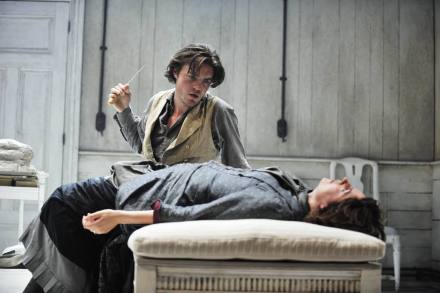
Girl with a Pearl Earring Theatre Royal Haymarket Waste Almeida Creditors Donmar I don’t know much about art but I know what I dislike. Art history. It forces one to view paintings and sculpture through the medium of literature. Every word spoken in appreciation of art is a step away from true art appreciation, which is inevitably unconscious, illiterate, oblivious to itself. The more you know, the less you feel. Those who enjoy art understand these limitations and long for fresh ways to approach their pursuit. Soap opera provides a surprisingly satisfying point of entry and here’s the latest daub-drama, Girl with a Pearl Earring, a fictional narrative about Vermeer’s

On the road | 11 October 2008

For some reason October this year is yielding the kind of running about the place more normally associated with the summer festivals. From Naples to St Asaph, from Paris to Evora to St Omer and back to Evora in as many days with the added excitement of a broken-down Eurostar and various throat- and ankle-related incapacitations, no one in my troupe is talking about ‘the glamour’ of the touring life just now. Yet despite, or perhaps because of, the stress of constant travelling, I am still capable of out-of-mind, serendipitous moments of delight when under pressure from schedules. Walking towards our hotel in Prestatyn, near St Asaph in Wales —

In the doldrums

There’s something agreeably aimless, even melancholy, about late Saturday afternoons, after you’ve finished whatever you were doing in the day and before it’s time to go out. I found myself in a hotel room in Yorkshire last week at the crepuscular hour of 5.30, too lazy to do any work, too enervated to shower and change. So I flipped on the television, and caught a programme called Hole in the Wall. It is an extraordinary confection. Two teams, each of three celebrities (of course), stand wearing wetsuits and crash helmets in front of a pool. At a signal a plastic wall, roughly eight-feet high, moves towards them. There is a

Moving vista

Joan Eardley The Fleming Collection, 13 Berkeley Street, London W1, until 20 December The interplay between realism and abstraction that occurred in the 1950s and 1960s in British art gave rise to a number of fascinating paintings as artists struggled to resolve the balance to their own satisfaction. The co-existence of these extremes in the art world had the effect of polarising opinion, yet some of the best solutions were supplied by those who could harness both drives and make them work in a single painting. Joan Eardley (1921–63) was one who mastered enough of both idioms to make an original statement, and who thus took the evocation of landscape

Finding Pooter’s house

These days, Charles Pooter, the City clerk and narrator of George and Weedon Grossmith’s The Diary of a Nobody (1892) — the enduring comedy of hum-drum middle-class, late-19th-century life — could never afford to rent (or buy) his six-bedroom house, The Laurels, in Brickfield Terrace, Holloway. The Pooters of this world fled north London a long time ago, driven to the commuter belt by soaring property prices. However big the collapse of the housing market, the Pooters could not possibly buy their way back to those comfortable years of meat teas, live-in maids, and champagne from Jackson Frères at three and six a bottle. In the City these days, even

Credit where it’s due

This is a time for making the most of small mercies. One of the greatest of these, as the financial system collapses around us, is the splendid joke that is Robert Peston of the BBC. His extraordinarily camp, over-emphatic delivery would be perfect for reporting glitzy Broadway first nights but seems hilariously at odds with worldwide economic catastrophe. Peston has all the glee of the callow cub reporter rejoicing in the size of his scoop while lacking the imagination to understand the anxiety his excitable tales of doom-and-gloom might be causing others. Like poor Mr and Mrs Spencer of Claygate, Surrey, for instance, who somehow managed to commit themselves to

Fickle fortune

‘I couldn’t understand most of it. I mean I could understand each word but not when they were put together,’ says one of the characters in Tulips in Winter on Radio Three on Sunday night. I knew immediately what he meant. There was something wonderful going on in Michelene Wandor’s play word for word, but I’m not quite sure I caught it all in just one sitting. Wandor, a prizewinning playwright with a passion for radio, has been inspired by Rembrandt’s paintings and Spinoza’s works of philosophy to create a drama about the Jews of Amsterdam in the 1650s who were caught up in the trading battles between the Dutch,

A power to enthral

Henrietta Bredin on how book illustrations can bring the narrative to life The illustrations in children’s books play a crucial role in expanding the imaginative horizons of the reader and fixing the story in the memory. The very best book illustration is so inextricably linked to the text that it is hard to think of one without the other. Christianna Brand’s Nurse Matilda stories, quite apart from being published in alluringly small, pocketable volumes, are defined by Edward Ardizzone’s dashingly vivid drawings, as are the Chronicles of Narnia by Pauline Baynes’s delicate and precise depictions of Mr Tumnus the faun, the valiant Prince Caspian and Jadis, the vicious, Turkish-Delight-bearing White

IPod dilemma

A musician friend of mine acquired his first iPod recently, and like small boys who don’t realise that everyone else went through this about five years ago, he and I frequently discuss our battles with the things. A musician friend of mine acquired his first iPod recently, and like small boys who don’t realise that everyone else went through this about five years ago, he and I frequently discuss our battles with the things. To be fair, though, there is some substance to these conversations, as we are both fascinated by the way people listen to music — I as a fan and part-time critic, and he as creator, teacher

Playing games

Six Characters in Search of an Author Gielgud Riflemind Trafalgar Studios Pirandello, the master of pretentious bombast, is perhaps the most talent-free of all Nobel laureates. Here he is in the West End with one of his better-known experiments updated by Rupert Goold and his collaborator Ben Power. Playing games with the conventions of theatre was Pirandello’s main gift to the trade and his supporters will tell you this play ‘analyses the relationship between fiction and reality’. But there’s nothing as rigorous or coherent as an analysis here. We start in the editing suite of a young female documentary-maker whose latest project has stalled. Enter a family of over-dressed show-offs

Sound sensations

Why do some sounds endure to jolt the memory and take us back to a specific moment in time, like Proust’s taste sensations, while others fade away? The chunter-chunter-chunt of a steam train, for instance, is instantly recognisable even for those too young ever to have been on a ‘real’ steam journey. When they hear it they’re not being taken back to that excitement about travel before motorways and jet planes, before we became so restless for change and the sensation of moving on that we demanded much faster but far less interesting modes of transport. No, for those born post-1960, steam means something else, but what’s so odd is

Meditation on meaning

Rothko Tate Modern, until 1 February 2009 The first thing that should be noted is that this exhibition is not the retrospective that its title implies. In fact, it’s a severely limited show, concentrating on the late work only. There are therefore none of the joyful, brightly coloured paintings that sell so well around the world in reproduction. This exhibition is an altogether more sombre experience, the work darker and more minimal. I wonder how many people will buy their tickets (£12.50 per head, concessions £10.50) expecting a feast of colour and be disappointed. I hope they won’t — this is a fascinating exhibition — but it is not a

Losing is the new winning

How to Lose Friends and Alienate People 15, Nationwide How to Lose Friends and Alienate People is based on Toby Young’s best-selling memoir of the same name and, already, I know what you are thinking. You are thinking: what, a film based on Toby’s book? Well, he kept that very quiet, the sly old devil. Who’d have thought it? I even suspect that although, in the end, Toby did attend the recent glitzy, red carpet première in London — you saw him lined up with all the other celebrities in the following day’s papers, surely — he probably wasn’t that keen, probably protested with something along the lines of: ‘It’s

Campaigning genius

Jamie’s Ministry of Food (Channel 4, Tuesday); Ian Hislop Goes off the Rails (BBC4, Thursday) ‘People have a problem with me,’ claims Jamie Oliver, but I’m not one of them. I’ve had my doubts in the past — overuse of phrases like ‘luvly jubbly’, the Sainsbury’s ads, the general extreme jealousy of his stupendous wealth, ruining my daughter Poppy’s name by calling one of his daughters Poppy and starting a massive trend — but I love his new campaigning series Jamie’s Ministry of Food (Channel 4, Tuesday), just as I loved his last campaigning series Jamie’s School Dinners and his ‘Look, I can still cook you know and, by the

The turf | 1 October 2008

An old friend in journalism, well aware that he was prone to conspiracy theories, especially where his own career was concerned, used to say to me, ‘Just because I’m paranoid doesn’t mean the bastards aren’t out to get me.’ So were the authorities out to get Aidan O’Brien when they convicted him and jockey Colm O’Donoghue of team tactics in the recent Juddmonte International, won by Duke of Marmalade? I ask because some of the best-respected voices in racing have suggested that the motivation for the action against O’Brien was jealousy, because English trainers are having a comparatively poor season while O’Brien and his Ballydoyle team have already secured a

Ayckbourn’s unflinching gaze

Veronica Lee profiles the playwright as the Old Vic revives his best-known work Alan Ayckbourn, so theatre lore has it, is the second-most performed British playwright after Shakespeare. So why has he become so unfashionable among theatre cognoscenti? Partly, it’s his own doing. In 2002, disillusioned by the musical-laden, drama-free territory it had become and despite his many successes there throughout his career, he announced a West End hiatus on his work (only recently ended for a revival of Absurd Person Singular with Jane Horrocks). Plus, he insists on premiering all his new work in his beloved home town of Scarborough. And two of his tropes — complicated plotlines and

Michael Henderson suggests

Theatre   It promises to be a wonderful autumn for London’s theatre-goers. Ivanov, Tom Stoppard’s adaptation of Chekhov’s early play, has opened the ‘Donmar at Wyndham’s’ season, to superb reviews. Joining it in a quest to bring the increasingly dowdy West End into repute is No Man’s Land, Harold Pinter’s 1975 masterpiece, revived at the Duke of York’s with Michael Gambon and David Bradley assuming the roles of Hirst and Spooner initially taken by the great knights, Ralph Richardson and John Gielgud (and, 17 years later, at the Almeida, by Pinter himself opposite Paul Eddington).   The Norman Conquests, the three-parter with which Alan Ayckbourn conquered the West End three