Arts Reviews

The good, bad and ugly in arts and exhbitions

Beguiled by Weill

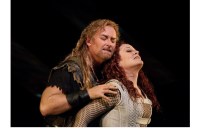
  Street Scene may well be Kurt Weill’s most successful work from his American period, but seeing it in as good a production as the Opera Group’s at the Young Vic was cause for both enjoyment and reservations. In the next couple of weeks it will be touring to Basingstoke, Edinburgh, Newcastle and Hull, so plenty of people will have and should take the chance of seeing it. I’d go again if I were nearer one of those places, for Weill is always at least interesting, though not always quite in the way that he wanted to be — he intended, like Brecht, that we should be filled with indignation

House rules | 8 October 2011

Britain needs more houses, and the government’s highly unpopular draft National Planning Policy Framework (NPPF) at least asks how to get them — the right question even if it gives the wrong answer. Anyone who deals with the planning system knows how overblown it has become, and that the cost and effort can exhaust a developer, to the extent that the good intentions of a scheme drain away at the crucial moment of building. The existing planning system may be imperfect but, if it is to be simplified, it needs to be better at eliminating bad designs, not the reverse. Prodigious amounts of brain power and energy have been devoted

Smart operator

Back in the Fifties, it was possible for a single TV sitcom to capture 92 per cent of the small-screen audience; 92 per cent? It sounds astonishing to us now. The idea of so many people watching the very same comic gags at the very same time. Those fabled water-cooler, coffee-machine chats about what was ‘on’ last night no longer happen. Offices have lost their communal buzz, and are often as dead quiet now as a funeral parlour. No more telephone calls, as everyone is texting. No need to talk to anyone, you just email. Nothing to talk about, because we’re all listening, watching, playing something different. No wonder we

Nice Mr Fry

Whenever I find myself dreaming about how awful things would be under a red/green dictatorship — increasingly often, these days — the one person who gives me a glimmer of hope that I might get out of the hell alive is Stephen Fry. He’s a leftie, of course — but, like Frank Field and Kate Hoey, he’s the right kind of leftie. Even when appointed Minister for Culture in the new regime, as he inevitably would be, you just know that he wouldn’t indulge in either the gloating triumphalism or bullying sadism of his fellow Nomenklatura. It would be more a case of: ‘Yes, my dear, dear chap. How perfectly

Unfit for purpose

In recent months, two new museums have opened to much acclaim: The Hepworth in Wakefield and Turner Contemporary in Margate. Now Colchester is receiving the dubious benison of a new building. What is this assertive new generation of museums in England supposed to be about? Leisure, business or art? There’s precious little of the last in the much delayed Firstsite gallery in Colchester, a long pavilion by Rafael Viñoly Architects clad in gold-coloured metal which looks wonderfully out of place in the Roman city of Camulodunum (the name also chosen for its inaugural exhibition). Don’t get me wrong: I live in East Anglia and would welcome a great new museum

Down to earth

Lloyd Evans talks to the warm, vibrant, vegetable-growing actor, teacher and director Caroline Quentin Terminal fear. Rising nausea. And possibly vomiting. That’s what Caroline Quentin expects to go through on the opening night of her new play, Terrible Advice, at the Menier Chocolate Factory. ‘I’m really pretending it’s not happening at the moment,’ she tells me when we meet in the theatre bar. With two weeks to go before the first performance, she confesses, ‘I get dry-mouth at the very bloody thought of it. Mind you, I’m always like this halfway through rehearsals, I think, agh! I can’t bear it, perhaps I can run away. Or feign injury. Or I

Chance encounter

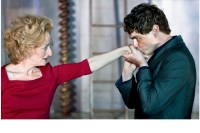
Is it possible to write a great opera, or a great work of art of any kind, about Auschwitz? One thing is clear: it would have to be truly great. The very idea of a fairly good work, or for that matter a fairly bad one, with such a subject is absurd. And not only absurd, but also revolting. Take Bernhard Schlink’s novel The Reader, which was published to much acclaim 14 years ago, but which was soon seen to be a meretricious concoction by discerning readers, just on account of its attempting to illuminate the Holocaust by relating it to subsequent events and ‘relationships’. The most moving and powerful

Unrequited love

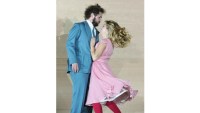
It’s a record breaker. The Trafalgar Studio is staging a rare revival of Christopher Hampton’s breakthrough play, written when he was 18, which made him in 1966 the youngest writer ever to have his work staged in the West End. This record has now stood for so long that it could probably do with a lie-down. The plot, meticulously fashionable and youth-orientated, focuses on an unrequited affair between Ian and his flatmate Jimmy. Hampton’s conception of personality is underdeveloped. And overdeveloped, too. Most of his characters are handsome, vague, middle-class numbskulls, posh little tadpoles wriggling around a cosy pond. But the central character, Ian, is a brilliant study of brooding,

Great expectations | 1 October 2011

Talent, said Laurence Olivier, was plentiful; skill much rarer. Genius in a performing artist is rarer still, but Olivier had it, and so does Christian Gerhaher, the Bavarian baritone, who presented Schubert’s three song-cycles last week in a series of concerts that brought splendour to Wigmore Hall. This was singing of exceptional quality and, just as important, exceptional intelligence. Expectations were high, yet Gerhaher met them in full.  By the time he concluded Schwanengesang, with its terrifying vision of Der Doppelgänger, he had taken the audience on an emotional journey they will hold dear when winter nights draw in, and for many winters to come. Daniel Harding, the English conductor,

Mind the gap | 1 October 2011

Ho-hum. Another week, another batch of secret agents, and while I have nothing against secret agents personally — they are generally willing to die for their country, which is nice, although probably quite tiring — The Debt never equals the sum of its parts. It has a blinding cast (Helen Mirren, Tom Wilkinson, Ciarán Hinds) and there are some good things to be said for it but it never fully compels or meshes as the emotionally driven, multilayered, grown-up thriller it yearns to be. Plus, it is certainly in the running for my annual, much uncoveted Most Preposterous Third Act Award. The do, if you are interested, is always held

Eastern promise | 1 October 2011

Sad to say that none of the ex-pats who were interviewed in India for Home from Home (Radio 4, Friday) talked about missing the BBC. Their removal to the subcontinent from the UK might have left them with a longing for a pint of Guinness, but not a word about Jazzer and the Grundys, Nicky Campbell or even John Humphrys. It was as if British radio had never touched their lives, in spite of growing up here. Hardeep Singh Kohli, the turban-wearing broadcaster with a broad Glasgow accent whose taste for highly spiced food derives from his family ancestry in the Punjab, went in search of British Indians who have

Tale of the unexpected | 1 October 2011

I imagine there is software that helps you write biopics for television. First you pick the childhood from a drop-down menu, selecting [poor but respectable] [very poor] [so poor that all your belongings will fit into a single wheelbarrow which your mother pushes from a grim slum to the nearby hell-hole]. Father deserts family [yes] [no]. Star is determined to make it big but [is sent from one agent to another with mocking laughter in their ears] [meets an impresario who is sceptical at first then turns incredulously to accompanist and says, ‘My God, she’s got something!’]. Then there are the other staples which must be included by law. The

A quick journey into nightmare

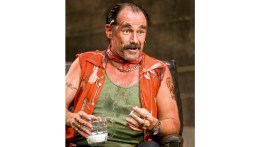
As our television screens luxuriate again with images of Downton Abbey, one of its cast members is starring in an altogether grittier production in the heart of West London. Last time we saw Kevin Doyle, he was pleading a lung condition to escape being sent to the Battle of the Somme. Here he starts off as another lugubrious chauffer, awakening in an even more chaotic world than that of the Somme, before morphing into the charismatic, careworn but chatty interrogator in the torture cells of a faceless, totalitarian state. The occasion is the first professional revival in London of Harold Pinter’s double-bill, Victoria Station and One for the Road since

Medieval frescoes

Rome contains many hidden treasures, but the most remarkable of the lot is concealed on the Caelian Hill, above the Colosseum, in the medieval monastery of Santi Quattro Coronati. It’s a cycle of frescoes dating from around 1250. It is extremely rare for painting from this period to survive anywhere, but it’s even rarer in Rome, where the rebuilding of the city by the Counter-Reformation popes destroyed almost all medieval painting. The paintings are in a vast vaulted gothic hall, the walls of which — about 800 square metres of them — were originally completely covered in frescoes. About half the original paintings remain: an earthquake, and the construction of

‘An obsolete romantic’

In 1982 Sven Berlin placed a sealed wallet labelled ‘Testament’ on top of a rafter in his studio with instructions for it not to be opened before his 100th birthday on 14 September 2011. Inside was a key to the identities of the characters in his notorious roman à clef about post-war St Ives, The Dark Monarch, published 20 years earlier and immediately withdrawn after four of those characters sued for libel. None of them was a major artistic figure and by today’s standards the libels were laughable, but Berlin’s exposure of the petty politics behind the St Ives idyll — which he later compared to ‘going for a bathe

The Wiki Man: Bring back the madcaps

I recently watched another one of those delightfully obscure BBC4 archive documentaries. This one was called Bristol on Film. I like archival film footage for what it reveals unintentionally: the incidental details which have nothing to do with the film-maker’s original intent, but which 60 years later reveal how profoundly the world has changed. Like the sign once glimpsed in 1950s Ramsgate: ‘Lift to the seafront 2d — perambulators and wheelchairs 4d’. There was one such moment in the Bristol programme. It was footage of the Queen inspecting the first Concorde prototype at Filton. What astonished me was that it was filmed in black and white. It’s now hard to

Classic comeback

A new programme to revive Latin and Greek in our schools Some 15 years ago, at the behest of the then editor Charles Moore, I wrote a jovial 20-week QED: Learn Latin column for the Daily Telegraph. It attracted a huge following, and I still have four large box-files full of letters from users. The majority of them expressed one of three sentiments: ‘I learned Latin at school x years ago, loved it and am delighted to renew my acquaintance’; ‘I learned Latin at school, hated it, but now realise what I have missed’; and ‘I never learned Latin at school and have always regretted it’. These responses have stayed