Arts Reviews

The good, bad and ugly in arts and exhbitions

Outside edge

Unimpressed by the relentless barrage of blockbusters, Andrew Lambirth singles out some small-scale gems Although it can’t be easy to run a major museum in this country, and balance the books as well as fulfil a remit to provide the best possible conspectus of past and contemporary art for the general public, our museums are becoming increasingly narrow in what they offer. The range of art on show in London, for instance, has shrunk alarmingly, as the Whitechapel, the Serpentine and the Tate pursue very similar programmes, vying to be the first to put on the same internationally fashionable artists. Big names are required to draw the crowds, but these

Tough at the top

The first thing you should know is that I love, adore and worship Sacha Baron Cohen and have this fantasy whereby we get married and set up home in Notting Hill as a power couple and when the phone rings and it’s Richard Branson I will say, ‘I’m so sorry, Dick, but we can’t come to Necker Island next week as we’ve promised to go away with Charles and Nigella. We know, boring, but we can’t cancel them again.’ Baron Cohen is, I believe, the greatest comic film-maker working today, and although The Dictator is not up there with Borat, or even his Ali G television persona, as it’s so

Lives of others | 19 May 2012

He was accused of listening too much to the ‘wrong people’, of being ‘too deferential’, not judgmental enough. Sometimes those he interviewed afterwards said that he was like ‘a ferret’, who pried too deeply into their lives, ‘looking for the facts that he wanted’. But Tony Parker, who died in 1996, gave a voice to those who were not usually heard or cared about. He made their lives sound special, individually important. In books such as Life After Life, The People of Providence, Lighthouse and Red Hill he opened up the lives of murderers, working people on a south-east London estate, lighthouse-keepers and miners, telling their stories in their own

Fond farewell | 19 May 2012

Now and again a sitcom gag lodges in the public mind. In 1974, Ronnie Barker, in Porridge, was reminiscing about Top of the Pops and its all-girl dance troupe, Pan’s People. ‘There’s one special one — Beautiful Babs,’ he says. Beat. ‘Dunno what her name is.’ Her name was Babs Lord. She attracted the attention of a young actor called Robert Powell, then in a long-forgotten thriller called Doomwatch, so he met up with her in the celebrated and notorious BBC Club at Television Centre; after 36 years they are still married. She also became an explorer, described as the only housewife to have visited both the North and South

Marketing man

People go to exhibitions for different reasons, and although I was highly critical of David Hockney’s recent show at the Royal Academy, I accept that a great many people visited it and came out smiling and uplifted. They tended to be individuals who don’t usually go to exhibitions or look at real painting, and it may thus be said that they had very little idea of what they were actually looking at, or indeed should be looking for in an exhibition of painting, but if the experience made them happy, where’s the harm — you may ask — in that? Undoubtedly a great many went because it was the thing

Restoration tragedy

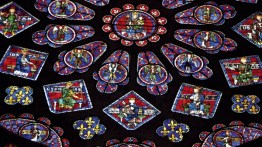
Alasdair Palmer questions the ill-conceived makeover of Chartres cathedral which robs us of the sense of passing time that is part of its fascination and mystery Should old buildings look old? Or should they be restored to a condition where they look as if they could have been put up yesterday? Those questions are raised in a particularly pertinent form by the work going on at one of the most beautiful and inspiring of all old buildings: Chartres cathedral in France. Most of Chartres cathedral dates from between 1194 and 1230, when the bulk of the colossal stone structure, with its nearly 200 stained-glass windows and thousands of sculptures, was

Flaws with a clause

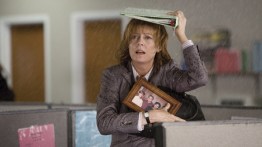
Jeff, Who Lives at Home is a film about Jeff, who lives at home, and that’s enough subordinate clauses for one day. (Don’t be greedy; you know how fattening they are.) It’s a comedy from the Duplass brothers, Mark and Jay, who have previously made small films that have been well received (The Puffy Chair, Cyrus), and this is their first big film although it’s a small big film, coming in at 83 minutes, which, in its small way, is quite big enough. It’s a whimsical comedy and, as far as whimsical comedies go, it is quite whimsical, and sometimes comedic, which is fair enough, but ultimately it is slight

Ugly caper

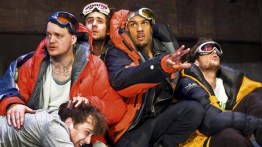
We all know the ‘excellence theory’ of migration. Barriers to entry guarantee that imported cargoes have outstanding qualities. Manfred Karge’s parable of urban despair in the Ruhr comes to the UK with high expectations. It’s been here before. Director Stephen Unwin premièred the play at Edinburgh, 1987. His new revival at the Arcola demonstrates that the ‘false charm theory’ of migration also applies. The foreign and the exotic can mesmerise us more easily than the homegrown. Unwin sets the play in some vague tower-block ghetto. We meet a quartet of jobless alcoholics who become fascinated by Amundsen’s trip to the South Pole. By impersonating Norwegian explorers, the drunken lunks briefly

Opportunity knocks | 12 May 2012

I should have thought about this more carefully — the timing of it, I mean. This is Crucible time, and in the normal scheme of things I would be watching almost nothing but snooker. Yes, dear readers, I am that sad and pathetic thing known as a snooker addict, and a red-button one at that. But I eschew the green baize and march purposefully into the world of television previews — and what a challenging world it is. Not, I suppose, as challenging as the task that faces The Town Taking on China (BBC2, Tuesday), one of those programmes that reassuringly does exactly what it says on the tin. Kirkby-based

Talking head

‘There’s no point in being a liberal if you’re just a furry little herbivore on the edges of British politics,’ declared Paddy Ashdown on Sunday on Private Passions (Radio 3). It was a revealing comment. The programme went out last weekend after the LibDem’s disastrous results in the local elections, but it would have been recorded much earlier. Ashdown was meant to be talking about his favourite music, and why he had chosen it, but he could not resist telling us what he thought of the Con-Lib Coalition. ‘This [being in government] is not going to deliver a dividend for the LibDems until a little before the next [general] election,’

The first lady of song

Folk legend Sandy Denny’s eminently coverable songs, direct of melody and opaque of lyric, have scarcely declined in popularity since the singer’s death in 1978 at the age of 31. A tribute concert at the Queen Elizabeth Hall in 2008 was such a hit that a similar event is being staged at the Barbican this month. Once again, a variety of vocalists will front a house band including members of contemporary folk stars Bellowhead and share the stage with Denny’s former Fairport Convention bandmates Jerry Donahue and Dave Swarbrick. Insecure but blessed with a versatile voice free of phony mid-Atlantic inflections, Denny’s infusion of traditional material transformed Fairport from blokey

Outsider artist

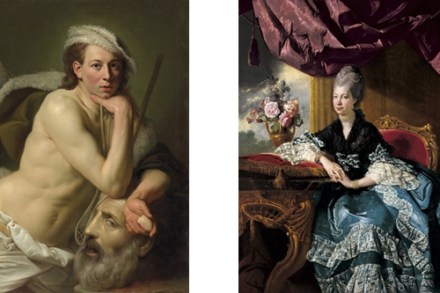
In the various mixed exhibitions I’ve seen over the years that dealt with 18th- and 19th-century British art, Johan Zoffany (1733–1810) has always seemed to stand out. Yet there hasn’t been a museum show devoted to his work in this country since the National Portrait Gallery’s survey of 1977, so Martin Postle must be congratulated on organising the current exhibition (supported by Cox & Kings), already seen at the Yale Center for British Art in Connecticut, especially since plans to hold it at the Tate were scuppered. I wonder why? The show has proved successful: it was very busy the day I went, though I did wonder what proportion of

Water works | 3 May 2012

My colleague Lloyd Evans had much fun a couple of weeks ago playing the curmudgeon with the Cultural Olympiad. Alas poor Bard, he quipped, ‘press-ganged’ into the World Shakespeare Festival. And it sounds as though Lloyd will be running for his life, especially from the Bankside-based Globe to Globe project in which all 37 plays will be given in the same number of languages. It is left to the RSC to fly the flag for Shakespeare in his native tongue with a dozen new productions. Risky, you would have thought, to launch its initial contribution of The Comedy of Errors, Twelfth Night and The Tempest as ‘Shakespeare’s Shipwreck Trilogy’. And

Small talk

What’s going on? Everyone’s doing playlets all of a sudden. I saw five this week. The Donmar is presenting a trio of scripts by Robert Holman entitled Making Noise Quietly. A silly title. ‘A writers’ writer’ — an even sillier cliché — is how the programme notes describe Holman. If they mean ‘a boring writer’ they should say so. His first play shows us two teenage pacifists meeting in the countryside during the closing months of the war. One is openly gay, the other is still hunting for the closet door. They chat. They flirt rather innocently. Then they strip off and sunbathe. That’s all that happens. Plays like this,

Celebrating identity

Last year, when I reviewed The Sum of Parts, the community-oriented piece produced by Connect, Sadler’s Wells Creative Learning department, I thought it wouldn’t be possible to do any better. Well, I was wrong, as this year’s Compass was an even more breathtaking experience. The new project, which involves more than 100 non-professional performers and a unique roster of artists, has been conceived at a time when World Cities 2012, Pina Bausch’s retrospective of works devoted to cities and cultures from around the world, is imminent. Compass, however, focuses only on London, which is a vibrant melting pot of diverse and complementary cultures. It is this idea of celebrating distinct

Elemental force

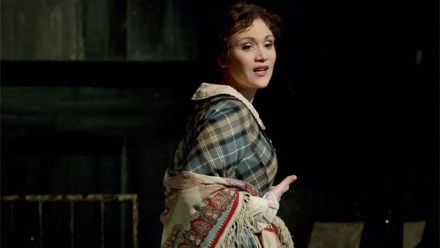
The new production of Wagner’s first indisputable masterpiece The Flying Dutchman by English National Opera is a decided success, the best account of what contemporary producers make strangely heavy weather of that I have seen in decades. For some reason they find it hard to focus on the title role, and make it all a dream of Senta, or the Steersman. Jonathan Kent presents the Dutchman on Wagner’s terms, even though he can’t resist beginning the opera — and during the Overture, absurdly — with Senta as a small child being put to bed by her father Daland, and reading the story of the Dutchman, while projected mighty waves and

Soaps and suds

Listeners beware. Especially those of you who are unashamed Archers addicts. The antics of the denizens of Ambridge might seem like casual, everyday stuff, but they’ve probably been carefully designed to indoctrinate us with the ‘right’ kind of behaviour. That’s if a two-part documentary on the World Service, hosted by none other than Debbie Archer (alias Tamsin Greig), is to be believed. Soap Operas: Art Imitating Life took us back to those first radio serials in America, funded in the 1930s by the big soap manufacturers to market their latest products. Yes, soap operas are so-called because they were originally given the means to go viral by firms like Colgate-Palmolive.