Arts Reviews

The good, bad and ugly in arts and exhbitions

Star quality | 2 June 2012

English Touring Opera ended its spring tour in Cambridge this year with three performances of The Barber of Seville and two of Eugene Onegin, both in English translation, the former done without surtitles, the latter with. Neither of them really needed them, since the Arts Theatre is small and most of the singers enunciated with a clarity one hopes they retain in the careers one hopes some of them go on to have. Barber was moderately successful, Onegin almost wholly so. Comedy is much harder to pull off than tragedy, as everyone knows, but singers don’t necessarily remember and act on that when they come to perform, and too much

Royal watch

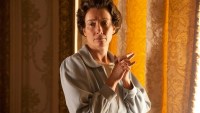
This is the week we almost drowned in Jubilee programmes. Sadly, many of these were unavailable to reviewers, possibly because to criticise such a programme would itself amount to lèse-majesté, or perhaps they just hadn’t finished the edit. But I doubt we’ve missed much. This weekend BBC1 (Friday) was running A Jubilee Tribute to the Queen, presented by Prince Charles. Maybe he’s said that it’s all very well banging on about her sense of duty, but it didn’t do much for family life, and he still can’t get over how, after six months touring the Commonwealth, she famously didn’t kiss her little boy but shook his hand. I doubt it.

Time to reflect

It was my first Jubilee moment — Judi Dench on Radio 4’s Today programme suddenly launching into Shakespeare mid-glam (incredibly glam) party. She was talking to Jim Naughtie at the Queen’s gala for the arts at the Royal Academy and bewailing the decline in the teaching of Shakespeare in schools. Mid-sentence, she breaks into Cleopatra’s lament: ‘I dream’d there was an Emperor Antony/O! such another sleep, that I might see/ But such another man.’ It was so natural, so heartfelt, so extraordinary that she could remember the speech line-for-line and give it to us, just like that, with no preparation, no sense of performance or theatrical delivery. I just had

Frontier dreams

When I was growing up, the Dallas theme tune was like a call to prayer. As the Copland-esque trumpets rang out, we ran to the television set. A hushed silence descended as cattle stampeded beneath the snazzy gold title credits. To watch the glamorous travails of the Ewing family from a sofa somewhere near Coventry in the 1980s was to experience the very promise of the age. Escapism, certainly. But Dallas was also about dreams. Frontier dreams. That there was a place on earth where oil men in Stetsons plotted each other’s downfall while slurping bourbon was too fabulous. That these men were married to women with shoulder pads bigger

Glass act | 26 May 2012

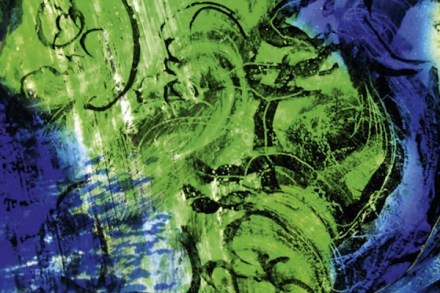
The name of Patrick Reyntiens (born 1925) is indissolubly linked to the recent history of stained glass in this country. Reyntiens bridges the often troublesome gap between craft and art: not only is he a superb and innovative craftsman, but he is also a substantial artist. The second quality is not always recognised. Best known as John Piper’s associate, many assume that Piper was the artist behind their stained- glass collaborations, with Reyntiens as technical expert. Actually, Reyntiens played a more creative role than is generally supposed. Certainly he is a painter and draughtsman of considerable originality, as can be seen in the new DVD, From Coventry to Cochem: The

Fruitful oppositions

There are so many good exhibitions at the moment in the commercial sector that the dedicated gallery-goer can easily spend a day viewing top-quality work without paying a single museum admission fee. The following shows nicely complement some of the current or recent displays in public galleries — such as Mondrian||Nicholson at the Courtauld and the Tate’s Picasso and Modern British Art. Despite the financial squeeze and such new burdens as the bureaucratic nightmare of Artists’ Resale Right, commercial galleries continue to play an extremely important role in the nation’s artistic life, though they are not given much credit for it. Typical of the museum-quality exhibitions now mounted with increasing

Revolting teenagers

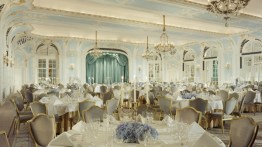
As 200 children descend on the Savoy, Niru Ratnam asks why corporations sponsor works of art In July, 200 teenagers from east London will head to the Savoy where they will take over the Lancaster Ballroom for the day. There they will be given the freedom to create a large-scale event — food and performances included. In the weeks leading up to it, they will have been prepped by Ruth Ewan, the artist behind the project, on the history of the Peasants’ Revolt in 1381. The preparation and the event itself will revolve around the teenagers’ interpretation of that historical moment when Wat Tyler led calls for the redistribution of

Radio 4’s Goldie Jubilee

At last, BBC Radio 4 has reconciled itself to the great importance of the graffiti artist and music performer Goldie. He has been named as one of the station’s ‘New Elizabethans’, alongside the likes of Sir Edmund Hillary, Graham Greene, Margaret Thatcher and the Queen. The qualification for admission to this gilded list is as follows: they must be ‘men and women whose actions during the reign of Elizabeth II have had a significant impact on lives in these islands and given the age its character, for better or worse.’ I think Goldie qualifies for that, don’t you? But then, I was always ahead of my time. Whilst editor of

Learning to love Falstaff

It’s taken me a shockingly long time to realise how great Verdi’s Falstaff is, and I still wouldn’t agree that it is his greatest opera, which fully paid-up Verdians tend to think. It may be a measure of my progress, though, that I got a lot of pleasure out of the new production at Covent Garden, by Robert Carsen, even while recognising that it is a shallow, wilfully unsearching account of a work much of whose magic is extraordinarily subtle, not only for Verdi, but for anyone. Carsen’s production, and the musical side, too, are on a level with the Shakespeare play from which Falstaff derives, which is agreed by

Old-git territory

I’m not the biggest fan of Neil Simon, I admit it. In the programme notes for The Sunshine Boys, I discovered that Time magazine once called him ‘the patron saint of laughter’. Good, I thought. When the curtain goes up I’ve got someone to pray to. The show opens with Danny DeVito slumped in a hotel room watching TV in mid-afternoon. He’s a spent vaudeville star whose feud with his comedy partner forced him into retirement 11 years earlier. His nephew, a pushy young agent, wants to revive the famous duo for one last TV special. DeVito insists that he won’t do it. (But he will, of course.) The corny

Birth pains

As a general rule, what to expect when you are expecting is a baby, which is always kind of miraculous, but the way everyone carries on in this film you’d think nobody had ever had one before. This is odd, particularly as the latest research has proven that having babies predates the iPod, internet and digital photography, and may even predate the Breville sandwich toaster, although this is not yet known for certain. Still, this all-star ensemble mash-up treats pregnancy as if it were the very latest news, and although it’s meant to be a comedy, did I laugh? I might never have stopped but for one small thing, which

Failing Britain

For my holiday reading in Australia I chose Max Hastings’s brilliant but exceedingly depressing Finest Years: Churchill as Warlord 1940–45. Once you’ve read it, it’s impossible to take any pleasure from second world war history ever again. Basically, runs Hastings’s persuasively argued thesis, we were rubbish at pretty much everything. Our generals were useless, our citizen soldiers lacked dash and folded at the first opportunity, our tanks were ill-protected and undergunned. Apart, maybe, from Bletchley, we contributed nothing major whatsoever to the Allied war effort: the Soviets doing all the killing and dying for us and the Yanks providing all the materiel. So, really, it should have come as no

Conflict management

7 Up, the TV series first made in 1964, would never have worked on radio. Ten young boys and (only) four girls were interviewed as they set out on their lives, with the intention of checking up on them every seven years thereafter to see what might have happened to them. They’ve now reached 56 and the series instead of looking forward to what these children might become is looking back over where they have been. The sad, guarded eyes of the young boy in a care home in 1964 made a powerful impact in black and white (colour had not yet arrived on TV), as did the sparky smile

Domestic bliss

At Home with the World, the Geffrye Museum’s latest exhibition (until 9 September), reinterprets objects from its permanent collection, highlighting those from overseas or those that have been influenced by other cultures. Because the museum concentrates on the changing styles and tastes of the urban middle class, rather than of the aristocracy, we can appreciate what became popular as a result of mass manufacturing and trade. The most obvious example is the craze for ‘taking tea’ from the mid-18th century onwards. The porcelain teapots on display throughout the period living-rooms (that range from 1600 to the present day) remind us that much of what we consider English actually originates elsewhere

Continental drift

Why did Florence become a hotspot for Americans in the late 19th and early 20th century? Henry James, Edith Wharton, John Singer Sargent and a gang of other American artists and writers descended on the Arno, often for years at a time. Sargent, born in Florence, the son of a Philadelphia eye surgeon, didn’t get to see America until he was 20. This engaging — if chaotic — exhibition answers the question. The Grand Tour had been around since the 16th century, first for the aristocracy and then for the bourgeoisie of northern Europe; Americans were part of the artistic immigrant crowd from the mid-18th century. But it was only

A most eccentric master

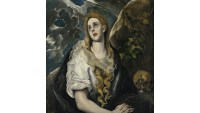
In 1895 the Spanish art collector John Charles Robinson donated a picture to the National Gallery. ‘On the whole I think it is very much above the average of this most eccentric master’s work,’ he phrased his offer less than enticingly. ‘At the same time you know the man was mad as a hatter and his work must be taken with “all faults” of which there are plenty.’ The man was Domenikos Theotokopoulos, aka El Greco, and the picture was ‘Christ Driving the Traders from the Temple’. To an English late 19th-century audience weaned on Murillo this ‘most eccentric master’ — a Cretan-born Byzantine icon painter turned Venetian colourist turned

Inside No. 10

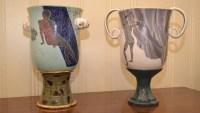
We are standing in the wood-panelled anteroom to the state rooms at No. 10 Downing Street — myself, Mo Hussein, David Heaton and Janice Blackburn, the former curator of the Saatchi Gallery who has been putting examples of contemporary decorative art and design into No. 10 since last July. We gaze up at Michael Eden’s Wedgwood Tureen on a high mantelpiece above the fireplace. Eden used to make earthenware pots in deep Cumbria but now he designs with 3D software and his pieces are built layer by layer by a 3D printer. His Wedgwood Tureen is based on a classic Wedgwood shape, translated into a vivid red diagram of the