Arts Reviews

The good, bad and ugly in arts and exhbitions

God in a stained glass window

Writing about Graham Sutherland in 1950, the critic Robert Melville observed: ‘When one looks at a picture one finds oneself over the frontier or one doesn’t. Criticism has no power of making converts to an experience which occurs without the intervention of reason … Criticism considers the sensitive flesh of the image and discovers its spiritual stature: indeed, unless we pursue the meaning of the image as language, painting may well fall silent and rest content in the pride of its flesh.’ This quotation is of relevance here for several reasons: because one of my principal roles as a writer is to function as an art critic; because Melville rightly

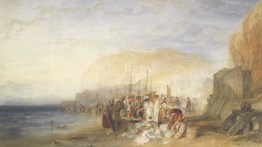
Turner’s seafaring ways — and his blazingly competitive art

Turner’s contemporaries regarded him primarily as a marine painter. This perception extended to his persona, with many who met him commenting on his nautical gait, manner of speaking and other salty characteristics. He frequented ports and coastal parts, relished sailing in storms, was immune to seasickness and famously had himself lashed to the mast to experience the full force of the gale before painting one of his most controversially ‘indistinct’ canvases ‘Snow Storm’. One witness recorded that he ‘somewhat resembled the master of a merchantman’, his first biographer described him as ‘half a sailor’, and he ended his days in unwedded bliss on the Thames in Chelsea with his long-term

Bleeding-under-Wychwood

Oh take a break at Bleeding-under-Wychwood Away from all the city noise and grime; Where the harvest moon shines bright and the knocking in the night Is the undertaker working overtime. You can dine quite cheaply at the Pig and Whistle On the roast beef of Olde England, rare and lean, But I don’t advise the soup, you’ll be rolling like a hoop For it’s liberally sprinkled with strychnine. You’ll need this little map of Bleeding Manor Where the villainous pursue their dread affairs; See, all the rooms have labels from the attics to the stables With a little matchstick body on the stairs. The squire, Sir Murgatroyd, is old

Bar Mirror

He had not recognised me or I him. The place was crammed and rackety, and our eyes Took each other in, and we didn’t realise… We stared, and we ruled each other out until After several glassy seconds I found the will And the nerve to speak. Well — it must be! — He knows my name. In the warmth that dropped on me after the ice-cold air, I’d been looking for someone I knew, to launch a greeting Eagerly after long decades of never meeting. In a crowd of loud unknowns I would still have said I might tell this man from the back of his schoolboy head, And

A Yorkshire Christmas Eve | 12 December 2013

His nearby town wore annual evening-dress, cheap jewellery of lights, white fur and bright drapes of Santa red which might impress late shoppers on this final trading-night, persuading them to spend their all before indifferent time slammed shut the last shop door. He heard hyena voices and he saw splashed vomit on the pavement as he left, saddened by this evidence of more contempt of what was once the numinous. He headed for the moors and his small house. Later on, as he prepared for bed, he could not rid himself of melancholy: the world had changed, Christmas seemed stone-dead or turned into a tasteless parody of what was thrilling

Walk on the wild side with the Gruffalo

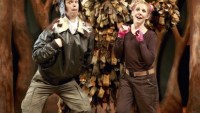
If, like me, you are allergic to pantomime (‘Oh, no you’re not!’; ‘Oh, yes I am!’) then help is at hand: the Gruffalo is in town and strutting his stuff, to the delight of legions of tiny fans, at the Lyric, Shaftesbury Avenue until 12 January. Julia Donaldson and Axel Scheffler’s much-loved verse fable tells of a feisty, wily mouse who goes for a stroll in a ‘deep dark wood’ where he confronts his demons. Having encountered and outsmarted a series of peckish predators by inventing the Gruffalo, a black-tongued, orange-eyed monster, he comes face to face with (and outwits) his own terrifying fantasy creation. It’s a tall order to

Just imagine what BBC schedules might look like in Christmas Future

Is it time to scrap the licence fee? That’s a question we’re going to hear more and more about in the next couple of years. Why should the BBC retain its archaic monopoly over the airwaves? Why not abolish the royal charter that grants the BBC the right to collect the fee (worth £3.6 billion a year) when it comes up for renewal in 2017? A change is long overdue, throwing open the broadcasting market, giving the independent production companies more opportunities to succeed and enabling the new digital online stations to expand, build audiences, create more original audio experiences. Or is it? Just imagine what would happen to radio

Jeremy Clarkson brings Yuletide joy to the Delingpole household

So I’m looking at the seasonal TV schedules trying to find something — anything — to watch. Britain and the Sea? Probably very well done, but David Dimbleby is such a dangerously feline, OE-manqué, Flashmanesque, living-embodiment-of-the-BBC closet pinko that reviewing it would feel wrong, somehow, like chipping into a fund to buy Chris Huhne an eighth home. The Doctor Who Christmas Special? But it always makes me want to kill myself. I hate the idea that a Dalek garlanded in tinsel might burst into the Cratchit household with a fat goose dangling from its exterminator gun while the White Witch’s frozen heart melts and all the crippled children are released

Jude Law’s Henry V is a buccaneer leading a stag-night raid across the continent — but he’d be a great Macbeth

Henry V is the final show in Michael Grandage’s first West End season. The theatre was full to bursting on press night. Jude Law, in the title role, had attracted a crowd of autograph hunters, who shivered outside the stage door. One was a tall, chubby young man in loose grey clothes wearing a bobble hat and a very kindly grin. His flies were undone. The play itself is a disjointed, rambling affair. Poorly shaped, and even a little artless, it’s crowded with fights, bloodshed and laddish humour. The scenes of brutality are offset by soaring passages of patriotic verse that have been quoted into overfamiliarity. There was much coughing

Parsifal has anxiety, rage, near-madness — unfortunately the Royal Opera’s version doesn’t

Debussy’s description of the music of Parsifal as being ‘lit up from behind’ is famous; less so is Wagner’s own remark to Cosima that in his last music drama he was trying to get ‘the effect of clouds merging and separating’. The scoring of the music, especially in the outer acts, is so extraordinary that even people who are repelled by the subject matter of Parsifal, such as Nietzsche, are still overwhelmed by its beauty, which uniquely combines sensuousness and spirituality. It’s a beauty that has to cope with and contain a very great deal of pain, more even than Act III of Tristan. Even the quasi-liturgical unison opening bars

Is this the real First Lady of ‘Borgen’?

I meet Birgitte Hjort Sorensen in a plain office near the Donmar Warehouse in the West End. She’s warm, sharp and engaging, and her fast-flowing English is adorned with the odd Eurotrash platitude. Her American twang owes itself to the global language school of television. ‘I watched a lot of American and English TV growing up. We have it subtitled, not dubbed. Denmark is such a small country and nobody’s going to speak Danish outside of Denmark.We kind of have to learn.’ She’s about to appear as Virgilia in Coriolanus at the Donmar. How does she find playing the wife of a tyrannical anti-hero? ‘Interesting in that she doesn’t talk

The most inspiring gift for your child this Christmas

One of the big differences between Frank Lloyd Wright and me is that, when he was nine, his mother gave him a set of wooden building bricks. When I was the same age, I wanted Lego for Christmas, but my own mother thought it a mere toy, a puerile gift. So she put away childish things and I was given something more high-minded. Perhaps a boring encyclopaedia or a hated chemistry set, useful only for making obnoxious smells. It was 1876 when Anna Wright presented her boy Frank with Froebelgaben, or ‘Froebel Gifts’, an educational tool devised by ur-pedagogue Friedrich Froebel, who also gifted us the Kindergarten idea: the belief

Interview David Chipperfield: It is better to be fond of architecture than amazed by it

For a man who’s about to celebrate his 60th birthday, Sir David Chipperfield looks remarkably fresh-faced. His pale blue eyes are bright and piercing, his thick white hair is cut in a fashionable short crop. Clad in a dark polo neck, he looks almost boyish. This youthful vitality is reflected in his work. At an age when most of us tend to start slowing down, he’s busier than ever. His offices in London, Berlin, Milan and Shanghai employ more than 200 people. His current projects range from Paris to St Louis. I meet him in his groovy high-rise office overlooking Waterloo Station. He’s just flown in from Mexico City, where

The Passage

Here the homeless queue for motherly nuns to dish out meat and veg, for showers, clothes, central heating, company, conversation, medical attention, to use computers to apply for jobs, to borrow blankets against the cold, suits for interviews, an address for housing waiting lists: economic migrants, demobbed soldiers, the divorced, mad, alcoholic, unemployed, unlucky from Africa, Greece, Ireland, Manchester, shop doorways and Westminster Cathedral’s steps.

How I felt when I stepped inside the Hadron Collider

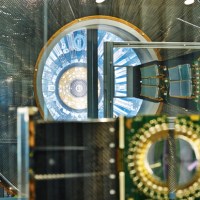
I have a new party piece. I can explain, with a degree of clarity and precision, how the Hadron Collider at Cern works and what it is looking for. I can’t claim credit for this feat of exposition myself; as any science teacher who had the misfortune to encounter me at school would testify. I owe everything to Collider: step inside the world’s greatest experiment, an exhibition at the Science Museum (until 6 May 2014). Collider shows how the contents of a cylinder of hydrogen and 27 kilometres of magnetic subterranean tubes are changing humanity’s understanding of life, the universe and everything. Why is gravity so weak that even you

The man who looks out for Obama’s soul

Just in time for Advent, that season of preparation, of getting ready, of making sure we are in the right mind to weather the excitements of Christmas, the World Service gave us a short programme designed to get us in the mood. In Heart and Soul on Sunday, Jane Little talked to Joshua Dubois who since 2008 has been sending daily ‘devotional’ messages to President Obama. Dubois began writing his emails during that first toughly fought election campaign. He was working for the Obama team in an outreach office, not close to the then senator but close enough to realise how tense and difficult the process of getting elected had

Are events in Last Tango in Halifax too bad to be true? 

Does love run out when life runs out? Or does it intensify, touching and changing all around it? Two series now on our screens make a strong case for the latter —  one is about love striking in old age, the other about young lovers struck by Aids. Both pack a wallop. Since its Bafta-winning first series last year, Last Tango in Halifax (BBC1, Tuesdays) — about a widower and widow, Alan and Celia (wonderfully played by Derek Jacobi and Anne Reid), who reignite their teenage romance by getting engaged in their seventies — has been lauded for its celebration of love among the over-35s. But pensioner passion is not

What it’s like to spend 90 minutes in the women’s loo of a thumping nightclub

Powder Room is a small British film all about women and starring only women — boo-hoo, men; my heart bleeds for you all — yet it is almost entirely set in a nightclub, so whether you enjoy this film may depend on how willing you are to spend 90 minutes in such a club along with all that thumping music and the flashing lights and the scrabbling to get to the bar. As a rule, this is how I’d feel about such a prospect: I’d rather shoot myself in the head. However, I accept this doesn’t hold true for everyone and, from what I’ve learned over the years, I suspect