Arts Reviews

The good, bad and ugly in arts and exhbitions

Bad robots

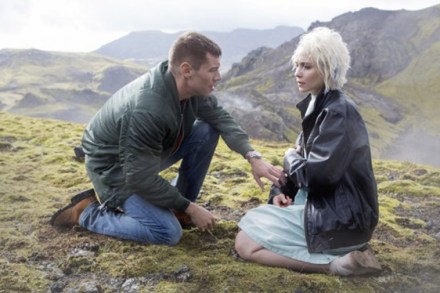
You’d think scientists might have realised by now that creating a race of super-robots is about as wise as opening a dinosaur park. Yet in Channel 4’s new sci-fi series Humans (Sunday), the manufacturers of the extremely lifelike cyber-servants known as ‘synths’ were weirdly confident that nothing could go wrong. Nor did it cross their minds that the synths — programmed only to do whatever their owners told them — could possibly develop their own thoughts and emotions… Still, if its premise is almost heroically unoriginal, Humans does look as if it’ll be giving the social, scientific and philosophical implications of advanced artificial intelligence an impressively thorough airing. And, because


Between Kafka and Crossroads

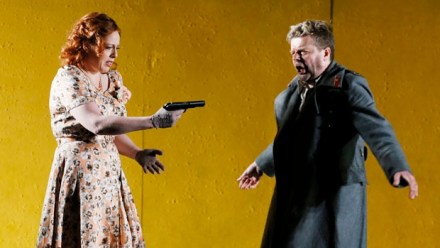
We opera critics love gazing into crystal balls. We’re particularly good at discovering Ed Milibands and backing them to the hilt. Postwar opera is full of them. Take Hans Werner Henze. He was considered the future his entire life. Yet watching a presentation of two of his chamber operas at the Guildhall School of Music last week, it was hard not to think, how? Why? To be fair Henze never intended his early radio opera Ein Landarzt (1961) to work on stage. Originally conceived as a vehicle for Dietrich Fischer-Dieskau, the piece concedes nothing to dramatic interest (even in this theatrical adaptation). An overwrought Kafka monologue — in which a

A sting in the tail

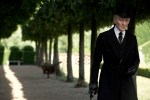
Mr Holmes stars Ian McKellen as the great detective in his old age and while it could have proved a touching character study — who are you, not just when your mind starts to fail, but when the mind for which you are famed starts to fail? — it veers off in so many tedious directions that the end product is lumbering and leaden and will require 22 espressos thrown back in quick succession beforehand, along with several Red Bulls, if you are to have any hope of staying awake. (I did not know this beforehand, and therefore dozed quite significantly.) You know, if I were invited to give a

Own goal

For nine years Patrick Marber has grappled with writer’s block (which by some miracle doesn’t affect his screenplay work), but the pipes are now ungummed and wallop! his new bolus of creativity splatters across the Dorfman stage. It’s a wordy three-hander set in the swamp of non-league football. Marber brilliantly captures the grubbiness and despairing optimism of ageing sportsmen who inhabit a golden age that never was. We meet Kidd, a hopeless but garrulous manager, as he tussles with Yates, a lugubrious old kit-man, for a controlling stake in a dazzling young talent, Jordan. The emotional terrain is lifted directly from Pinter and Mamet: male losers fighting over scraps of

Parmenion

Athens The air-raid siren howls Over the quiet, the un-rioting city. It’s just a drill. But the unearthly vowels Ululate the air, a thrill While for a moment everybody stops What they were about to do On the broken street, or in the slow shops, Or looks up for an answer Into the contrailled palimpsest of blue. Always we forget. It’s once a year Just as lush September’s getting sober Ambushed by October. It strikes the heart like fear, as the vibrations build To an All Clear. The test is dubbed ‘Parmenion’ After the general second in command To Alexander, Implicated by his own son In a confession to a

Entourage review: its obsession with boobs, babes and oiled up bodies continues

Look, could everyone please stop denigrating the Entourage movie for spurious reasons like ‘it feels like an extended episode of the TV series’? Since the US release a few weeks ago, critics across the Atlantic have booed and shamed writer and director Doug Ellin’s long-awaited reunion of Vinnie Chase and co for just that. As if, instead of being a cheery summer feel-good flick for nostalgic fans, the show ought to have morphed into some erudite reflection for Entourage neophytes on how childish 20-something boys grow up into upstanding young gentlemen. Yawn. What a boring film that would have been. What did detractors expect? A brand new cast, novel character

Chris Evans performs U-turn over Top Gear job

After Jeremy Clarkson was suspended from Top Gear following a fracas with a show producer, reports soon emerged claiming Chris Evans would be his replacement. However, the radio host was quick to ‘categorically’ deny these reports: While Mr S had been more than happy to ‘discount’ his candidacy, it turns out that Evans should really never say never. The BBC have announced today that Evans is in fact Clarkson’s successor. He confirmed the news in a statement: ‘I’m thrilled, Top Gear is my favourite programme of all time. Created by a host of brilliant minds who love cars and understand how to make the massively complicated come across as fun, devil-may-care and effortless. When in fact of

Why feminists like me are addicted to Game of Thrones

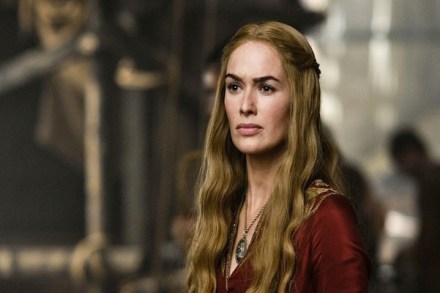
This post contains spoilers and discussion of the Season 5 Finale. My name is Kate Maltby, I’m a feminist, and I’m addicted to Game of Thrones. I’ve known I’ve had a problem for some time, really.  It all started at the end of Season 3. Languidly cat-sitting for a friend (this is what all feminists do on our weekends), I discovered that she had the last three episodes of Season 3 taped. I knew the show was famous for turning woman into nude pin cushions, but this didn’t count as watching, obviously. More like passing the time. Anyway, I had a cold at the time, so I was ill. It was allowed. When I binged my

Seeing the light | 11 June 2015

James Turrell gave me extremely precise instructions. After dinner, I was to walk out through the grounds at Houghton Hall to the skyspace he has built. Here I should observe the gradual darkening above as brightness fell from the Norfolk air. At 9.40 p.m., I was to join him and the Marquess of Cholmondeley to witness the illumination Turrell has devised for the west front of the house. So we stood in the chill air of an English summer evening and watched as a slowly changing sequence of pinks, mauves, blues and reds lit up the colonnades and Palladian windows designed in the 1720s by Colen Campbell and the domes

Oh dear

How many times these days I say those words, Muttering them quietly under my breath Or petulantly as the telephone rings Or shocked at some reported piece of news Or simply as a constant formula For things that pass by daily, and are gone Into the nowhere that life seems to be Day after day, as if unceasingly. Too soft to be an expletive, too repetitive To have distinction, more sigh than cry of rage, How many times these days I say those words And may well say them till the day I die When everything’s worn out and stiff with age And I have nothing else to say but

Hard reign

King John arrives at the Globe bent double under the weight of garlands from the London critics. Their jaunt up to Northampton for the première seems to have cast an opiate glaze over their faculties. Plays that are rarely revived earn their hermit status for a reason. They lack social skills or winning graces. They’re hard to get on with. Shakespeare launches his account of the bad king’s ‘troublesome raigne’ by exploring the shadowy crenellations of Plantagenet genealogy. A decent cast performing at full whack to an eager crowd couldn’t keep my brain engaged. After 70 minutes, the folds of my eyes were feeling as heavy as piano lids. Then,

Dead behind the eyes

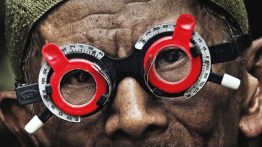
With Joshua Oppenheimer’s The Act of Killing you’d be minded to think that’s it, that’s the Indonesian genocide (1965–66) done, but now he’s returned with a second film that is equally stunning, equally riveting — in its horrifying way — and equally unforgettable. To have one such film in you, but two? I think it is now safe to conclude: there are good documentary makers and there are excellent documentary makers and then there is Joshua Oppenheimer, who is amazing. The Act of Killing showed Oppenheimer tracking down the ageing, unrepentant, positively gleeful members of the Indonesian civilian militia who, with the approval of the army and government, carried out

Pet rescue

I adore Andrew Roberts. We go back a long way. Once, on a boating expedition gone wrong in the south of France, we had a bonding moment almost Brokeback Mountain-esque in its bromantic intensity. Roberts had hired an expensive speedboat for the day (as Andrew Roberts would) and we’d left very little time to get it back to harbour and avoid being stung for a massive surcharge. Problem was, the seas had got very rough and our anchor was stuck fast. We manoeuvred the boat this way and that to no avail. There was nothing for it. Someone would have to dive down to free it. It wasn’t easy. The

Evan sent

Evan Davis’s series on business life, The Bottom Line (made in conjunction with the Open University), has become one of those Radio 4 staples, something that’s just there in the schedule and all too easily taken for granted. Productivity, contracts and contacts, the new appreneurs (creators and sellers of apps) are not subjects I feel the need to know very much about and the business pages of the newspaper usually get sent straight out for recycling. But Evan always draws me in and keeps me listening because of his enthusiasm, his ability to make even the mundane aspects of manufacturing sound fascinating, and his skill at drawing people out, employing

Dietrich Fischer-Dieskau

For anyone who has been interested in classical vocal music since the middle of the last century, whether choral, operatic or solo, there has been one inescapable name and voice: Dietrich Fischer-Dieskau. His repertoire was gigantic, surely larger than that of any singer ever. He began public concerts and recordings in the late 1940s and only gave up in the 1990s, when he took to conducting and narrating, as well as painting, writing a large number of books about German composers (including a ridiculous one on Wagner and Nietzsche) and of course coaching young singers. Such was his appeal that he not only recorded Schubert’s Winterreise several times with Gerald

Message

A tiny fly is moving over the page of my dull book this sultry evening, and it is my conceit that it has a message for me. It pauses on Rigoletto and, skirting pronouns and prepositions, lingers on the hyphen of orang-utan before a significant pirouette over rhubarb tart. When I wake up it is still there, making no sense at all. Cruelly, I close the book on it.

The Wachowskis’ Sense8 reviewed: the kind of programme where nobody ever fully dies

With 60 million international subscribers and a programme-making budget of about $3bn, Netflix is steamrolling most of the received wisdom about how we make and watch television. Already riding high on the success of prestigious hits like House of Cards and Daredevil, Netflix is expecting to bust new barriers with Sense8, whose 12 episodes became available to view today. The big news is that Sense8 marks the TV debut of Andy and Lana Wachowski, the enigmatic creators of the blockbusting Matrix movies, though riding a little less high of late following equivocal reactions to Cloud Atlas and Jupiter Ascending. The multiple storylines and global reach of Sense8 inevitably bring to mind

His dark materials | 4 June 2015

Have you heard the one about girlfriend-killer Oscar Pistorius not having a leg to stand on? Or what about the Germanwings knock-knock joke? If you find gags like these funny, you could come and stand with me on the terraces at Brentford FC. When we played Leeds United earlier in the season, we chanted at them, ‘He’s one of your own, he’s one of your own, Jimmy Savile, he’s one of your own.’ The general public has never wasted much time making up jokes about tragic public events. Making light of high-profile tragedies is a perfectly understandable human reaction, even if it might be frowned upon by some. And what