Arts Reviews

The good, bad and ugly in arts and exhbitions

The Craig-Martin touch

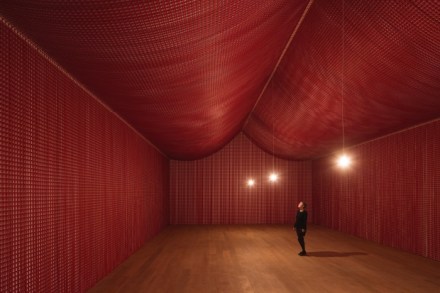
The Royal Academy Summer Exhibition has very little in common with the Venice Biennale. However they do share one characteristic. Each always contains so many diverse and potentially incompatible elements that orchestrating a smoothly blended result is dauntingly difficult. But, as with many almost impossible tasks, some manage it much better than others. Michael Craig-Martin, this year’s chief co-ordinator at the RA, has produced a distinctly better result than usual. The Summer Exhibition always tends to look — as David Hockney once put it — like a jumble sale. But the 2015 edition is a jumble sale with pizzazz and a chromatic zing. The transformation begins before you even get


Are you being funny?

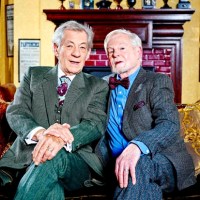
Monday saw the return of possibly the weirdest TV series in living memory. Imagine a parallel universe in which Are You Being Served? had starred Laurence Olivier, John Gielgud and Janet Suzman, and you might get some idea of what ITV’s Vicious is like. Alternatively, I suppose, you could just watch the thing and realise that no, you’re not drunk — you really are seeing Derek Jacobi, Ian McKellen and Frances de la Tour acting their socks off in a sitcom that would have been considered rather creaky in 1975. Jacobi and McKellen play Stuart and Freddie: a pair of gay actors who’ve been living together for decades despite the

Close encounters | 4 June 2015

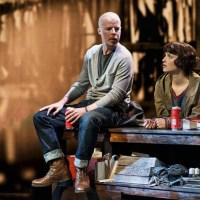
In October 2011 anti-capitalist vagrants built an open-air squat outside St Paul’s within shrieking distance of London’s financial heart. The City thrummed all night with the dob-dob-dob of bongo recitals while the rebels held angry debates beneath their plastic canopies and declared the Square Mile knee-deep in ordure. To press the point they used nearby alleys for their ablutions. This half-forgotten protest has become a play in which the central figure, the dean, has to choose between evicting and accommodating his crusty tenants. Conscience informs him that the noisy campers are Christ’s spiritual heirs. But temporal responsibility obliges him to heed his Square Mile parishioners and sweep the ragamuffins from

Boring Boorman

Queen & County is John Boorman’s follow-up to his 1987 semi-autobiographical film Hope & Glory, although why a sequel now, after 28 years, I don’t know. (We’re not in regular contact.) I can only tell you that if you absolutely loved the first film, as I did — and still do — the news I’m about to deliver is not great, but there’s no avoiding it, so here you are: this is tonally confused, emotionally unengaging, doesn’t seem relevant in any way, and as for Bill, who was once so bright and charming and promising, he’s nothing special any more. I don’t know what I expected him to turn out

The long goodbye

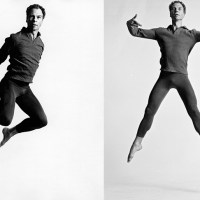
There’s been a clutch of middle-aged danseuses taking leave of life in one way or another recently. We’ve seen the abject (Mariinsky star Diana Vishneva’s solo show at the Coliseum) and the magnetic (Alessandra Ferri mournfully channelling Virginia Woolf at the Royal Ballet). A fortnight ago, the Paris Opéra’s aristocratic Aurélie Dupont retired from the stage in one of her great roles, as did American Ballet Theatre’s stellar women Paloma Herrera and Xiomara Reyes in New York. For top ballerinas and their fans it’s a harsh act of killing, a flower cut off in its fullest bloom. Darcey Bussell has said she sank into depression when she retired at 38,

Host

In eastern Congo years ago on a road logged into a hill I drove or was driven one evening to see pygmies who claimed they were being eaten. This was possible. I’d met a woman with my name who’d watched the fire on which her arm was cooked and then devoured. The pygmies turned out to be lying and this isn’t about pygmies. In the truck I argued with the driver about gays and the Bible as we lurched through the intestinal dark toward the safe haven of a Catholic priest who fed us the baby chimpanzee we’d seen fighting his tether on the father’s porch.

Life imitates art as two ‘old drunks’ take over The Lady in the Van set

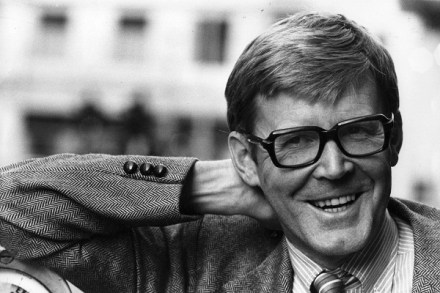
Alan Bennett’s Lady in the Van tells the story of a homeless woman called Miss Shepherd who moved her van into the playwright’s drive temporarily and ended up staying there for 15 years. Speaking about the film adaptation, which stars Maggie Smith, at Hay, Bennett claimed that Miss Shepherd would not be given the same welcome by the ‘basement-digging bankers’ who currently live on Gloucester Crescent compared to those who did when she arrived back in the 1970s. Bennett – who says that the British are best at hypocrisy – is right about people in the present day being less compassionate. Speaking about the film, the project’s director Nicholas Hytner revealed they had some unwanted guests of their

Museum relic

On 1 July, at a swanky party at Tate Modern, one of Britain’s museums will bank a cheque for £100,000, as the Art Fund announces this year’s Museum of the Year. Sure, the money will come in handy. Sure, the publicity will be useful. But this posh bunfight can’t disguise a growing sense that museums face an existential crisis. Cuts are one problem — some say the present round will take museums ‘back to the 1960s’. But they also face a more profound dilemma. In the age of Wikipedia and Google Images, what are modern museums actually for? When I was a child museums were my adventure playgrounds, but was

Living history

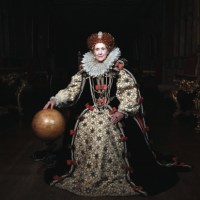
It has been a while since the BBC really pushed the boat out on the epic history documentary front. Perhaps to make amends it is treating us to possibly the most historian-studded, blue-screen-special-effects-enhanced, rare-documentastic, no-hyperbole-knowingly-under-employed series ever shown on television. Armada: 12 Days to Save England (Sundays, BBC2). Having clearly spent a lot of money here, the BBC is taking no chances with its demographic spread. For the laydeez, in the Ross Poldark role it has Dan Snow, captured somewhat gratuitously piloting his handsome yacht into the choppy waters of the English Channel. (Just like in 1588! Sort of.) For the dirty old men it has no fewer than three

Dr Johnson in Tahrir Square

Goodness knows what the Great Cham would have made of Radio 4 airing an adapted version of his philosophical fable, Rasselas, Prince of Abyssinia, on Sunday afternoon. Perhaps he would be surprised to see it done at all: the works of Dr Johnson are hardly fashionable these days and Rasselas is probably little known to most people, let alone read for pleasure. Which is a shame. We studied it for A-level (a dead giveaway as to my age) and although Johnson’s robust cynicism could have scarred a depressive teenager for life (‘Human life is everywhere a state in which much is to be endured, and little to be enjoyed’; ‘Such

Carmen v. Carmen

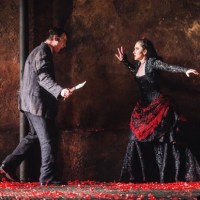
It’s been a busy operatic week, with a nearly great concert performance of Parsifal in Birmingham on Sunday (reviewed by Anna Picard in last week’s Spectator), Carmen at the Coliseum on Wednesday, Donizetti’s Poliuto at Glyndebourne on Thursday and Carmen, also at Glyndebourne, on Saturday. A trajectory that Nietzsche would have approved of, moving from brooding northern transfiguration to sunlit, brilliant southern violence and destruction. Poliuto is mostly known, if at all, in the live recording made at La Scala in 1960 as a vehicle for Callas’s return, in a role that made comparatively small demands on her, and much larger ones on Franco Corelli and Ettore Bastianini. That recording

Stolen goods

Man Up is a British rom-com starring Simon Pegg as Jack and Lake Bell as Nancy. Nancy’s problem, at the outset, is that she is 34 and still single — has yet to ‘man up’ — and is therefore a failure, and if you can buy that as a premise for a film, then that’s your look-out. I’m old and I’m tired and I can’t be always telling you what’s right and what’s plain wrong. So it opens with Nancy, who is single (at 34!; the horror!), attending a friend’s engagement party and refusing to come down from her hotel room as her love life, we are given to understand,

One foot on the catwalk

St James Theatre hosts a new play about Alexander McQueen (real name Lee), whose star flashed briefly across the fashion world before his suicide in 2010. It opens with a mysterious stalker, Dahlia, breaking into McQueen’s Mayfair home and demanding that he make her a dress. ‘I’m calling the police,’ he shrieks but she placates him and they embark on a surreal odyssey to his childhood haunts where they meet his mentors past and present. A pretty clunky start. Who is Dahlia? A dramatic ploy, a figment of McQueen’s imagination or a real person? We don’t know so we don’t care about their relationship. Still less about her flipping dress.

There’s one obvious reason why this image could only be of Shakespeare

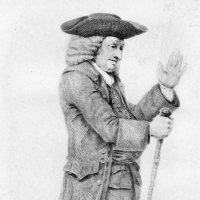
Professor Stanley Wells writes that the newly identified picture of Shakespeare on the title page of Gerard’s Herball (1597) is ‘obviously not Shakespeare’ but neither he, nor Mark Griffiths, the botanist who made this discovery, have fully understood why it is obviously Shakespeare.  That the figure is a poet is undisputed.  In his right hand he holds a Narcissus lily (snakeshead fritillary) which is the flower that grew from the spilled blood of Adonis in Shakespeare’s Venus and Adonis (1593). In his other hand he holds a cob of ‘Turkey Corne’ (which we call ‘maize’ of ‘sweet corn’), again representing Adonis who is God of Corn.  So just as the engraving shows Lord

Restoration drama

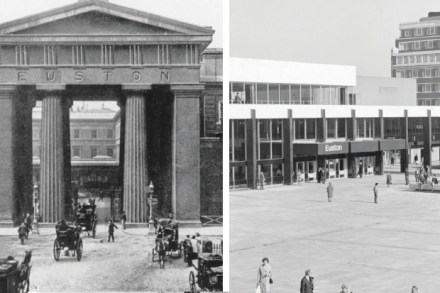
Yes   William Cook Rejoice! Rejoice! Fifty-four years after its destruction, Euston Arch has returned to Euston. Well, after a fashion. Four blocks from this lost portico, salvaged from a murky river bed in east London, have been deposited outside the station by Euston Arch Trust, a heroic pressure group that is campaigning to rebuild this much-lamented landmark. It’s only a tiny fragment of the original, but I can’t begin to tell you how much this small pile of rubble cheered me up. Wouldn’t it be terrific fun to reconstruct this splendid monument? Wouldn’t it be wonderful to bring old buildings such as Euston Arch back to life? Even by

Eastern reflections

In his introductory remarks to the Afro–Eurasian Eclipse, one of his later suites for jazz orchestra, Duke Ellington remarked — this was in 1971 — that east and west were blending into one another, and everyone was in danger of losing his or her identity. Nowhere is it easier to observe that phenomenon than on the little island of Naoshima, in the Seto Inland Sea of Japan, which I visited last month. Naoshima possesses sandy beaches and tranquil blue waters dotted with further islets stretching towards the horizon. But this is an especially heavenly spot for a relatively small and specialised, even eccentric, group of travellers. For more than two

Dedicated follower of fascism?

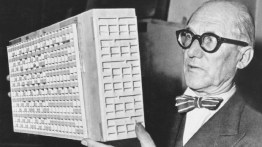
The ‘revelations’, 50 years after he drowned, that Le Corbusier was a ‘fascist’ and an anti-Semite are neither fresh nor startling. Indeed they’re old hat. And it defies credibility that the authors of three recent books about this tainted genius were ignorant of what anyone with even the frailest interest in architects’ foibles and tastes has been aware of for years. Not that this has deterred them; nor has it deterred newspapers from filleting the books for supposedly sensational titbits. What next? The hot news that the cuckold Carlo Gesualdo murdered his wife and her lover? That Jean Genet has been discovered to have been, you know, on the light-fingered

Relief

To draw conclusions from the precise force Exerted by a handshake or a kiss Is to confuse a delta’s civilities With the ambiguous thunder of its source, And what the fingers or the lips endorse Could be misleading. It comes down to this: Emotions are such things as you might miss. The river is the mystery of its course. And so it may not seem to matter much If you react with unexpected fright To what was thought to be a welcome pressure, Or quite inconsequentially delight In disappointment, taking a guilty pleasure In the dismaying lightness of a touch.