Arts Reviews

The good, bad and ugly in arts and exhbitions

What has happened to the Paris Opéra Ballet?

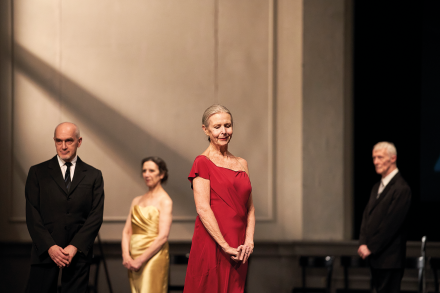
Freighted by a 350-year history, the Paris Opéra Ballet is a behemoth of an institution – lavishly subsidised by the state, hampered by barnacled traditions (including compulsory retirement on a full pension at the age of 42) and about twice the size of our own dear Royal Ballet. They do things differently there. Programming favours choreographers such as Pierre Lacotte, Maurice Béjart and Jiri Kylian – relatively unfamiliar in London – and the classics are dressed up in fancily revisionist productions by the company’s overly venerated former director Rudolf Nureyev (transliterated as Nouréev in French). Once famed for fabulously glamorous ballerinas – among others Élisabeth Platel, Isabelle Guérin, Agnès Letestu,

Ruthlessly manipulative: Hamnet reviewed

Hamnet is an imagined account of William Shakespeare’s marriage to Agnes (Anne) Hathaway, their unspeakable grief at the death of their son (the titular Hamnet) and how this may have inspired Shakespeare to write Hamlet. It stars Paul Mescal and an extraordinary Jessie Buckley, who will likely win every award going, yet be warned: it does do everything it can to make you cry. You can hold out and hold out and refuse to be emotionally manipulated, as you’re better than that, but when Max Richter’s ‘On The Nature of Daylight’ kicks in at the end you will give up the fight. Take a hanky if you do not wish

Cadavers will always captivate. Museums need to chill out

Is it right to put human remains on show? It’s a question that museum curators and the public have been asking themselves ever since European institutions began displaying bodies of the dead – notably Egyptian mummies – in the early 19th century. It’s the same question that continues to be posed today in Canterbury. Here, an exhibition at the Beaney House of Art & Knowledge chronicles and collates the significant archaeological discoveries in and around the city over recent decades. Finds that have unearthed skeletons of the city’s previous occupants – mostly Anglo-Saxon nobility and Roman soldiers and civilians from the 2nd and 3rd century AD. The question remains the

Lucy Worsley's sleuthing is rather impressive

Lucy Worsley’s Victorian Murder Club opened with its presenter unexpectedly channelling that gravelly voiced bloke who used to do all those film trailers beginning ‘In a world…’. ‘The London Thames,’ she intoned as gruffly and menacingly as she could, ‘winding silently through the capital. But in Victorian times…’ dramatic pause ‘…it had a sinister side.’ She then introduced ‘a story that has haunted me since I first heard it’ – possibly, you couldn’t help thinking, from a TV producer keen to find her another true-crime project. In the late 1880s, a serial killer dismembered several women while also taunting the police and never being found. Yet, this was not Jack

The magnificence of Beare’s Chamber Music Festival

The quartet is the basic unit of string chamber music. Two violins, a viola and a cello: subtract any one of those, and you’re walking a tightrope. Add further players and the issue is redundancy: you’d better know precisely what you want to do with those additional voices, because otherwise they’ll congeal like cold gravy. When it comes to the string octet – two string quartets fused together – only the 16-year-old Mendelssohn really cracked it, going all out for transparency, daring and youthful verve. The Romanian George Enescu took the opposite approach. His Octet of 1900 is chamber music as epic construction project, wrought from steel, not spindrift. ‘No

Why has the National got it in for Oirish peasants?

The Playboy of the Western World is like the state opening of parliament. Worth seeing once. Director Caitriona McLaughlin delivers a faithful production of John Millington Synge’s grand satire about dim-witted Oirish peasants and, perhaps unwisely, she spreads the show across the entire length of the vast Lyttelton stage. It looks as if it’s being performed on a railway platform. The drama consists of several broad, daring and improbable steps. A handsome farmer’s boy, Christy, rolls up in a sleepy village in Co. Mayo and claims to have murdered his father. The lustful local girls treat him as a hero rather than an outlaw and compete for his hand in

The genius of Morton Feldman

To accompany an exhibition of paintings by Philip Guston at the Royal Academy of Arts in London in 2004, a performance was arranged of Morton Feldman’s composition written in homage to Guston, for which I was persuaded to page-turn. For Philip Guston runs non-stop for four hours and the thick A3 bundle of manuscript paper balanced precariously on a flimsy music-stand was a matter of concern: what could possibly go wrong? Once the performance ended, I snatched the bundle of £20 notes that I’d been promised, sprinted to the bathroom, then fortified myself with the chunkiest slice of cheesecake I could find in Patisserie Valerie on Old Compton Street. Nothing

An opera that will actually make you laugh

‘What we want is proper comedy!’ bellows the male chorus in the opening seconds of Prokofiev’s L’amour des trois oranges – in this case, a bevy of Monty Python bruisers in nylon frocks. The audience stirs. We’re being invaded by outsize schoolkids and what looks like a Scandinavian Eurovision entry, pushing through the stalls to the roars and whoops of a more-than-up-for-it student crowd. The previous night, I’d had four hours of manicured Handel and now a solo trombone was blowing raspberries in my face. ‘Stuff your tragedy! Take us out of ourselves!’ Yes, please! Do that. After prolonged exposure to da capo arias, a blast of raucous, multicoloured nonsense

One for hardcore Stoppard fans: Indian Ink reviewed

Unusual. After the press night of Indian Ink by Tom Stoppard, no one leapt up and cheered. The crowd applauded politely at the amusing dialogue and the marvellous acting in Jonathan Kent’s handsome three-hour production but there was no standing ovation. The script feels like a literary novel overstuffed with detail. Flora Crewe is a ravishingly beautiful but utterly sexless poet who floats around India in the 1930s provoking the adoration of lustful men. But she doesn’t evolve or change during the action. And she’s maddeningly indifferent to the romantic attention she excites. A maharajah tries to impress her with his fleet of Rolls-Royces. A dashing English captain proposes marriage

Enough with torture-porn TV

Has anyone got to the end of Malice yet? I’m halfway through – at the time of writing, anyway – and am dearly hoping that I might bump into someone at a party who will blurt out all the plot details and spare me the misery of having to sit it out to the bitter end. The Fawn thinks I’m being a wuss, grumbling that I never used to be this squeamish about gory, psychologically harrowing torture-porn TV. Maybe so, but the older I get, the more I wonder: what am I actually gaining by spending six hours on a sofa writhing my way through a horrid story about a

Constable changed the course of painting, not Turner

Flanders and Swann; Tom and Jerry. Some things come in pairs. Like Turner and Constable, even though our two most famous painters were more like chalk and cheese than cheese and pickle. They were close contemporaries: Turner was born in 1775, Constable a year later. Both painted landscapes. But that’s almost all they had in common. In every other way that matters, personal and artistic, they could hardly have been more different. Turner was a prodigy, a student at the Royal Academy Schools from the age of 14 and an associate (ARA) at 24. That same year, Constable had only just enrolled in the Schools, and was not elected ARA

Who let Men Without Hats make a new album?

Grade: D A Montreal band led by a Ukrainian/Canadian called Ivan Doruschuk, with a histrionic baritone, famous solely for having had the most ludicrous hit of that ludicrous decade, the 1980s, with ‘Safety Dance’. Perhaps more famous still was the hilarious video that accompanied the song: Mr Doruschuck in medieval gear cavorting in fields with peasants, throttling a dwarf and entrancing a very pretty blonde woman who looked well up for it. Status Quo, bizarrely, covered ‘Safety Dance’, but the band had no more hits. Why on earth are they still going? Who gave them the advance for a new album? And is it any good? No, of course not.

Am I a useful idiot visiting Uzbekistan’s first art biennial?

In the ruins of a 16th-century mosque, in the heart of the ancient silk-road city of Bukhara, dozens of abstract figures stand mute and motionless. As the desert sun dips below the horizon, and the shadows thicken, the effect is eerie. Wandering among the statues alone, you feel as though you’ve stumbled upon the aftermath of a forgotten, inscrutable rite. But these aren’t Ozymandian relics. They’re an artwork, ‘Close’, installed last summer by the British sculptor Antony Gormley. His work was one of more than 70 scattered across the Unesco World Heritage city as part of the inaugural Bukhara Biennial, which ran from 5 September to 23 November last year.

What's the greatest artwork of the century so far?

15 min listen

For this week’s Spectator Out Loud, we include a compilation of submissions by our writers for their greatest artwork of the 21st century so far. Following our arts editor Igor Toronyi-Lalic, you can hear from: Graeme Thomson, Lloyd Evans, Slavoj Zizek, Damian Thompson, Richard Bratby, Liz Anderson, Deborah Ross, Calvin Po, Tanjil Rashid, James Walton, Rupert Christiansen and Christopher Howse. Produced and presented by Patrick Gibbons.

The thrill of Stanley Spencer

‘Places in Cookham seem to me possessed by a sacred presence of which the inhabitants are unaware,’ wrote Stanley Spencer. Mystically devoted to the Berkshire village near the Thames where he grew up, Spencer was synonymous with Cookham as early as 1912, when he was at the Slade; ‘Cookham’ was his nickname. His greatest work is probably ‘The Resurrection, Cookham’ (1924-7), and he lived out his life there. He became known for pushing an old pram full of paints around town. The former Wesleyan Chapel, where he worshipped as a boy, is now the Stanley Spencer Gallery. So it was intriguing to come across this new show connecting him with

What links Jeffrey Dahmer to the Spice Girls?

The path that links the Spice Girls to Jeffrey Dahmer – necrophile mass murderer of at least 17 men – is a circuitous and unusual one. It involves the establishment of Mothercare and Harold Wilson’s Chancellor of the Duchy of Lancaster and the New York underground of the early 1980s. The thread that joins the ends is a 76-year-old Ohioan called Chris Butler. Butler was part of that art underground in 1981. He was – and is – a musician. Back home in Akron he’d started several bands – the wonderful art rock group 15-60-75 (aka the Numbers Band), and Tin Huey – and he’d brought the newest of them,

Paddington – The Musical is sensational

Who doesn’t love Paddington? The winsome marmalade junkie has arrived at the Savoy Theatre in a musical version of the 2014 movie. First of all, the show is sensational. Absolute box-office gold, full of joy, mirth and spectacle. It’s also quite pricey but never mind. Sceptics who feel indifferent to children’s fiction will be relieved to learn that the dyspraxic Peruvian asylum seeker doesn’t feature much in the story. Paddington’s main attribute is his physical clumsiness and once he succeeds in destroying the crockery and furniture at the Browns’ family home, he runs out of narrative possibilities. His fur is invitingly combustible. Could someone set him on fire? Not quite.

Why is divorce so seldom addressed in art?

Two years ago I was flown to Reykjavik to interview the Icelandic performance artist Ragnar Kjartansson. It was a weird old trip, booked in at 48 hours’ notice, but Ragnar was consistently charming and generous. Indeed, the only slightly touchy moment came when I asked him about his 2012 video installation The Visitors, a berserk undertaking split across nine screens, in which the artist and an entourage of musician friends spend 52 minutes chanting the baleful refrain from a song written by his then recent ex-wife. The artist tensed up as he considered the question. ‘Shit, I gotta go,’ he said. He probably did, but his reticence might also have