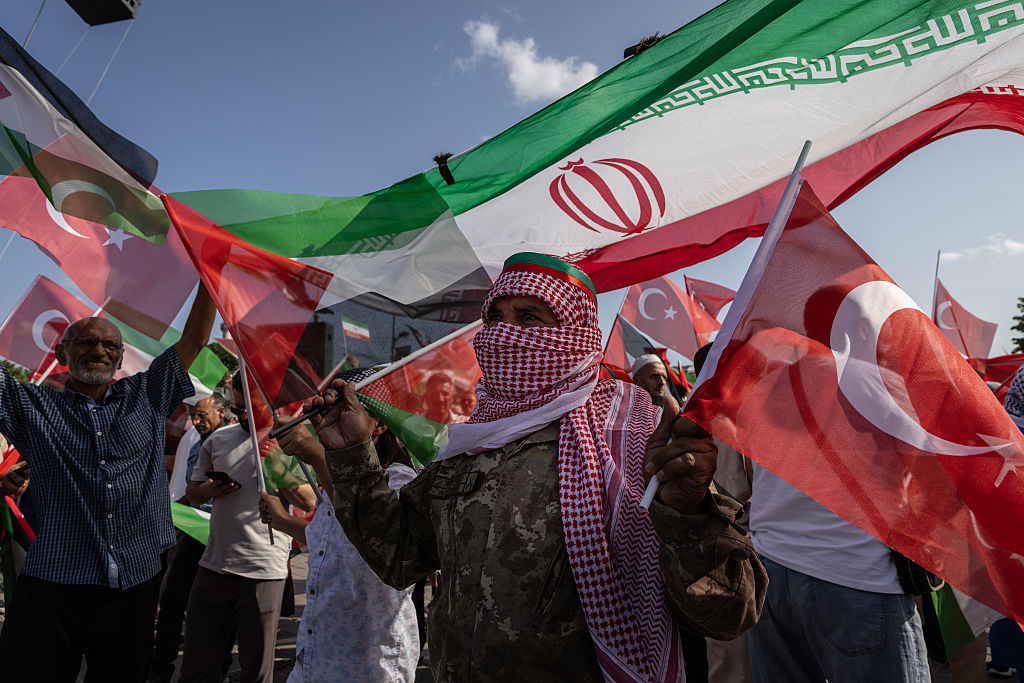


With the exception so far of a single missile intercepted over Turkish airspace and a strike on an Azeri-controlled territory near the Iranian border, Tehran has so far declined to mess with the Turks, and for good reasons.
Turkey is a member of NATO and attacking it would trigger Article 5 mutual defense measures. And it is NATO’s leading member, the United States, which is attacking Iran in the first place. A more serious restraining factor is Turkey’s own large and highly effective army – and its proven willingness to use it against weakened neighbors. Over recent decades Ankara hasn’t hesitated to send troops and launch bombing raids into both Syria and Iraq, occupying border regions when it decides that Turkey’s internal security is threatened. But the most significant factor of all is that despite Turkey’s pivotal historic role in the Atlantic alliance – acting as host to one of the region’s biggest US airbases at Incirlik – Turkish president Recep Tayyip Erdogan is, in many ways, more of a friend to Iran than he is to America.
Sitting on the fence has been Erdogan’s strategic speciality for a quarter of a century
Within hours of the launch of US and Israeli combat operations targeting the Islamic Republic, Erdogan publicly condemned both Donald Trump’s offensive and Tehran’s retaliation. The following day, Erdogan expressed his “sadness” at the elimination of Iran’s Supreme Leader Ali Khamenei and offered “condolences” to the people of Iran. In January, as Iranian security forces were massacring protesters, Erdogan repeated the regime’s narrative that the mass demonstrations amounted to foreign-backed “terrorist” plots linked to Israel. He also congratulated Iranian President Masoud Pezeshkian for his effective “handling” of the unrest. Ankara has also reportedly denied US forces access to its air, land, and maritime space for operations against Iran – which has further strained an already very frayed relationship with Washington, supposedly a strategic ally.
Sitting on the fence – also known as Turkey’s “zero problems with neighbors” policy, coined back in 2002 – has been Erdogan’s strategic speciality for a quarter of a century. And it’s worked. As once-mighty regional neighbors Iraq, Syria and now Iran have crumbled under US and Israeli assaults, Turkey has managed to avoid the contagion of conflict spilling onto its soil. More, Ankara has succeeded in gaining influence in every theater where Tehran was losing from Syria, the Caucasus and Iraq.
For Ankara, there is one jeopardy that represents the sum of all its fears: the threat of a renewed Kurdish insurgency. The Kurds, famously dubbed the world’s largest nation without a state, inhabit a swathe of mountainous territory that stretches from south-eastern Turkey to north-western Iran to Northern Syria and Iraq. The native populations on both sides of every one of those borders have far more in common linguistically and culturally with each other than with the metropoles of Tehran, Ankara, Damascus or Baghdad. For 40 years Turkey fought a bloody Kurdish insurgency that claimed more than 40,000 lives and resulted in the forcible depopulation of nearly 6,000 villages. As recently as 2015, an offensive by the resurgent Kurdistan Workers’ party (PKK) occupied the centers of many major Turkish cities, including the ancient citadel of Diyarbakir. More recently still, Turkish troops and planes have attacked and occupied parts of the self-declared Kurdish statelet of Rojava in Northern Syria. Turkish domestic politics, as well as Erdogan’s own parliamentary majority, has for years pivoted around a series of fragile on-again, off-again alliances with pro-Kurdish parties.
So when reports broke that Trump had spoken to Mustafa Hijri, the president of the Democratic Party of Iranian Kurdistan (KDPI), one of Iran’s two leading insurgent factions, the day after he authorized the bombing campaign against Iran, the Turks were seriously concerned. Iran’s other and much larger Kurdish guerrilla group, the PJAK, is aligned with the PKK and deemed a terrorist organization by the US Treasury. The US has used the Kurds as a proxy warrior group against Saddam Hussein in the aftermath of the first Gulf War, and against ISIS. Fomenting an uprising by Iran’s eight to 12 million Kurds (around 10 percent of the population) against the crumbling Tehran regime could, for armchair hawks in Washington, be a logical next step. Indeed, according to a recent report by CNN, the CIA is already “working to arm Kurdish forces” in preparation for an uprising – though both the KDPI and PJAK are already well-armed and long-established insurgent groups now largely based in north-east Iraq. Iran has targeted the Kurdish camps in Iraq with missiles, killing at least one prominent leader. In retaliation, US and Israeli planes have reportedly struck Iranian Revolutionary Guard targets in a swathe of towns and cities along Iran’s border with Iraqi Kurdistan, apparently with the intention of softening up regime resistance in case of a Kurdish insurgent invasion.
Axios reported Israeli Prime Minister Benjamin Netanyahu has spent months lobbying behind-the-scenes to encourage just such a rebellion. “It is the general view, and certainly Netanyahu’s view, that the Kurds are going to come out of the woodwork… that [the Kurds] are going to rise up,” one US official told Axios.
From Ankara’s point of view, encouraging a Kurdish uprising in Iran is a terrible idea. If the Kurds lose, Turkey is likely to have to deal with a massive influx of refugees along a 530-kilometer border (though 145 kilometers are protected by an Israeli-style security wall). If the Kurds win, they will want something in return for their military help – namely their own state. That’s a recipe not only for civil war in Iran but also a re-ignition of insurgency inside Turkey despite the official dissolution of the PKK in February last year.
Then there is the matter of an ethnic Turkic population of around 12 to 20 million in Iran’s north-western provinces. The border between Turkey and Iran was drawn in 1639 and remains the oldest stable frontier in the Middle East, surviving the collapse of both the empires which created it. But as the Turks know all too well from both historic and very recent experience, stirring up ethnic uprisings can have unpredictable and usually disastrous consequences.
And hawkish statements from right-wing Israeli politicians aren’t exactly helping to bring Ankara onside. Former Israeli prime minister Naftali Bennett claimed on February 17 that an unholy alliance of Turkey and Qatar were building a new alliance that includes the “Islamic Brotherhood Monster” – nuclear-armed Pakistan, Hamas and Syria – to create a “choke ring” around Israel that could eventually become as dangerous as Iran’s proxy networks. “From here, I warn, Turkey is the new Iran,” Bennet told the Conference of Presidents of Major American Jewish Organizations in Jerusalem. “Erdogan is sophisticated, dangerous, and he seeks to encircle Israel. We can’t close our eyes again.”
Such talk is a highly paranoid interpretation of what’s actually happened. In Syria, it was indeed Ankara’s backing of the rebel coalition that produced Hayat Tahrir al-Sham, which toppled the Assad regime in December 2024. Today, Turkey anchors Syria’s security architecture and leads its gigantic (and very profitable) national reconstruction effort. It was Turkish Bayraktar drones – produced by a company owned by Erdogan’s son-in-law – as well as military advisers that helped Azerbaijan overrun the Armenian enclave of Nagorno-Karabakh in 2020. In Iraq, Turkey has teamed with the UAE and Qatar to build a multibillion-dollar corridor from the Gulf to Europe via Turkey, dubbed the Development Road Project. Ankara has, in short, successfully re-made the region’s political and economic foundations not to strangle Israel, but to pursue Turkish economic interests.
Realpolitik and the region’s ethno-geography are pushing Erdogan toward supporting the continued survival of Tehran’s mullahs. The regional status quo, repeatedly shattered by the US invasion of Iraq and Iran’s bloody mischief-making in Syria, Lebanon and Gaza, has been carefully rebuilt largely thanks to Turkish efforts. It is strongly in the Iranian regime’s interests to keep Turkey onside. Which makes sending a missile towards Turkey – perhaps targeted at the US Incirlik airbase, where nuclear weapons are stored, but more likely aimed at the oil terminal at Ceyhan on the Mediterranean – all the more inexplicable. Just as foolish, from a rational point of view, are Iranian missile strikes on an airport in the Azeri territory of Nakhichevan just a day after Azerbaijan’s President Ilham Aliyev visited the Iranian Embassy in Baku to offer condolences on the death of Ayatollah Ali Khamenei. There is a large population of ethnically Turkic Azeris in Iran, too.
Iran officially denied having targeted Turkey, suggesting either that the missile went astray or that the late Khamenei’s standing order that individual Iranian units had command and control over their missiles resulted in a geopolitically idiotic attack ordered by junior commanders. Either way, it’s clear that the Iranian government is well aware of the dangers of provoking Turkey. And for Erdogan, too, the last thing he needs is another violent shake of the region’s delicately-balanced ethnic kaleidoscope.





Comments