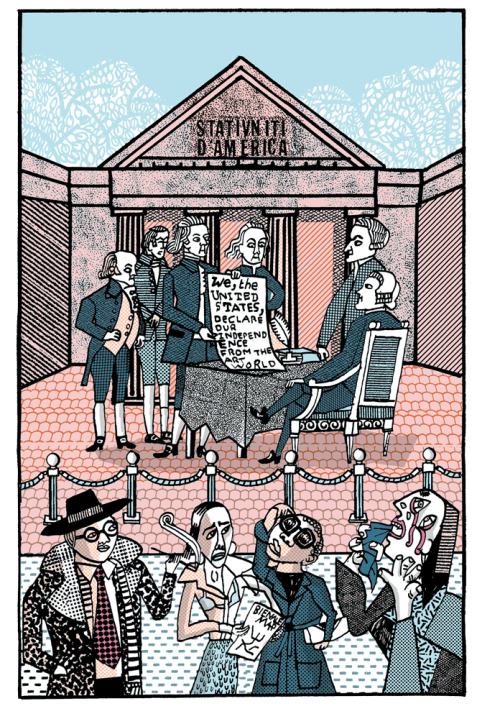
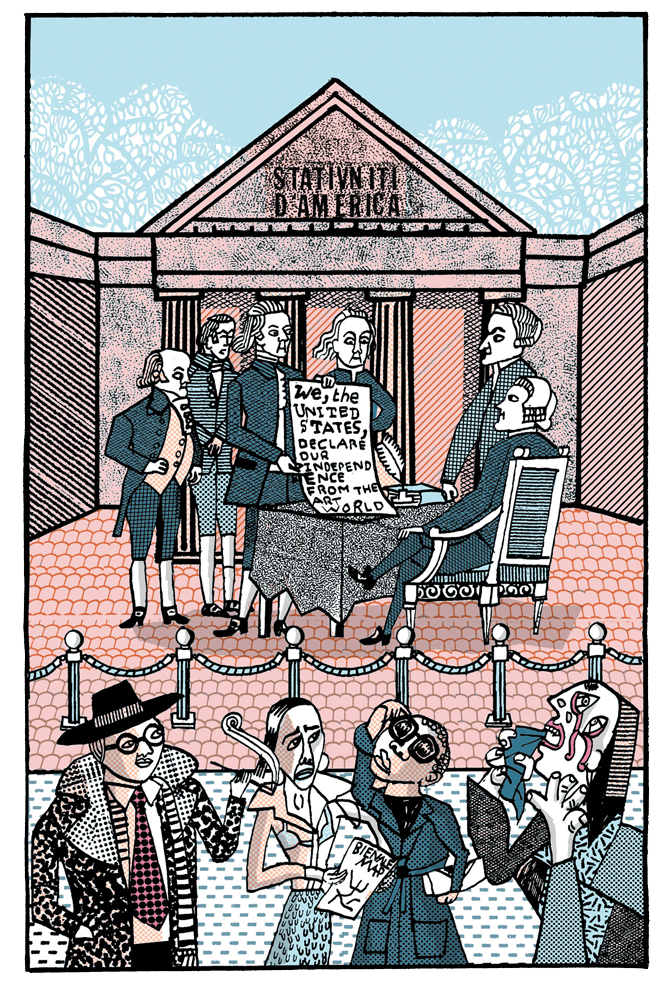
“All art is propaganda,” wrote George Orwell, “but not all propaganda is art.” Upon this subtle distinction rests the success or failure of whatever art we see at the Venice Biennale.
The Most Serene Republic’s exercise in art-world Olympics is propaganda by design. A garden of national pavilions – small buildings in various styles as you might find in a zoological park – presents exhibitions that compete with one another for a “Golden Lion for Best National Participation.” Here, in the murky parkland of the Giardini in the city’s eastern Castello district, nationalist and anti-nationalist passions mix with art-market imbroglio into a sordid spectacle. Just how bad will it be this year? To discover the answer is why we keep coming back.
The 61st iteration of this Italian job, which opens May 9 and runs through November 22, is already shaping up to be a casino totale – which we might translate as “hot mess.” On April 30, days before the opening, the five-person jury behind the Golden Lion prize, led by Solange Farkas, a Brazilian curator of no repute, announced their resignation. The cause? They had previously declared that they would not consider the pavilion of any country whose leaders were being investigated by the International Criminal Court. Such a denunciation would include Putin’s Russia. But of course their real target was the Israel pavilion and its artist, Belu-Simion Fainaru.
Having not seen them, I cannot comment on Fainaru’s drip sculptures. Rose of Nothingness, the name of his Venice installation, reportedly consists of a commercial irrigator that pours water on the pavilion floor. What we can already say is that the work has inadvertently revealed, like much else in globalized culture, the art world’s tender embrace of anti-Semitism. For the antifadists, even the river to the puddle must be free.
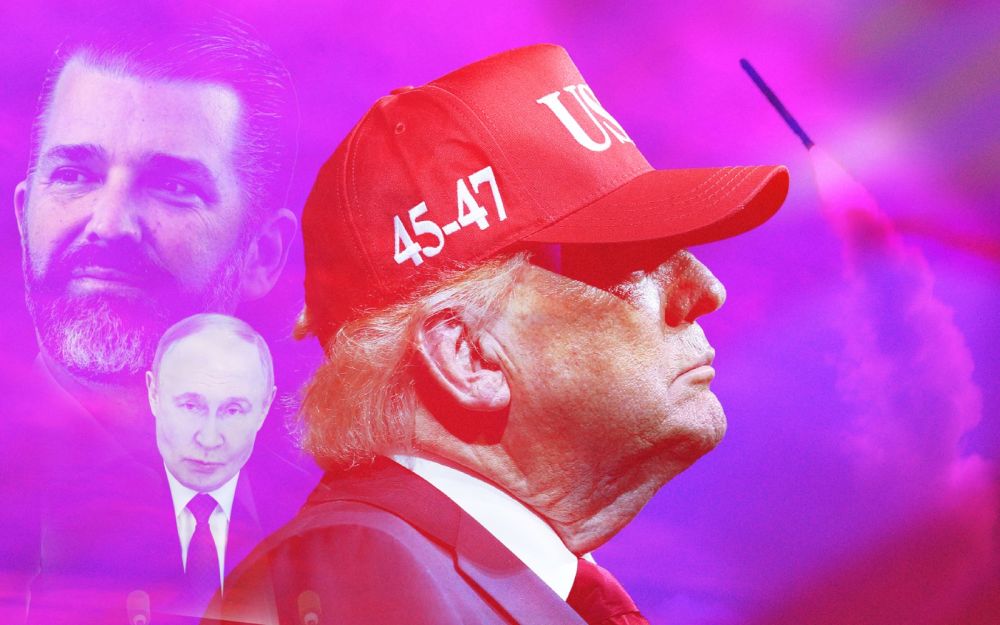
It tells us something about our state of affairs that the most high-profile contretemps at this year’s Biennale does not involve Donald Trump. Nevertheless, this has not prevented the New York Times and its bigly art reporter Zachary Small from going after the American presentation. “With Trump Novices, Can the US Win the ‘Art Olympics?’” asks a headline of April 19. “After the State Department overhauled the process for choosing an artist for the Venice Biennale,” continues the subhead, “it gave control to a woman who previously owned a pet food store.”
When it comes to Venice’s dog-and-pony show, there’s something to be said for recruiting talent from the pet-care market. Reading down, we learn that this year’s US commissioner, Jenni Parido (fresh “from selling venison nuggets and dried sardines,” sneers the Times), has tapped Jeffrey Uslip (“criticized for being racially insensitive”), who has selected the sculptor Alma Allen (“an under-the-radar American sculptor based in Mexico.”)
From what I can tell of Allen’s contributions, his abstract sculptures are inoffensive. For the Times, this is certainly part of the problem. Another issue is that the US commission “never approached traditional funders… including the Ford Foundation and the Andrew W. Mellon Foundation.” Shock horror. The expected boxes have not been checked.
The US pavilion is historically where our Department of State and its establishment underwriters expect unchallenged hegemony. How this happened says much about American consolidation of cultural power. An American presence in Venice began in 1922, when Walter Leighton Clark organized a cooperative of artists known as the Grand Central Art Galleries to purchase land for an exhibition hall. The great Beaux-arts firm of Delano and Aldrich donated their services for the design of the Palladian-style building that still stands today.
After World War Two, New York’s Museum of Modern Art purchased the pavilion in 1954 and began mounting exhibitions of American abstraction that were secretly underwritten by the Rockefeller brothers and the CIA. When such soft-power financing was exposed in the 1960s, the pavilion fell under the purview of the United States Information Agency. The Fulbright-Hays Act of 1961 is the public mechanism that has enabled the government to demonstrate American cultural interests, developments and achievements overseas.
In 1986, MoMA sold the building to the Solomon R. Guggenheim Foundation and its Venice-based Peggy Guggenheim Collection. With the fall of the Berlin Wall and the closing of USIA, control of the pavilion finally went to the Department of State, where it remains today.
There is much to be said for the role the US pavilion played in the Cold War, pitting the freedom of abstract expressionism against the diktats of Soviet realism. As early as 1950, MoMA’s Alfred Barr was bringing over John Marin, Arshile Gorky, Willem de Kooning and Jackson Pollock, along with other artists of the New York School. In 1964, Robert Rauschenberg won the Gran Premio through a stunning American PR campaign and last-minute amphibious assault, ferrying his large paintings by speedboat to the Giardini (documented in the 2024 film Taking Venice).
Since its takeover by the Department of State, rather than a pro-American message, the US pavilion has increasingly promoted a self-effacing aesthetic. Awash in the mandates of DEI, the presentations have at times become downright anti-American. In 2011, during the early years of the Obama administration, I observed an exhibition by the Puerto Rican duo Jennifer Allora and Guillermo Calzadilla that featured American athletes running on the treads of an overturned tank. In one room, a replica of the Statue of Freedom from the Capitol dome was tipped on its side. In another, a pipe organ spat out money from an ATM machine. And so on with the anti-American, anti-capitalist, anti-religious dross.
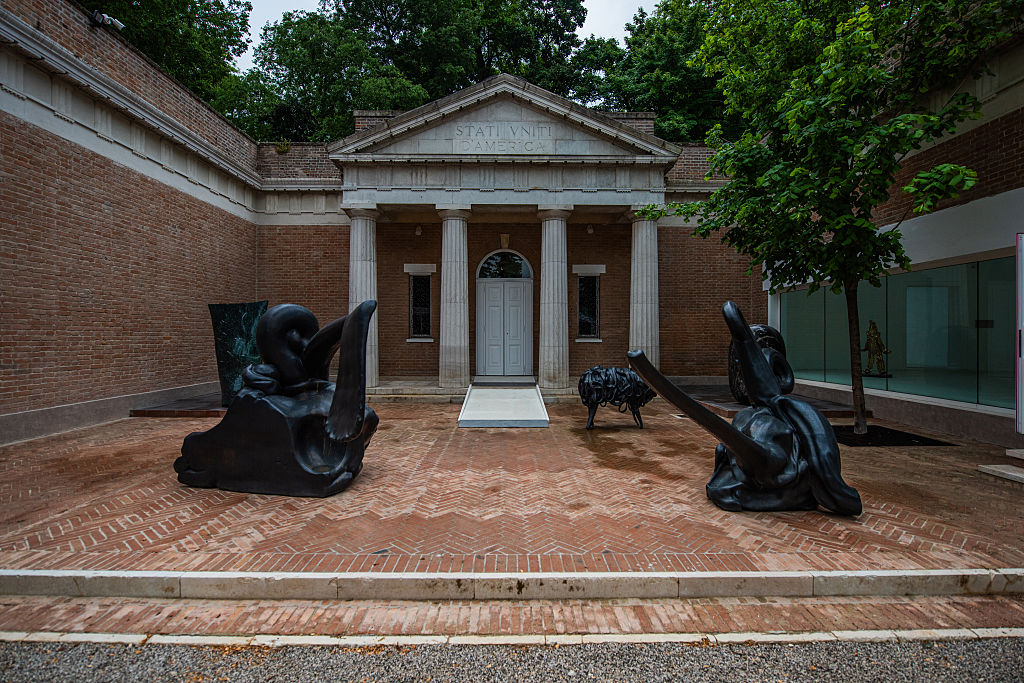
Such a presentation would have made an old Soviet curator blush. According to Lisa Freiman, the organizer at the time, “I chose Allora and Calzadilla because they problematize, or put into question, the notion of American identity at a moment when immigration issues are very important and who is allowed to be a US citizen and who is not allowed to be a US citizen are big debates with the American people.”
Such “art” was not an anomaly. It was the voice of the state. According to Freiman, the State Department’s “decision to select Allora and Calzadilla was unanimous… it was well-timed with Hillary Clinton in the State Department and Barack Obama in the White House.” Maxwell Anderson, then director of the Indianapolis Museum, the commissioning institution, added “everybody in Foggy Bottom down the line to the secretary herself” supported the work. Or as David Mees, then US cultural attaché in Rome, went on to explain: “It’s very important also to cultivate that softer image – what the Obama administration has called ‘smart power.’”
Nationalist and anti-nationalist passions mix with art-market imbroglio into a sordid spectacle
Just what was “smart” about these displays of “power?” In part the debasements of recent years were meant to appeal to the international mindset. See, went the message to those sipping their Aperols at Harry’s Bar, we hate America, too.
But the message was also directed at us back home. No longer there to reflect American freedoms, the propaganda of the Biennale evolved to demonstrate the power of our own unaccountable bureaucracy. They were in charge. They despised us. And there was nothing we could do about it. The nature and quality of the art presented in Venice by our Department of State might have varied over recent administrations, but social justice and race-essentialism were constant themes, “taking over” (often quite literally) the Palladian-style pavilion.
Consider Simone Leigh, the 2022 selection. Lee Satterfield, then assistant secretary of the US Department of State’s Bureau of Educational and Cultural Affairs, heralded Leigh for her “historic achievement as the first Black woman to represent the United States.” Leigh described her work as paying “homage to a long history of Black femme collectivity, community and care.”
Her interventions in Venice included covering the classical pavilion in thatch to resemble a West African palace – meant to remind us of the (racist, of course) 1931 Paris Colonial Exposition. Inside, Leigh presented a sculpture based on “Mammy’s Last Garment,” a 19th-century Jamaican postcard featuring “stereotypes created by the burgeoning Anglophone Caribbean tourism industry,” according to the commissioning institution ICA/Boston. Another room presented sculptures “that send up essentialist ideas of the Black femme body.” The race obsession was total. Naturally, George Soros’s Open Society Foundations provided extra support for the run.
With traditional American values overturned through symbolic acts of desecration, the riotous atmosphere of these aesthetic takeovers came to reflect the real riots that engulfed American cities – stoked by the same racialized psy-ops of supposedly warranted self-hatred. It is the loss of one of their propaganda outlets that our managerial elites now lament and will do anything to restore.
Every presentation at the Biennale is designed to send a message. Today, the Trump era is defined, in part, by its own cold war – one pitting a populist insurgency against a uniparty elite. In choosing Parido, Uslip and Allen – outsiders all – the administration has sent a Sicilian message to the Venetian lagoon: the Deep State swims with the coda di rospo. On the eve of the US semi- quincentennial, the American pavilion has declared its own independence.



Comments