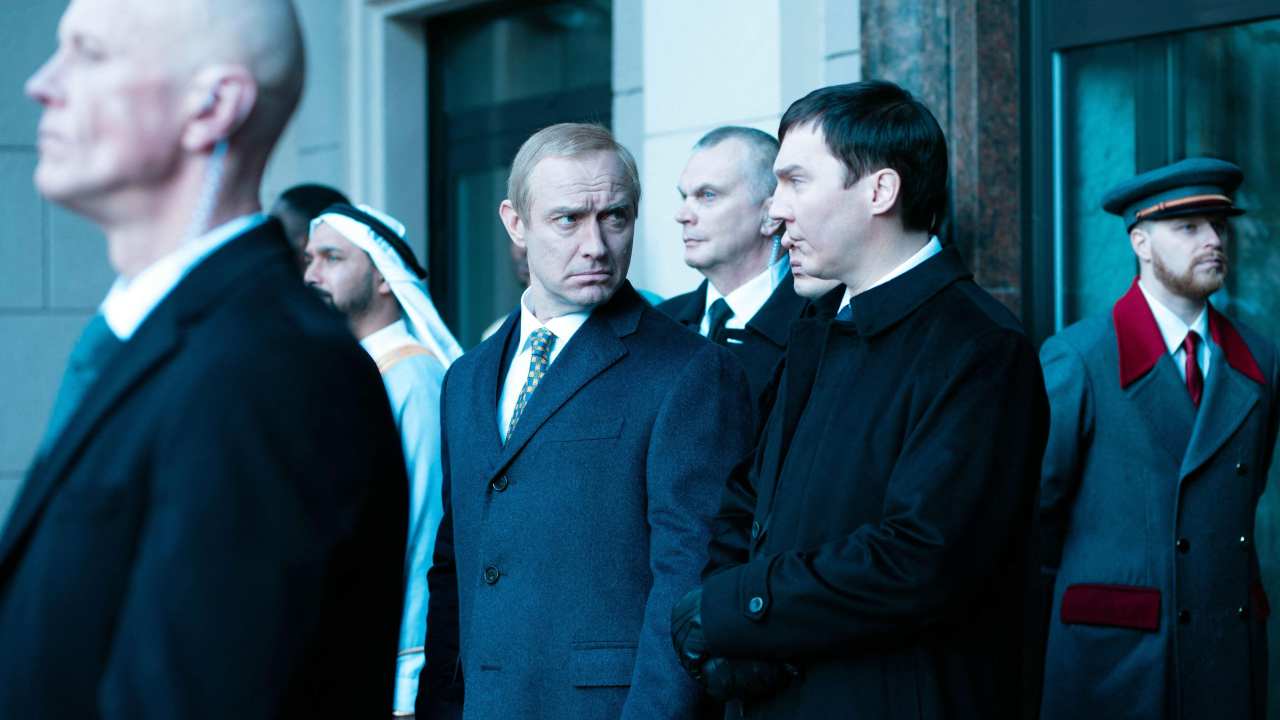
Sometimes life disappoints you in interesting ways. I hated Giuliano da Empoli’s 2022 book The Wizard of the Kremlin, a fictional political thriller about the dawn of Putinism, with a shuddering passion. I had, therefore, been looking forward to despising the film version when it arrived in cinemas last month, too.
Yet it turns out that TWotK, directed and co-written by French filmmaker Olivier Assayas, is an impressive film: visually stunning, well cast, a straight story well told. Paul Dano (the greasy-faced young preacher from There Will Be Blood) plays Vadim Baranov, the fictional “Wizard” of the title, a whizkid theater and TV executive tasked with creating and curating a successor to the ailing Boris Yeltsin. Will Keen (the Queen’s painfully tactful private secretary from The Crown) is brilliantly cast as Boris Berezovsky, the oligarch mastermind who talent-spots Vladimir Putin and believes (very wrongly) that he is placing an obedient puppet on the throne. And Jude Law proves once again that the real test of a great actor is playing someone other than themselves as he deadpans a daring performance as President Putin himself.
The narrative, closely based on the original novel, is framed as a story within a story. An American academic (played by Jeffrey Wright) who has written about the career of the mysterious Baranov arrives in Moscow for a sabbatical of literary research. He is contacted by an anonymous fan who asks to meet. The American is picked up in a black Mercedes and driven to a remote wooded dacha owned by you-guessed-who where Baranov recounts his rollercoaster life story as the architect and facilitator of Putinism in all its awfulness. What follows is a tick-tock of the epochal events of Russian politics from the roaring 90s through to the annexation of Crimea in 2014 – all calmly related in Dano’s whispering, confiding monotone.
While Baranov himself is a fictional character (albeit one modeled on spin doctor Vladislav Surkov), other parts of the film wear their inspiration more obviously. Some viewers may find themselves asking why we are watching what amounts to a two-and-a-half hour biopic about modern Russian history. Perhaps because I witnessed these dramatic years first-hand, I found it a fascinating resurrection of a lost era. In the tradition of Bohemian Rhapsody or Elvis, casting dead ringers as real historical personalities is uncanny. Will Keen, though he doesn’t resemble Berezovsky physically, catches the scheming oligarch’s beetling intensity perfectly. Magne-Havard Brekke brilliantly channels the strutting arrogance and cynicism of the ultranationalist writer Eduard Limonov. Jude Law’s pouting, brooding turn as Putin may not be his greatest performance, but it is certainly a great impression.
The original book’s chief flaw was its cliche-loaded cheesiness. Or as I put it in a review in these pages: “If a novel this inept is so successful then we have truly entered Spenglerian end times.” The film, while not entirely dairy-free, carries its oversimplifications better. This is in large part because its co-scriptwriter is Limonov’s brilliant biographer Emmanuel Carrère – who makes a brief cameo as a French intellectual. Nonetheless, many cringey lines remain. “In Russia, things generally go quite well,” intones our American narrator. “But when they go bad, they go really bad.” Or from Baranov: “I know that Russia has always been forged this way – with an axe.”
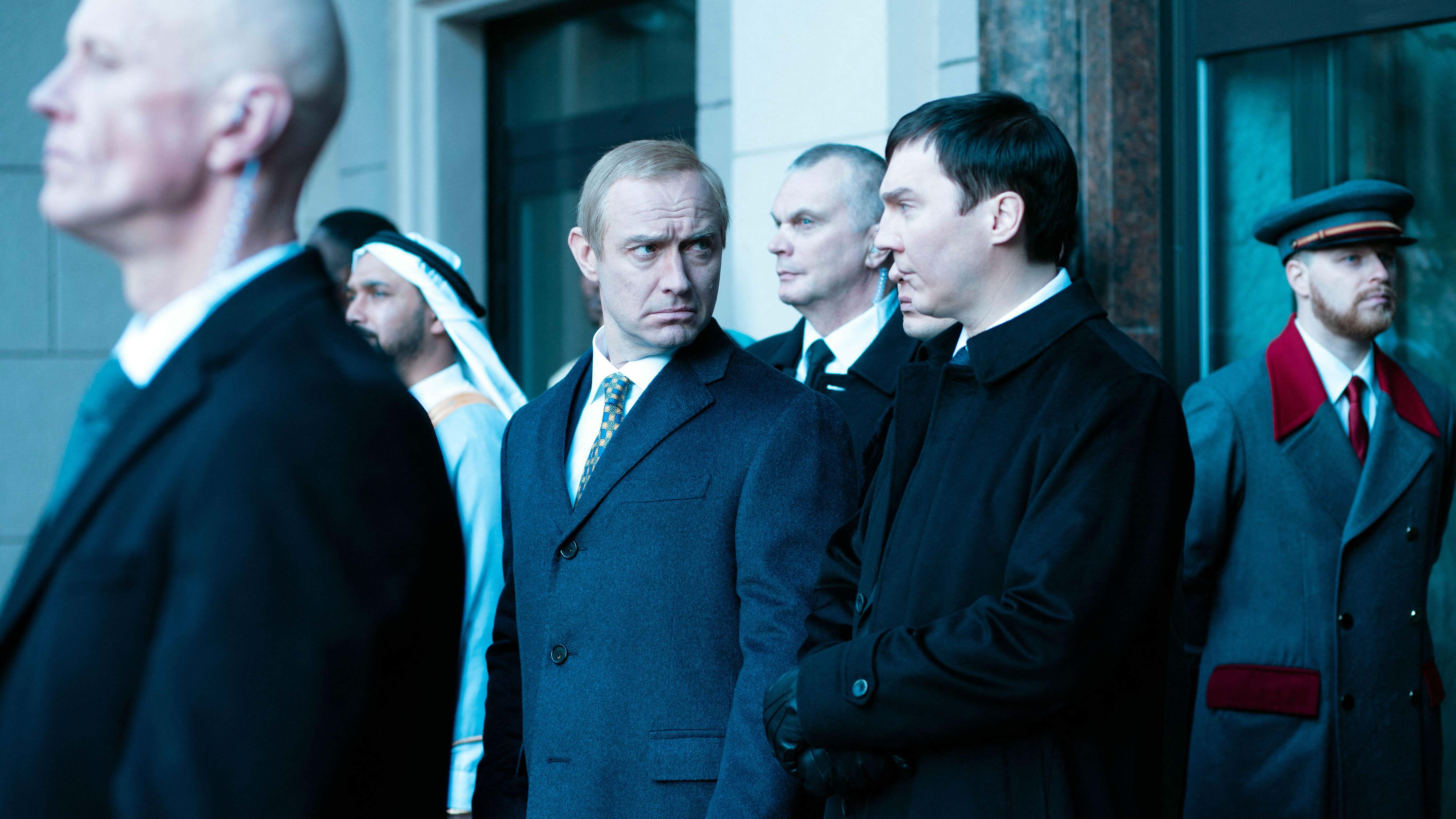
The stellar cast – which includes Alicia Vikanker as the Wizard’s beautiful, bohemian, gold-digging love interest Ksenia – is maybe a little too constrained by cosplaying their real-life originals to unleash their full talents. But the production design and attention to detail reaches a verisimilitude not seen on screen since HBO’s Chernobyl. The Latvian capital of Riga and its environs makes a convincing stand-in for Moscow. The sets and costumes of arty 1990s parties – complete with a naked man pretending to be a dog, based on performance artist Oleg Kulik – are uncanny, as is the decor of Kremlin offices and the luxurious Logovaz Club.
A few clangers break the spell. Given how many Russian actors are in the cast and crew, would it have killed the director to have the leads pronounce Vladimir Vladimirovich (as in, Putin) properly with the stress on the first “i” not the second? Berezovsky would never think of addressing Putin by the familiar diminutive “Volodya.” Russian girls don’t wear huge fur hats inside as everywhere is volcanically heated. Nor is it conceivable to walk into a Russian restaurant, much less a formal meeting, in your overcoat.
Period and location accuracy feel important here because The Wizard of the Kremlin occupies an unusual space somewhere between feature film and docudrama. And while it’s strong on the documentary part, the dramatic drivers of character motivation and high stakes are lagging. What drives Baranov (or, rather, Surkov) in his quest to shape Russia’s reality other than a vague artistic ambition? Why does he choose to unburden himself of his life story to a random American stranger? And why should viewers be invested in this story? My answer would be that Putin’s rise and Russia’s transformation is an important story for our times – well and for the most part accurately told here. Whether you find history lessons entertaining is a different story.



Comments