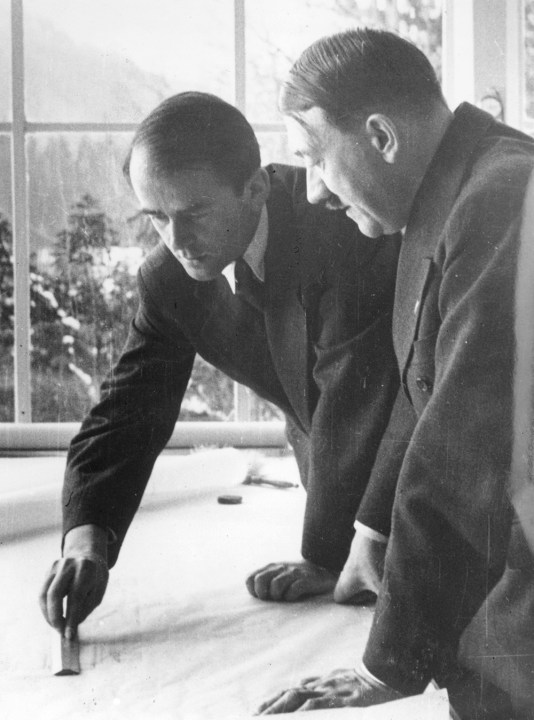
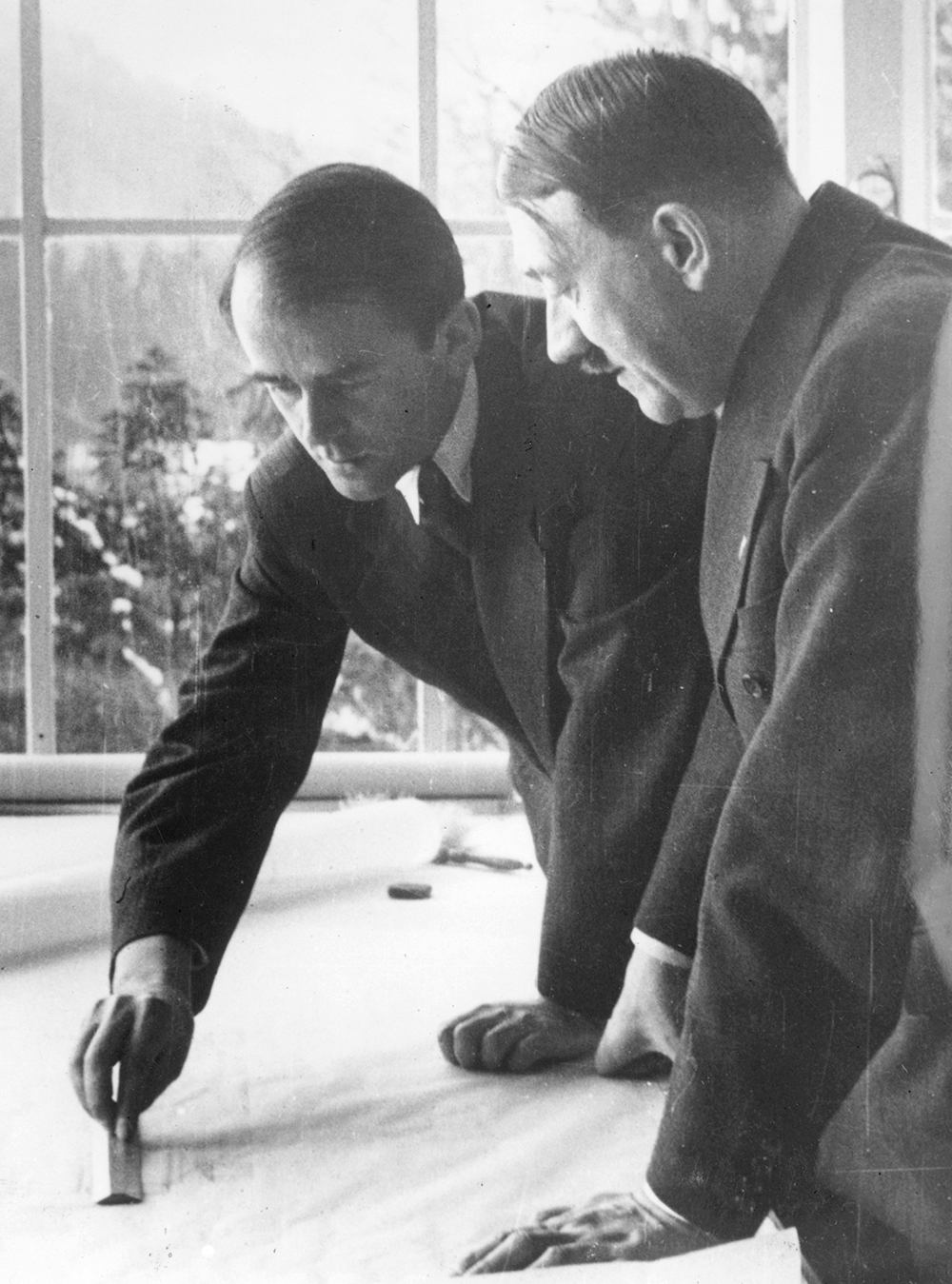
At the Nuremberg trial of the main Nazi war criminals, one man stood out: Hitler’s favourite architect and later armaments minister, Albert Speer. He cut a gentlemanly figure in a gallery of rogues. The strutting, smirking Hermann Goering reminded Rebecca West, who attended the trial, of ‘a tout in a Paris café offering some tourists a chance to see a black mass’. Julius Streicher, the Jew-baiting brute, was like ‘a dirty old man of the sort who gives trouble in parks’. On the same bench, all declaring their innocence in the face of overwhelming evidence of monstrous crimes, were the lantern-jawed SS leader Ernst Kaltenbrünner, the sour-faced ex-champagne salesman Joachim von Ribbentrop, Fritz Sauckel, the thuggish slave labour chief, and the rest of the sorry gang.
But Speer, softly-spoken, handsome, courteous, trim and well-dressed, was prepared to accept the collective responsibility of having served in a criminal regime. However, he declared, as an ambitious architect and industrial technocrat, oblivious to politics, he had had no personal knowledge of such matters as the Final Solution to the ‘Jewish problem’. Like millions of others at the time, he had simply been seduced by the glorious promises of Hitler’s Reich, and the chance to build a great new capital city for the Führer.

In fact we now know that Speer was well aware of what was going on in blood-soaked Poland. He was present in 1943 when Heinrich Himmler gave a speech to SS officers stationed there spelling out the programme to exterminate the Jews. As armaments minister, Speer was also responsible for working many thousands of concentration camp slaves to death. Telford Taylor, one of the prosecutors at Nuremberg, later said that Speer should have received the death penalty instead of serving a mere 20 years in prison. The reason he got off lightly, Taylor said, was that Speer came across as ‘much the most appealing of any defendant in that trial’. When Taylor’s words were played back to Speer during an interview, he said with a dry chuckle: ‘If that was the reason I only got 20 years, I’m glad I left that impression.’
Speer left quite an impression on the historian Hugh Trevor-Roper, too, who wrote in The Last Days of Hitler:
If [Speer] seems sometimes to have fallen too deeply under the spell of the tyrant whom he served, at least he is the only servant whose judgment was not corrupted by attendance on that dreadful master.
Not only did many people continue to take this view of Speer after his release from Spandau prison in 1966, but he became a bestselling author and a media star. He died in London in 1988, after speaking to the BBC – one of countless interviews he gave as the suave ‘good Nazi’ who had reflected on his past and repented for having been such a naive, and, yes, opportunistic young man, so blinded by his ambition that he remained unaware of the worst things that happened in his time.
This was a carefully constructed myth that has fascinated many writers and filmmakers, not least Gitta Sereny, who wrote the remarkable biography, Albert Speer: His Battle with Truth. In true French post-modern fashion, Jean-Noël Orengo sets out to deconstruct the myth by writing a book that is neither fiction nor history nor an essay but a little bit of all three. It doesn’t quite come together in any of these forms; but much in this kind of thing depends on literary style. The translation doesn’t really do this justice, nor is it entirely reliable. Courtesan in French means ‘courtier’, so Hitler was not ‘always surrounded by courtesans’.
We now know that Albert Speer was well aware of what was going on in blood-soaked Poland
Still, Speer remains an inexhaustibly interesting subject, and Orengo has some important things to say about his artistic ambition and the role of architecture in Hitler’s phantasmagoria: ‘Architecture was the power of space. All architects are authoritarian and perfectly aware that they dictate our living spaces with their constructions.’ Speer, educated in the old school by the distinguished architect Heinrich Tessenow, surely recognised the vulgarity of Hitler’s fantasies, but there was something liberating about the licence to be unashamedly grandiose. Orengo writes: ‘What architect would not want that? To build freed from the strictures of taste, and money no object?’ True, no doubt, but not a particularly fresh insight.
The book becomes more interesting when the relationship between ‘the guide’, as Orengo insists on calling Hitler, and his architect shifts to the relationship between the architect and ‘the historian’, namely Sereny. The historian, Jewish and born in Vienna, dedicated her life to writing about people who committed shocking crimes, most notably Franz Stangl, the commandant of Treblinka. She tried to get to the source of evil deeds, but Speer was an enigma to her. She could see through his ‘mix of facile charm and glibly worn guilt’, in Orengo’s words, yet ‘she couldn’t bring herself to conclude that he was manipulative’.
Reading Sereny’s book, one feels that she was seduced by her subject – not sexually, but in a weird platonic sense. Orengo is at his most provocative when he compares her attraction to Speer with Speer’s attraction to Hitler:
He talked about Hitler’s charisma; now she could talk about the undeniable charisma of his favourite. He had been Hitler’s architect; now she was becoming Albert Speer’s historian.
In one of her many intimate conversations with Speer, Sereny quotes a psychoanalyst, who proposed that Speer’s relationship with Hitler was a form of homoeroticism – not sexual, but ‘an irresistible mutual attraction for their respective statuses as artist and man of power’. This may have been so. More thought-provoking is the question of why Sereny fell under the former Nazi’s spell. Why did so many people, in Germany as well as Britain, believe in Speer’s mythic status?
Here Orengo waffles a bit, in the post-modern fashion: ‘He manipulated truth in the way that writers in the 20th century manipulated fiction.’ Speer’s memoir, Inside the Third Reich, is ‘a political and aesthetic autofiction, the best ever produced to this day’. In the battle of narratives, Speer is ‘always one step ahead’. Well, OK.
Sereny’s infatuation was less high-falutin. She reveals in the final pages of her book that Speer, a sexually abstemious man, had had an affair with a young female fan near the end of his life. He calls Sereny on the phone, drunk, and brags about having done quite nicely, after all – Hitler’s architect, armaments minister and a successful author to boot. Sereny is shocked. This was not ‘the Albert I know. What happened?’ Well, he replies, he had had ‘an experience’. It is as though Sereny felt betrayed by Speer’s affair.
As for the others who took a liking to Speer, the reason may be no different from what prompted the judges’ leniency at Nuremberg. It is reassuring in a way that a certain decency can still exist in a moral cesspool. We want to believe that this is still possible. Orengo is not a believer. He repeats several times in his book: ‘Pessimism is the only wisdom.’
Tessenow, Speer’s professor of architecture in the 1920s, had a simpler explanation for Speer’s behaviour. He told the German-Jewish grandparents of a friend of mine that Speer was an Arschloch, an arsehole.


Comments