


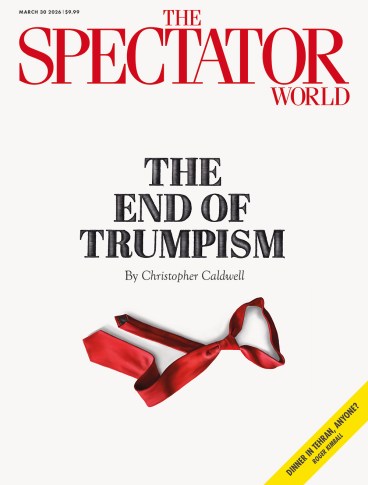
Who wants to join me for dinner in Tehran or Havana? I suspect that both will be open for business very soon. I suppose we could even go to Caracas. As I write, the American flag has been raised at the American Embassy there for the first time in seven years. Amazing, isn’t it?
And in Cuba? In mid-March, protesters were setting fire to the office of the Communist party in the town of Morón in the Ciego de Ávila province. Elsewhere across the island, protesters were in the street shouting, “Down with communism!” The nervous Cuban government released dozens of political prisoners. Since Donald Trump cut off its supply of Venezuelan oil, much of the country has been without electricity. This saddened Greta Thunberg. Usually against oil and all its works, she waddled over to her little rampart to protest the US for not allowing fossil fuel into Cuba’s ports.
The unintentionally hilarious magazine Jacobin got into its Jane Fonda costume and thundered that “Cuba has been a beacon of anti-imperialist, international solidarity for over 60 years. As the US government attempts to crush it, defending its independence is crucial in resisting Donald Trump’s plan for a US-dominated western…” blah, blah, blah.
For his part, Trump has been remarkably consistent in his attitude towards that beacon of “anti-imperialist, international solidarity,” i.e., brutal communist dictatorship. Some enterprising commentator uncovered a clip of Trump addressing Cuban Americans in 1999. One day Cuba will be free, Trump promised. He rightly described Fidel Castro as “a murderer, a killer, a bad guy in every respect,” and noted that, “things can turn around very rapidly.” It has taken more than 60 years, but now things are happening very quickly indeed.
Just a few days ago, President Miguel Díaz-Canel publicly admitted that his government had entered negotiations with the United States. Trump just gave Secretary of State Marco Rubio his 18th, or possibly his 27th, job: settle things in Cuba. The Cuban government announced various economic reforms, including opening up Cuban businesses to private investment by Cubans abroad. Why did that happen? “The economic opening comes amid unprecedented pressure by the Trump administration,” the Miami Herald reported. I knew it had to be something.
Meanwhile, in and around the Persian Gulf, the endgame is nigh. The US Navy is just about to be crushed by the Islamic Republic of Iran. Just kidding. That’s the headline that CNN and similar organs of anti-Trump animus have inscribed on their wish list. So far, my favorite chunk of surreality was the charge that neither Trump nor his military advisors anticipated that Iran would threaten to close the Strait of Hormuz, through which some 20 percent of the world’s black gold passes each day.
Secretary of War Pete Hegseth was right to call CNN’s story on the subject “patently ridiculous.” Iran has been periodically threatening to close the strait since 1979, when that malevolent lunatic Ruhollah Khomeini took over Iran and plunged it into its current grotesque misogynistic dystopia.
Iran says the strait is closed. Scratch that. It is open to all ships except those from Israel and the United States. Since only about a dozen US-flagged ships pass through the strait annually, that is not much of a burden. But then Saudi Arabia said (I translate freely from the Arabic): “Screw this. Bypass the Strait of Hormuz altogether. Sail up the Red Sea and we’ll load your oil at the port of Yanbu.” “Oh, wait,” quoth whatever Iranian authorities are still ambulatory, “we didn’t mean it. Come back!”
It gets even funnier. As one commentator put it, “In 72 hours we went from: ‘Trump never expected the possibility of Hormuz closing’ to ‘Trump was briefed Hormuz could close but riskily did it anyway’ to ‘Trump bombed Kharg Island but it likely won’t force Iran to open the strait’ to ‘Iran opened the strait.’” By George, I think he’s got it.
Imagine having the confidence to invite warships from your biggest rival to aid in an operation
Some say Trump exaggerates and overstates things. Perhaps, on occasion, he is given to mild hyperbole. But consider, sed contra, this masterpiece of understatement: “The United States of America has beaten and completely decimated Iran, both militarily, economically, and in every other way.” The Roman practice of decimation, rarely employed, was a brutal punishment for cowardice. The offending unit would be divided into groups of ten. One man from each would be selected by lot. The unlucky ticket holder would then be killed by his colleagues.
What the US and Israel have visited upon the Iranian regime is far more extensive than decimation. Most of its leadership has been erased. Ditto its military infrastructure and war-making industry. Underground depots storing missiles, launchers and drones have been bombed. The various headquarters of the IRGC and other police facilities have been destroyed. What air force Iran possessed has been eliminated, as has almost all of its navy. Its air defenses are gone. A day or two back, I read that there have been 15,000 sorties launched against Iranian assets. The number will be much higher by the time you read this. And despite what you hear from the propaganda press, it has been accomplished with minimal civilian casualties.
Meanwhile, Trump has solicited countries that have depended on oil from the Strait of Hormuz to send warships to help secure it. The countries he mentioned included China, France, Japan, South Korea and the UK. Imagine having the confidence to invite warships from your biggest rivals to aid in an operation! “This should have always been a team effort,” Trump said, “and now it will be. It will bring the world together toward harmony, security, and everlasting peace!” CNN and Thunberg hardest hit. They will not be invited to dinner.




Comments