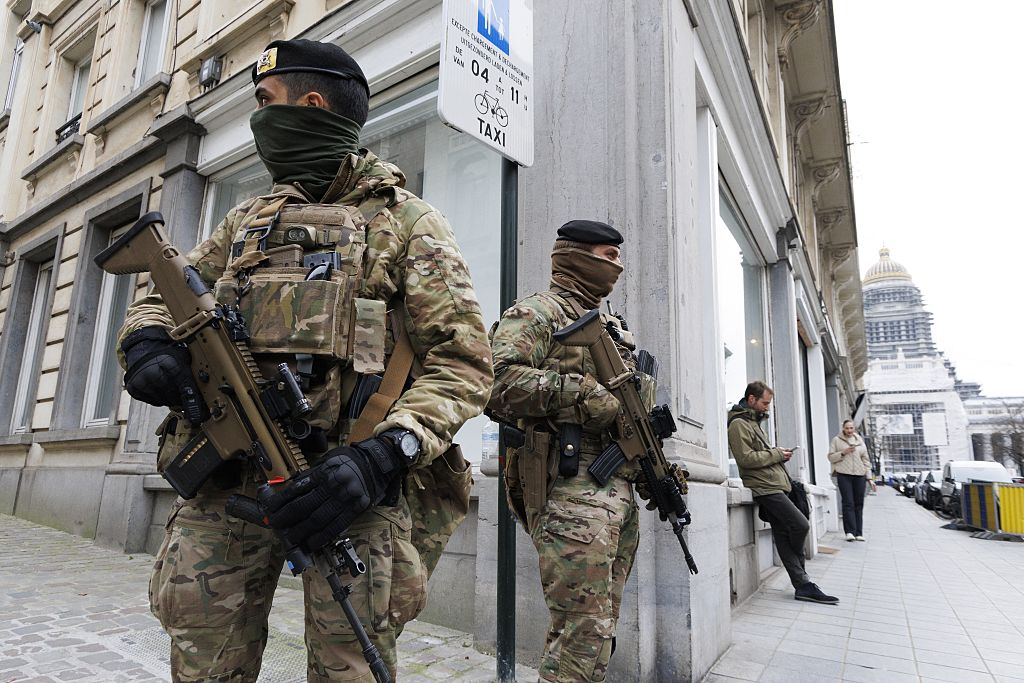
It’s not uncommon to see camouflage on the high street in Belgium. It is a peculiarly Belgian reflex: when the state feels the strain, it reaches for the army. This week, the federal government has done so once more. Soldiers have been deployed to bolster security around Jewish sites and neighborhoods in Brussels and Antwerp, following a spate of clumsy but troubling attacks across Belgium and the Netherlands. Synagogues have been targeted with arson and a Jewish school struck by an explosion. Mercifully, no one has been injured and the damage has been minor. Yet the intent is clear, and the authorities have been quick to identify the incidents as anti-Semitic acts.
Belgium’s cities, and Brussels in particular, have in recent years acquired a reputation for lawlessness
After deploying the army, Theo Francken, Belgium’s effective and plain-talking defense minister, declared Antwerp ‘a little safer again and the Jewish community too’. One suspects the reassurance is aimed as much at a jittery public as the Jewish community itself. While the attacks were amateurish – the work, it seems, of poorly organized youths rather than seasoned extremists – they have taken place in a country already uneasy about its security.
Dutch police, meanwhile, have arrested a handful of teenage suspects (some with Dutch-Caribbean backgrounds, according to the Dutch daily, De Telegraaf) in connection with the arson attack in Rotterdam. The same shady group that claimed responsibility for an arson attack on London ambulances owned by a Jewish charity, Harakat Ashab al-Yamin al-Islamia (HAYI), also said it was responsible for the attacks across the Low Countries. Experts do not know who is actually behind the incidents. Organized crime groups in the Netherlands frequently hire youths with migrant backgrounds to carry out jobs. HAYI’s statements reportedly contain errors in Arabic, suggesting they have been written by a non-native speaker – or at least someone lacking sophistication. That is not much comfort though to Jews in the region.
There is another factor at play here in Belgium. It has justified deploying its military after the most recent attacks, but the return of soldiers to the streets has been months in the making. It was a move that had been delayed by protracted political wrangling over legal frameworks and rules of engagement.
The official line is that this is a temporary measure. Up to 200 troops will be deployed for three months, with their numbers later reduced. They will assist the police in Brussels, Antwerp and, in time, Liège and other cities. At the same time, the army’s role is widening. Soldiers will not just be guarding synagogues, they will also support railway police, patrol major stations and even participate in large-scale operations targeting organized crime and the drug trade.
Why? Because Belgium’s cities, and Brussels in particular, have in recent years acquired a reputation for lawlessness. Drug-related violence has crept into public view; firearms no longer remain in the underworld’s shadows. The police, by most accounts, are overstretched – one could even argue outgunned. And so the military is stepping into the breach. They are cheaper, readily available, better armed, well trained and, to many, reassuringly visible.
There is a precedent here. After the Paris attacks in 2015, Belgium’s streets quickly filled with paratroopers in balaclavas. The deployment lasted until 2021 and had one excellent side effect: it reduced crime. Going back further still, the same happened in the 1980s, when troops were deployed after the elusive Brabant Killers terrorized the Greater Brussels area, resulting in 28 fatalities.
However, the policy is not without its critics. Military unions dislike the lack of clear legal protections for their members, and have warned that soldiers risk being used as a cut-price police. The so-called “rules of engagement” remain, by all accounts, a work in progress. Talk of giving the military expanded powers, from identity checks to arrests, has alarmed civil libertarians and legal experts.
The soldiers deployed in the past did not have a clear mandate. They were trained for war, not for the delicate ambiguities of civilian policing on a busy city street. To blur that line is to invite confusion at best. As one union representative observed, a misstep just beyond the letter of an order could leave an individual soldier personally exposed to legal risk – a heavy burden for a domestic deployment.
Yet the federal government appears willing to take that risk, with security in Brussels spiraling out of control and the capital itself struggling with a near-constant political crisis. Deploying troops to back up local police may give Belgium’s federal government some leverage in improving the situation, especially given Brussels’s standing in the European Union. And so Belgium finds itself, once again, in a familiar place: a state seeking to project strength while at the same time quietly acknowledging its own limitations when it comes to policing its own neighborhood.






Comments