If it takes one to know one, this may explain why spy fiction is enjoying such a renaissance, since among the best new titles are those written by former intelligence operatives. I.S. Berry and David McCloskey are both former CIA officers who happily acknowledge how much their novels rely on their past careers. Equally impressive is the work of ex-MI6 officer James Wolff, whose use of a pseudonym puts him at a comparative disadvantage when it comes to promoting his books, but whose Spies and Other Gods (Baskerville, £20) places him in the top tier of today’s spy writers.
A young ex-academic, Aphra McQueen, is sent by a parliamentary oversight committee to investigate a whistleblower’s complaint about MI6. All over Europe an assassin codenamed CASPIAN has been murdering Iranian dissidents. The anonymous sender of the complaint suggests that in the frantic efforts to catch the killer, gross negligence has been committed by the service.
Aphra is greeted with suspicion by the denizens of MI6’s Vauxhall headquarters, who are unaccustomed to this kind of exposure. A long-term employee, assigned to shadow her in the building, entraps her by planting a classified document which is found when her bag is searched as she leaves. She is barred from any further work on the case.
But Aphra has seen enough to pursue the matter on her own. Her research takes her to Birmingham and then to Paris, where the nephew of CASPIAN is based. Her motivation for continuing off-piste is initially unclear, but the reverberations of it are profound and draw the attention of the MI6 head, Sir William Rentoul. Aware of his cognitive decline, he is eager to handle the hunt for Aphra himself as a kind of last hurrah.
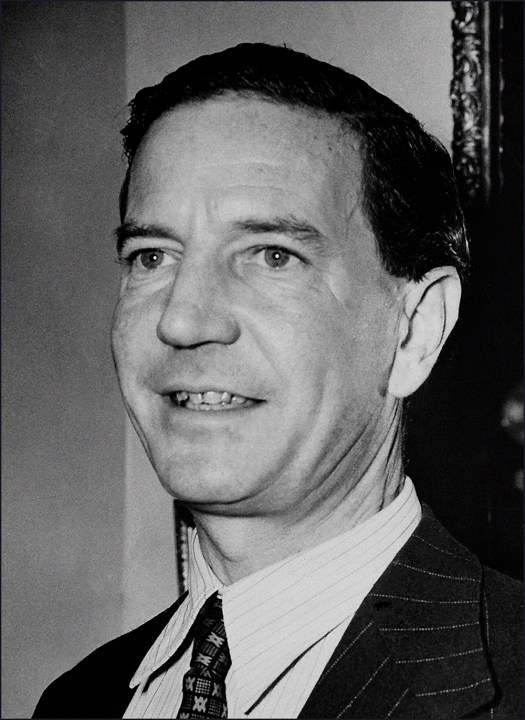
There’s a cameo appearance by Kim Philby talking openly about his treasonous work for Moscow
The novel is told largely through the eyes of Aphra and Sir William, though there is an overall knowing narrator who is never identified but who functions as the objective voice of MI6 itself. The chase elements are well paced and, as always with Wolff, the writing is clear and evocative: a character turns ‘his face toward the lemony sun, pale as a boiled sweet in a tin of powdered sugar’. The tradecraft involves sophisticated surveillance and high-tech methods of eavesdropping, showcasing the author’s intelligence background. But Wolff’s greatest strength lies in his imaginative language and clever exploration of his characters. Like John le Carré, he is first and foremost a writer of fiction who happens to have been a spy.
In A Stranger in Corfu, by Alex Preston (Canongate, £18.99), we are introduced to the tiny Greek island of Vidos, part of the Corfu group. It functions as a sort of foreign version of Mick Herron’s Slough House, where retired British intelligence agents are put out to pasture and younger damaged ones are sent to recuperate. Nina Wolf, the daughter of two spies, is a new arrival, recovering after horrendous experiences on a botched mission in Srebrenica where she was taken prisoner, tortured and repeatedly raped by her captors.
When a resident of the island mysteriously drowns, Nina finds herself exploring what has happened. It gradually emerges that many of the retired MI6 officers living on Vidos had been double agents, working secretly for the Russians. All are linked by Oxford, where they were recruited as a kind of group –a conceit explored more realistically in Charles Beaumont’s excellent thriller A Spy Alone. Preston’s network seems more fanciful, even verging on the preposterous – with a cameo appearance by Kim Philby talking openly and implausibly to the Oxford clique about his own treasonous work for Moscow.
But realism is not where the novel’s strengths lie. The characters are sharply drawn, especially the troubled Nina, who takes no pleasure in her new surroundings:
It was as if she lived now in a gallery from which the paintings had been removed, leaving only patches of discoloration on the walls, reminders of the love that had once been there.
Descriptions of Vidos are often beautiful while also persuasively claustrophobic. The former spies are effectively prisoners, carefully watched and only rarely allowed to leave the island. Preston is especially good at conveying the tension underlying the residents’ idle days.
The Cut Up (Canongate, £16.99) is the third in a series of thrillers by Louise Welsh that has attracted critical praise and a rapidly growing number of readers. The books feature Rilke, a gay auctioneer with a healthy sideline in trouble. This latest novel is busy from the start, as Rilke stumbles upon the still-warm corpse of a client of the auction house he works for. The writing is immediately arresting – the victim, a jewellery dealer named Mandy Manderson, ‘was obnoxious when sober; unpleasant when drunk, but I would not have thought him important enough for murder’.
It’s an especially gruesome killing (Manderson has been stabbed through the eye) and sets the tone for the dark story that unfolds. Rilke is Philip Marlowe-like, though less aggressive, and the mix of mobsters and antiques mavens, with a supplementary policeman as Rilke’s boss’s boyfriend, makes for an entertaining romp. But there is grimness as well, particularly in the relentless brutality of Glasgow gangster life, which makes Ian Rankin’s Edinburgh seem positively insipid. Readers who are new to the series will almost certainly want to go back and read the first two novels.
If he is remembered at all today, Duff Cooper is known for the eponymous non-fiction prize given each year in his honour; or as the husband of the magnificent if slightly kooky Lady Diana Cooper; or even as the target of Evelyn Waugh’s vituperative appraisal. A politician and diplomat (rewarded by Churchill with the plum post of ambassador in Paris), he was also a highly competent author of histories and biographies as well as a novel, Operation Heartbreak, involving a risky secret mission, now reissued by Penguin Classics (£9.99). It is a remarkable book, beautifully written, suspenseful and a pleasure from beginning to end.
Willie Maryngton is an Englishman, orphaned from an early age. His mother dies giving birth to him and his father is killed at the beginning of the first world war. Willie is raised by the widow of a fellow officer of his father, and even as a child he is determined to become a soldier. Despite his keenness, he finds his ambition to see combat perpetually frustrated – being too young for the first world war and too old for the second. He spends some of the interwar years in India and Egypt – military postings that are pleasant enough but unsatisfying.
His emotional life is similarly problematic. Engaged in India to the daughter of his regiment’s commander, a flighty young woman who shares his love of horses, he looks forward to having a family – only for his fiancée to run off with a louche, older officer. Back in England, Willie falls deeply, helplessly in love with the daughter of the woman who has raised him, but he finds that her reciprocal avowals of love do not include a willingness to marry him.
Eventually, leaving the army, he sets up a training stable, while retaining his reserve status and hoping, as always, for war. Enough happens (with a glorious final twist) to keep thriller addicts happily engaged. Reading Operation Heartbreak certainly makes one wish that Cooper had written more fiction.




Comments