James Panero

The message behind the US pavilion at the Venice Biennale

“All art is propaganda,” wrote George Orwell, “but not all propaganda is art.” Upon this subtle distinction rests the success or failure of whatever art we see at the Venice Biennale.  The Most Serene Republic’s exercise in art-world Olympics is propaganda by design. A garden of national pavilions – small buildings in various styles as you might find in a zoological park – presents exhibitions that compete with one another for a “Golden Lion for Best National Participation.” Here, in the murky parkland of the Giardini in the city’s eastern Castello district, nationalist and anti-nationalist passions mix with art-market imbroglio into a sordid spectacle. Just how bad will it be this year? To discover the answer is why we keep coming back.

venice biennale

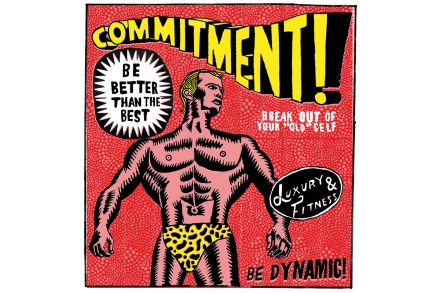
Inside the cult of Equinox

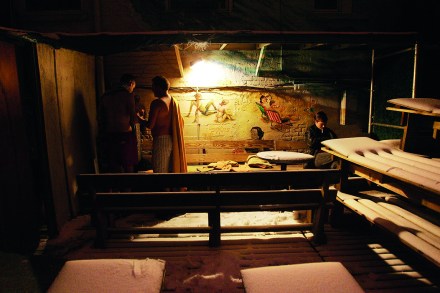
Scratch the surface of Silver Age Rome and what do you find? Most likely, a tight subterranean vault built as a meeting room for the followers of Mithras. This Persian mystery cult was everywhere in the early Anni Domini, coming to prominence between the decline of Hellenism and the rise of Christianity, filling that gap between the gods of Olympus and the God of Moses. The cult’s dark temples, the Mithraea, squeezed devotees into opposing benches designed to make them uncomfortable, all while in communion with their fellow initiates. Today, sociologists might call a Mithraeum a “third place.” Here was the kind of space where Roman men who had become disillusioned with Jupiter Stator could go between work and home to be purified together in a shower of bull’s blood.

Equinox

In Claude Monet’s postmodern garden

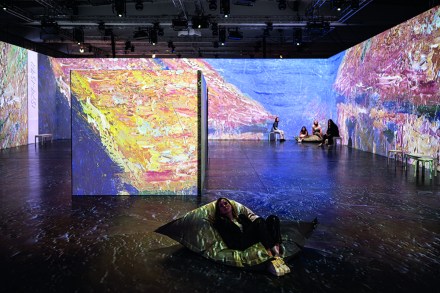
There are few topics that rankle the art critic more than “immersive exhibitions.” They must be second only to “nonfungible tokens,” whatever those are. I speak of the immersive spectacles where images of famous artwork are flashed on the walls and floors of a large white room in which you sit. Certainly, this should be outside the remit of my union card, I might think. Until now, if you were looking for some opinion on this-or-that out-of-copyright projection venue slash tourist trap, I would simply say not my job. Maybe go see the real thing. Then we can talk. And yet, with art on the walls, real or imagined, judgment always comes calling. Suddenly we seem to be immersed in immersion. It can be a challenge just to keep your head above the digital waters.

immersive

A seaplane out of Manhattan

In the awfulness of LaGuardia Airport, the small 1939 Marine Air Terminal stands out as a reminder of earlier and better days. Today it is arguably the oldest American airport terminal in operation. Shuttered for decades, the building was resurrected by the Pan Am Shuttle in the 1980s, then the Eastern Shuttle, then the Delta Shuttle, and most recently JetBlue. Here was a terminal made for commercial aviation before the age of the “airbus.” You might miss the Daily Planet details of the main hall if you only pass through the side door. Designed by William Delano of Delano & Aldrich, the terminal connects the classicism of the Beaux-Arts with the thrust of Art Deco.

seaplane
sergent

John Singer Sargent comes to Spain

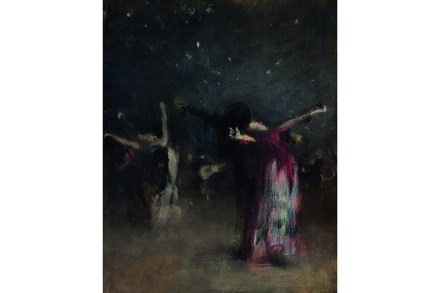
One of the great achievements of Spanish art is in its use of black. No other national school harnessed the dark arts to such effect. In Spanish painting, the color black might convey shadow, or the mystery of the unseen, while at the same time presenting a brooding presence, a dark mass right there on the surface. Just look at “Las Meninas,” Diego Velázquez’s masterpiece of 1656. Now consider the subject. Is it the five-year-old infanta? Her ladies in waiting, the “Meninas” of the title? The painter portrayed at his easel? The infanta’s royal parents in the reflection of a mirror? Some unseen viewer interrupting this tableau?

Zabar’s is still thriving

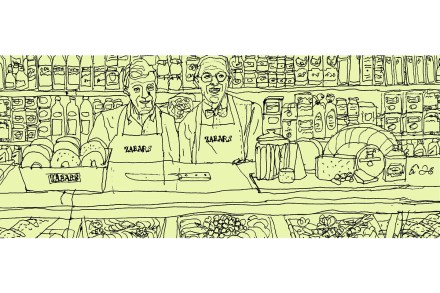
You might expect Zabar’s, the world-famous “appetizing” store on Manhattan’s Upper West Side, to have become a shadow of its former self. This seems to be the case for most of New York’s other independent specialty shops. Fairway, Balducci’s, H&H Bagels, Dean & Deluca: the food purveyors of my youth have gone kaput. They were bought, leveraged, expanded, overextended and oversold. They expired past their sell-by dates. But somehow Zabar’s survived. For the Upper West Sider, Zabar’s is our Yale College and our Harvard. Like many I make my way down to 80th Street and Broadway most weekends for continuing education. I head to the appetizing counter and take a number.

zabar's

Holbein at the Morgan

There’s a moment in portraiture when people started having a mind of their own. All of a sudden you see it in the faces: the eyes, the brow, the lip. We are no longer looking at a figure for all time — or even a sitter in a moment in time — but at something more like “me time.” The focus is not on outward appearances but inward looking. These people are lost in thought. That’s just where Hans Holbein the Younger, the great portraitist of the early sixteenth century, found them. The German artist, born into a family of painters around 1497, could conjure the smallest details at his fingertips. He quickly became the most sought-after portraitist in Europe and, by 1536, the court painter of Henry VIII (at a time when Henry himself was courting).

Holbein

Carnegie plus one

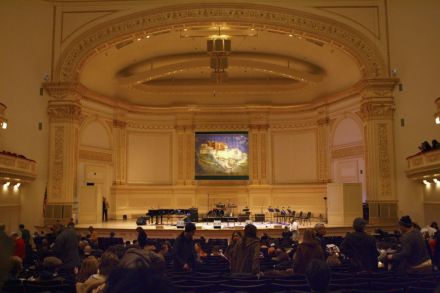
"A cable channel... but for classical music! It could be called ‘The Carnegie Hall Channel.’” I was on a beam reach to Eatons Neck about a quarter-century ago when a young man named Lawrence Perelman made this blustery pronouncement. We were Bill Buckley’s guests for an overnight sail across Long Island Sound. My first thought was: good luck with that. My second thought was no one wants to watch classical music on television. PBS’s Great Performances? More like lesser performances. With pixels the size of Cheez-Its and tin-can soundtracks, the experience was nothing like the real thing. But Perelman, an impresario who became an advisor to classical artists and institutions, as well as a friend, kept waving his baton long after we returned to Stamford.

Carnegie
pan

The pan handler

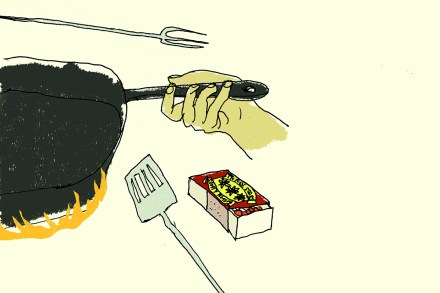
I have become a pan handler — a handler of cast-iron pans. I can think of few hobbies that are as rewarding as collecting and cooking on cast iron. Skillets, griddles, muffin tins, Dutch ovens, waffle irons, corn-stick pans and much else: there was a time when America produced the finest cast-iron cookware in the world. The iron ore was abundant. So was the coal to melt it. Foundries went up across this great land. American cuisine developed around it. From fried chicken to cornbread, the American menu should still be cooked on cast iron. Southern cooks never forgot this. The same goes for soul food; black America has always prized its cast-iron inheritance. Now I find I have little need to cook on anything else.

Hunter Biden: portrait of the scam artist

“Put your phone in your pocket and keep it there.” So I was told by the guard blocking the entrance of the Georges Bergès Gallery. I wasn’t going to argue. That’s because I was about to become one of the few to see The Journey Home: A Hunter Biden Solo Exhibition. I can’t think of many other art shows that have been more heavily discussed than seen. This critic is guilty as charged. But the press, and the public, are not all to blame for the ratio'd attention. The Journey Home has been open “by invitation only” for just about its full run. Invitations have not been abundant. You will not find the show listed on the gallery website or given any sense of its start or end.

hunter biden

Prints of Wales and elsewhere

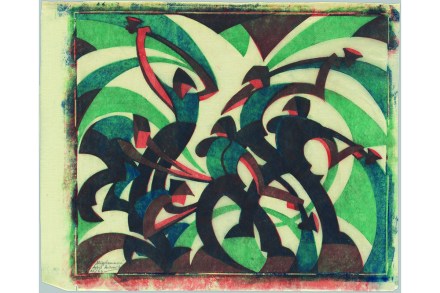
The print is a curious category in the world of art. Prints are not singular, of course — not typically at least. They are not ubiquitous, either — at least, again, not typically. They exist somewhere between art objects and art products. Printmakers often use the tools of sculpture to create works on paper. Three-dimensional carved objects become two-dimensional printed products. Think about it and you realize prints are far more curious than they let on. While art history typically does not know what to do with its curiosities, artists can sometimes make much out of the opportunities of hybrid creation.

prints

Hunter Biden, artist of modern life

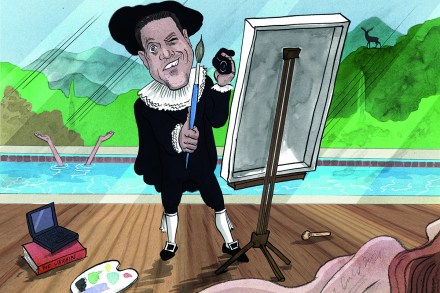
Why do we keep hearing about Hunter Biden? Why is this disgraced political son and aspiring amateur pornographer now making art? Why must we even contemplate his creations? The reason is that much of our culture — at least its sanctioned, outward-facing elements — now operates ‘against nature’. I refer to that 1884 novel by the Symbolist author Joris-Karl Huysmans. À Rebours, known in English as Against Nature, is the book in which French literature dispensed with naturalism and its common-man struggles, and instead gave voice to the rot of the elite. Before we dwell on Biden fils, let us briefly revisit Jean des Esseintes, the main character of Against Nature. He is the withered end of a once noble family.

hunter biden

Cuomo by design

'Please. I beg you. It’s not worth seeing. Avert your eyes. It’s all laptop screensaver crack smoke. Just please don’t make me write about Hunter Biden’s artworks.' Such were this critic’s fevered thoughts as the news of New York governor Andrew Cuomo’s resignation came across the Twitter-tape. And so we turn to another artist manqué. This time, he is a builder, a builder of works on the order of the Romans of the 1930s. And now, these works will remain unappreciated (such is the fate of true artists). So, let’s appreciate. 'Excelsior', this governor scrawled across the edifices and tunnels and apps of his numinous creation. 'Ever Upward', he helpfully provided just beside it in translation. 'It’s Latin!

design Andrew Cuomo (Getty Images)

The season for seersucker

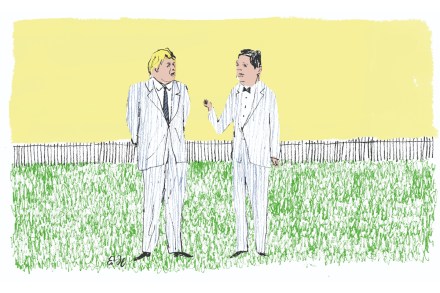
'To every thing there is a season,' we read in Ecclesiastes, and summer is the season for seersucker. No fabric is better suited for long summer days. Its lightness reflects the sun. Its pucker ventilates the skin. Rather than avoid the heat, seersucker dresses up for the hot occasion. Summers in New York are infernally hot. Seersucker makes it livable, if not always desirable. Since fashion dictates that seersucker only emerge between Memorial Day and Labor Day — timing that varies as you head south — its absence also makes its return that much more rewarding. As the weather warms, out it comes, radiating the light of summers past.

seersucker

Son of a gun

In his late-middle age, my father cultivated more of the interests of the old neighborhood. His kitchen overflowed with pasta makers and deli slicers. His prep table was taken over by a home wine-making operation; we ate our meals beside a glass carboy as it bubbled up fermented gas. And scattered about the living room, tucked in the bookcases and stashed behind the coffee table, he positioned an array of locked cases and bags containing a growing collection of rifles, pistols and shotguns. The acquisitions that came to fill our Upper West Side apartment mainly came from the shops around Little Italy. Home winemaking was once common among Italian Americans. So too was a well-developed sense for gun culture.

gun

Meet the Medici at the Met

Someone turned up the lights on portraiture in 16th-century Florence. Lyrical poetry went hard rock. Colors became high key. Posers now scowled at the oil-on-canvas flashbulbs, giving attitude, hands on hips, codpieces a-thrusting. Not that they even cared about looking as good as they do. Sure, they got dressed for the occasion, but notice the sprezzatura, the indifference in their eyes to the whole affair. That was the maniera moderna, the new mannerism in art, and no one captured it better than Agnolo Bronzino. Whether it’s the ‘Portrait of a Young Man with a Book’ (mid-1530s), his haughty painting in the collection of the Metropolitan Museum of Art, or ‘Lodovico Capponi’ (1550-55), his side-eye romancer at the Frick Collection, these figures are boys interrupted.

Medici

Cousteau was the boulevardier of the oceans

For a few years in my youth, I tried to be a scuba diver. In the deep pool of the 63rd Street Y, I learned how to clean my goggles and clear my air regulators. In a lake in upstate New York, I earned my certification by swimming around a junked car in 40 feet of murky water. I went on to dive to some cold wrecks in Rhode Island and to swim among the warm sea life of Key Largo. But it wasn’t for me. The bobbing boats and the heavy equipment caused much discomfort. In one dive I banged my head against the tank of my divemate and nearly got knocked out. It was all less elegant, and quite a bit more involved, than I had expected. My inspiration, of course, had been Jacques Cousteau. The French underwater explorer dived the world’s oceans a generation ago as both celebrity and icon.

Cousteau

Don’t sweat it

I miss my shvitz. At least once a week before the shutdown, I went to the Russian & Turkish Baths on 10th Street in Manhattan’s East Village. I saw it as my connection to the ancients. Here was a tiny remnant of classical bath culture surviving in the modern city. Or so I liked to believe. Like much else in New York, I now sweat for its return. Back when I was studying classical archaeology, I spent a week or so crawling through the ruins of the public bath house of Ostia, Italy. Even in that Roman port town, something like the Brooklyn of the empire, bath design exceeded anything in the post classical world. Each room had its own distinct shape and purpose.

baths

Hungry like the rabbit

In the darkest hour, there emerged a new light. It was 1940 when the double-barreled shotgun of the world first took aim at a little hole called home. At first, it seemed as if the hole’s inhabitant would be taken in by the old carrot trick. At least he would be careful enough not to stick his neck out. With an unblemished, white-gloved, four fingered hand, he feels around his immediate borders and takes the carrot. Of course, it’s a trap to draw him out. Did he know that all along? He would soon enough. The next time, it’s not a carrot but the hard steel of a gun aiming straight down his burrow. He flicks the barrels with his finger — plink, plink, plink — just to be sure. He tosses back the half-eaten carrot and pats the gun, but it is too late.

looney tunes

Porgy and best

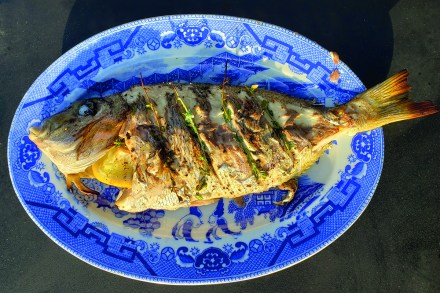
Give a man a fish, and you feed him for a day. Teach a man to fish, and you feed his esteem for a lifetime. There are few miracles greater than what rod and reel will conjure from the deep. So it has been for me as I cast away my cares in this uncertain year. In early spring, I delighted for the first time in the freshwater lake fish of New England. In the cooler months, bluegill, pumpkinseed, yellow perch and largemouth bass all swim close to the Connecticut lakeshore. Fishing from the shore in one such lake in Litchfield County, I found that a simple spinning jig or, better yet, a nightcrawler on a hook and bobber are all that is necessary for a strike. These frisky creatures can be as colorful as their names.

porgy