The jacket design of this splendid book shows Lewis Carroll’s Alice pulling back a curtain to reveal the door into Wonderland. In the original story, it leads to ‘a small passage, not much larger than a rat-hole’, at the end of which Alice notices ‘the loveliest garden you ever saw’. She is too large to squeeze through this doorway, but questions whether she might be able to defy the laws of physics and get into the garden anyway; after all, she tells herself, so many curious things have happened to her already that it seems ‘very few things indeed were really impossible’.
It’s hard to imagine a better metaphor for reading a work of fiction. Open a story like Alice’s Adventures in Wonderland and even tiny passages of writing can lead you to places where the usual rules of life are temporarily suspended. Most of us do this so often we simply take it for granted; but sometimes it’s worth reminding ourselves of what a mind-altering miracle the act of reading is. As Stephen King put it in his guide On Writing: ‘Books are a uniquely portable magic.’ Pluck one off the shelf and it can give you different personalities to try on and new experiences to try out, allowing you to be simultaneously yourself and someone else, or to be living here (this bedroom, this train, this waiting room) and elsewhere (New York, Narnia, the Ocean at the End of the Lane) without having to move a muscle. Reading turns the planet from a giant full stop into a limitless blank space we can populate with our dreams.
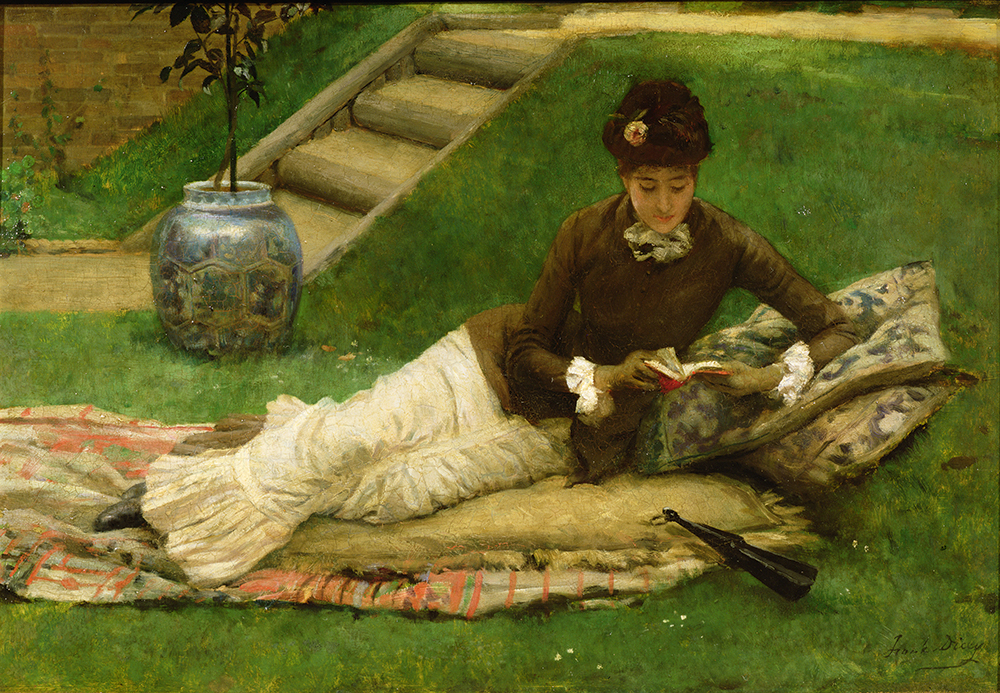
Pluck a book from the shelf and it will give you new personalities to try on and new experiences to try out
This could be true of any work of imaginative literature, but it’s especially true of the novel, a uniquely restless, rummaging literary mongrel that emerged in the 18th century, cobbling together elements of older forms, like conduct manuals, moral essays and prose romances, to create something entirely new. For the first time, Philip Hensher points out, people were no longer doomed to the lives they had been born into. Instead, they could imagine creating different possible futures for themselves, and with its rich range of characters and stories the novel was an ideal literary form for training up their imaginations. It allowed readers to explore alternative ways of living without having to commit to them just yet.
Explaining how this literary revolution came about is hard enough. What Hensher tries to do in his giant historical survey is even harder – namely, to describe the evolution of the novel in Britain from its origins to the end of the 20th century. The outcome is a story that is every bit as satisfying as a multi-plot novel, including some brilliant sketches of literary classics, such as Laurence Sterne’s Tristram Shandy – which continues to expand ‘until it often appears to be running on the spot with great energy’ – alongside fresh assessments of works like Rhoda Broughton’s ‘vividly responsive love story’ Not Wisely But Too Well (1867), or the ‘exceptional’ novels of social mobility written by her contemporary, R.S. Surtees, which at the time sold in their thousands but are now mostly gathering dust in university libraries.
Hensher’s main argument proceeds chronologically in six long chapters, each of which is sharply written and dense with literary detail. (The lack of subheadings might prove a challenge to some readers: in the middle of a 100-page chapter, the line between the critically exhaustive and the merely exhausting can seem quite thin.)
We move from early 18th-century experiments in the form to the Gothic novels of authors like Ann Radcliffe (‘a simply terrible writer… She doesn’t know anything’), and on to the gloriously loose, baggy monsters of Victorian novelists like Charles Dickens and William Makepeace Thackeray. From there we follow a well-trodden path – albeit one that still has plenty of surprises underfoot – that leads to the genre-bucking work of modernists such as Joseph Conrad and Virginia Woolf. Finally, after more than 500 pages, we arrive at contemporary novelists like Zadie Smith, who write with a bone-deep knowledge of the form’s history while still making something new from it, thereby demonstrating how 400 years later the novel can still be… novel.
Inevitably, confronted by such a brick-like book, it’s tempting to skip straight to the index in order to see what it misses out. Anyone who does this will find plenty of holes to poke into, such as Hensher’s near-total disregard for the sort of novels that regularly top the bestseller charts but have about as much literary merit as a bus ticket. (The comparative amount of space he gives to Jane Austen – 14 pages – and Julian Barnes – one-and-a-half sentences – suggests that although he presents himself as a literary omnivore, he is far happier when grazing on the high ground.) Other readers might reasonably point out that the novel has always been such a busily border-crossing form that trying to contain it geographically is like attacking a waterfall with a sieve. It isn’t just that many British novels have been reimagined in foreign contexts, as when the American teenager Holden Caulfield tells us in J.D. Salinger’s The Catcher in the Rye that he won’t go into his birth and lousy childhood ‘and all that David Copperfield kind of crap’, thereby quietly admitting where his own narrative voice has come from. It’s also that the borders of ‘British’ fiction turn out to be remarkably leaky when anyone tries to define them.
Think of James Joyce’s famous sign-off on the last page of Ulysses explaining where it was composed: ‘Trieste – Zurich – Paris’. Although written by an Irishman, and saturated with local details of Dublin life, Ulysses is in many respects a pan-European novel, and its influence has been equally far-reaching – including in Britain. That’s why ‘a history of the novel in Britain’ cannot be restricted to novelists who happened to live here, and why in Hensher’s study Joyce, who features in an early footnote and continues to flicker in the margins of what follows, becomes a figure a bit like the Invisible Man in H.G. Wells’s original 1897 story: physically absent but still detectable by how he affects his surroundings.
It’s likely that every reader who picks up A History of the Novel in Britain will compile their own list of minor gripes and grumbles, mostly reflecting the fact that Hensher’s assessment of novelist X or novel Y doesn’t match their own. What they should probably bear in mind is that the most important word in the book’s title is also the easiest to miss. This isn’t ‘the’ history of the novel in Britain but ‘a’ history – one reader’s experience of plunging into the library and seeing what grabs him, or what he can cling on to, as the pages rush by.
Thanks to the novel, people were for the first time no longer doomed to the lives they had been born into
Hensher’s account of this process is frequently brilliant, occasionally infuriating and always wonderfully entertaining, as he interrupts long passages of sober analysis with spiky footnotes: Margaret Oliphant produced a steady stream of ‘atrocious’ publications; another Victorian writer, Geraldine Jewsbury, wrote ‘probably the most boring novels I read while preparing this book’.
The same mixture of critical voices is repeated in the main text, where Hensher often lets his mask of dispassionate critical inquiry slip and confesses what’s really on his mind, like the ‘Italian operas of unresisting imbecility’ that were based on Sir Walter Scott’s novels; or Scott’s own tendency to set his plots in a remote historical period on the understanding that ‘he could get away with asking his characters to spout any old rubbish’. It’s the sort of mixture that could sound jarring until you remember that Hensher is a talented novelist himself, as well as a critic, and then his braiding together of these different perspectives makes perfect sense.
That’s because this is the first history of the novel that is bold enough to exploit the novel’s own imaginative resources, from the lofty overview of an omniscient narrator to the questionable motives of a first-person storyteller. The result is one of the most enjoyable works of literary criticism I have read for many years. There are some passages where you want to punch the air with delight. There are others where you want to punch the writer. And when you reach the final sentence, the book’s greatest triumph is that you are tempted to close it as quickly as possible so that you can pick up a fresh novel and plunge back into fiction’s endlessly surprising Wonderland.




Comments