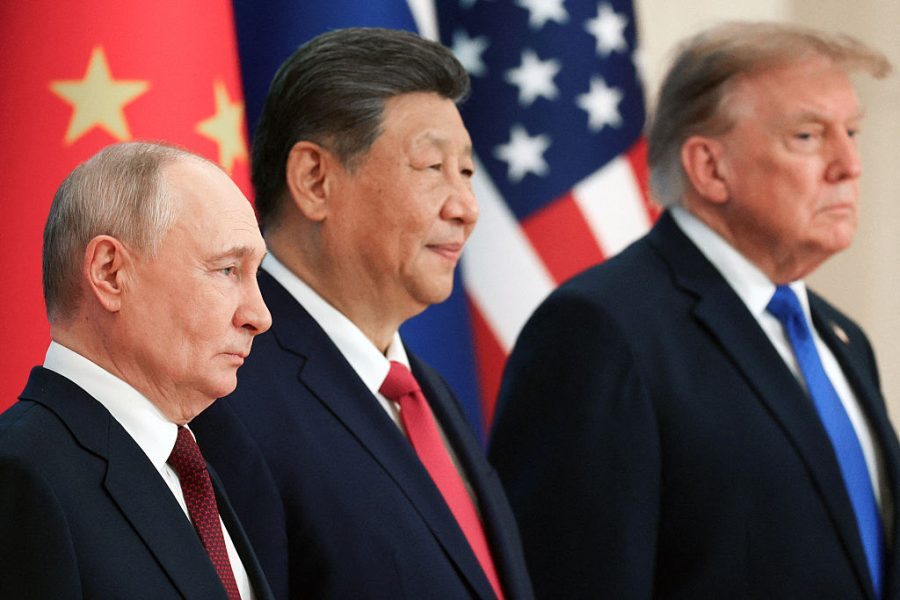
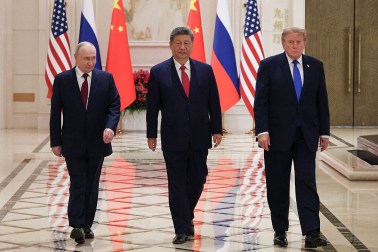
He may not have got a hug on the tarmac from Xi Jinping, but it’s been a good APEC summit in Shenzhen for Vladimir Putin nonetheless. Of course, the optics were always going to be good, with the trilateral meeting between Putin, Xi and Donald Trump elevating the Russian president to the same status as his superpower interlocutors. No wonder it has been hyped in the domestic media for days, even as they (rightly) downplayed the idea that this was ever going to be a “Yalta 2.0” dividing up the globe.
It is, however, about more than just optics. The Russians were not expecting any concrete agreements to emerge from the event but hoped to be able to accomplish three things.
First of all, keep the Donald onside. Whether the current round of Ukraine peace talks leads to anything is impossible to know, but the Russians are well aware that Trump, for all his inherent leanings towards Putin, is changeable and self-indulgent. At present, the US remains relatively supportive of Moscow’s position, but to maintain this, he needs constant attention from the man he described as “my friend.”
At the earlier bilateral meeting, the two men discussed Ukraine behind closed doors. No details have yet been released, but Putin’s team looked very satisfied afterwards. According to unconfirmed Russian accounts, this was an opportunity for Putin to sound reasonable, including over potential European participation in the peace talks, while doing what he could to keep the transatlantic divide as wide as possible.
At present, the US remains relatively supportive of Moscow’s position
Significantly, one of the four commitments in the “Declaration from Peace” that emerged from the subsequent trilateral is the increased production and supply of refined petroleum products “for the benefit of all countries.” Trump may believe that his new obsession with addressing the gas pump price back home has been addressed – although don’t expect such statements to have any practical effect any time soon – but in practice this sanctifies Russia’s desire for export earnings. Besides, the next time Ukrainian drones slam into Russian oil refineries, Putin will have a renewed opportunity to tell Trump that Zelensky is dissing him.

The second objective was to ensure that Moscow’s interests are embedded within any changes to the global order. Russia, China and the US – or at least Trump – all have their pet concerns, and Putin clearly wants to make certain that his are not overlooked, even while appearing supportive of the others’.
Two more of the Declaration’s clauses speak to this. One relates to “reforming the UN so that it can more effectively respond to global challenges and live up to its fundamental mission of international peace and security.”
To China, this means shifting the UN’s center of gravity away from the West and towards the Global South; to Trump, this means cutting costs. Putin is fine with both, but especially their common additional concern: that what Trump calls “rogue globalist organizations” do not infringe on the rights and sovereignties of nations. This is something Putin is happy to endorse so long as it means he gets to war as he pleases.
Indeed, the other relevant provision in the Declaration was a warning that “the International Criminal Court (ICC) and other similar bodies should not abuse their powers” and certainly not question the principle of “the immunities of state officials.” The United States signed but never ratified the ICC’s Rome Statute, so it is not a member. It has also imposed sanctions on it, claiming it was being used for “lawfare” against it. But as he continues to bomb and freeze the people of Ukraine, it is perhaps unsurprising that Putin is delighted to encourage Trump to undermine the power of international legal structures.
The third objective, though, was to make nice to China, too. It is not just that the increasingly-unequal Sino-Russian relationship is vital, but Xi pointedly refused to get sucked into discussions about Ukraine and has provided Putin with such a flattering platform.
One point of occasional friction has been Putin’s predilection for threatening or hinting at the potential use of nuclear weapons against Ukraine. Beijing is vehemently opposed to any weakening of the nuclear taboo, firstly because this is one area where its forces are vastly inferior to the US’s or Russia’s, but also because were it lifted, tactical nuclear weapons could make short work of any Taiwan-bound fleet.
By agreeing to reaffirm the line that a nuclear war cannot be won and should never be fought, Putin implicitly acceded to Xi’s wishes. He also supported his determination that Beijing not get involved in nuclear arms reduction talks – something about which Trump is enthusiastic – so long as its forces are so much smaller.
The right photo opportunities; evidence that the “isolation” of Russia has largely failed; ticking off his three main objectives. From Putin’s perspective, as he heads back home, it’s a job well done in Shenzhen.



Comments