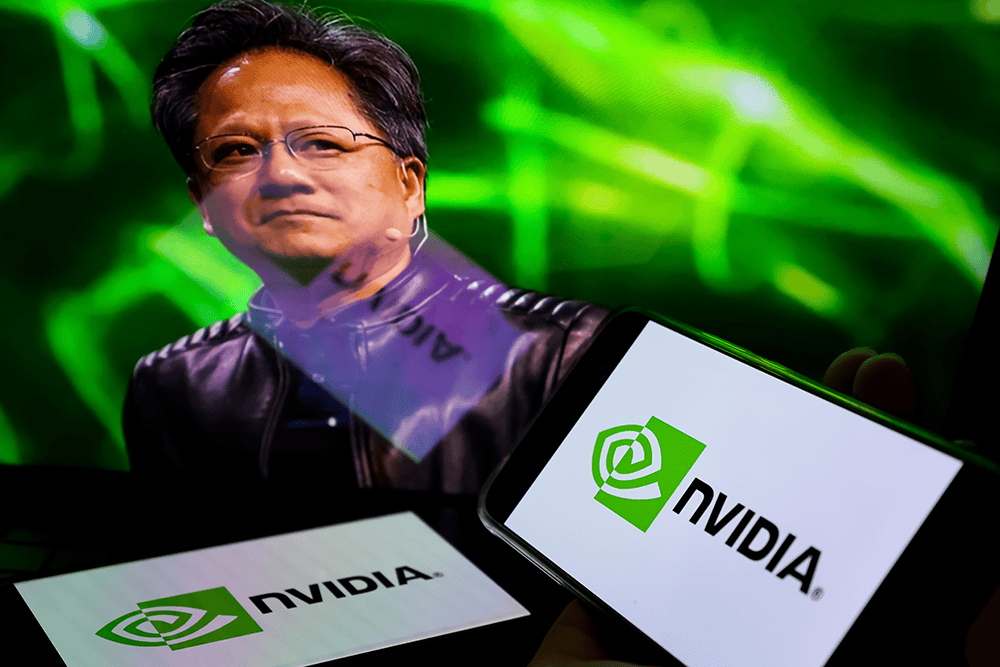


There’s little left to say about the super-chip in Nvidia ex-boss Jensen Huang’s trousers, except perhaps to launch a competition for alternative uses of AI. Not the epoch-making technology, that is, but the acronym itself, as in ‘amorous incontinence’ and ‘acrobatic infidelity’: readers’ suggestions welcome.
Meanwhile, cheerleaders for Huang, led by Elon Musk and Donald Trump, have called for his reinstatement as chief executive of the AI chip maker whose board demanded his resignation after claims of extramarital affairs with two colleagues and an alleged Chinese spy. Those would be career-ending sins in any normal organisation, but Huang’s case may be different.
Having co-founded Nvidia as a supplier of video-game chips in 1993, the Taiwan-born Huang drove it to the forefront of the AI revolution and the kudos of the first company to pass a market value of $5 trillion. Still worth $3.8 trillion after a share-price plunge, Nvidia’s specialness is partly its centrality in AI’s emergent ecosystem but even more to do with its weighty presence in investment portfolios the world over.
Whether you’re a pension fund, a charity or a wealthy saver, your fund manager will have put a chunk of your money into top US tech stocks because that’s where the hottest action has been in this decade. Within that allocation, Nvidia is often the biggest single holding, which means it may be the share most of us own – directly or unknowingly – more than any other.

In one UK charity endowment I oversee, Nvidia still accounts for 3 per cent of the entire global portfolio, and its recent fall represents a hit which gives rise to a moral conundrum. The modern no-no of sex with subordinates counted more against Huang than his dalliance with Beijing’s alleged Mata Hari. But no one doubts his superstar status in his industry – and if his return to Nvidia would send its shares back up again, restoring the reserves of struggling charities and millions of pension pots, should we be prepared to swallow our scruples?
Frontier perils
Huang’s salacious saga overshadowed both Nvidia’s third-quarter results – which surpassed analysts’ expectations with revenues of $116 billion, more than double 2025’s Q3 figure – and the flotation of Anthropic, the venture behind an AI assistant called Claude, marketed as ‘your thinking partner’. Due to start trading this week with a valuation of up to $1.5 trillion and Nvidia, Google and Microsoft among its core investors, Anthropic is another share that will find a place in standard portfolios, to be followed next year by its competitor OpenAI, home of ChatGPT.
These creators of ‘frontier’ AI models, capable of generating instant answers to every research question, are arguably more exciting long-term bets than either the chip suppliers behind them such as Nvidia and Broadcom or the real estate players that are racing to build sufficient data centres to power them. But that’s what the broader AI map looks like – and the peril in all parts of it is the colossal capital investment required to fulfil its potential, part funded by equity-raisings but much more so by debt.
In Anthropic’s case, that amounts to $900 billion of signed commitments for ‘computing resources, infrastructure and leases’ compared with just $33 billion of revenues for the first nine months of 2026. If Huang’s antics foreshadow a collapse of confidence and creditworthiness across the sector, as they say, go figure.
Microsoft mishaps
Continuing my IT theme, I fear you’d swiftly turn the page if I recited all the problems I’ve had with Microsoft’s Outlook email system, which does not like either my ageing Macbook or my even older BT internet account. But during the great Microsoft outage last week, my own messages seemed to whizz back and forth faster than usual – maybe because 400 million users elsewhere had accidentally been taken offline, leaving a channel unusually clear for my chatter. The Microsoft mishap, combined with supermarket fridge-hacking and ubiquitous AI scare stories, has provoked a reappraisal of dependency on technology beyond our control or understanding. While screen-addicted youngsters thrill to Grand Theft Auto VI but snort at the prospect of having to write on paper – as though they were being asked to use chamber pots and leeches – sensible Spectator readers, I feel sure, align with me on this issue. Neither all-out technophobes nor ardent adopters, we embrace useful, well-tested devices but stay firmly rooted in physical reality. That’s not only an insurance against malign actors and blackouts; it’s our handle on sanity.
Here endeth the lesson. But I’ll add an anecdote from my recent trip to the tech-mad US of A. When two dozen of my group lunched in a Chinese restaurant, a Texan financier offered to pick up the tab if we’d ‘Zelle’ our shares of it to his mobile number. A New Yorker suggested Venmo, which turned out to be another payment app – though I probably wasn’t alone on the UK side in confusing it with Flymo, which is a lawnmower, or Lumo, which is a train service to Newcastle. Later I thrust dollars into the Texan’s hand, with an apology in case my backward compatriots had left him short. Not at all, he said. ‘The Brits offered cash, it’s Americans who haven’t paid.’ Maybe they’re claiming an outage.
Spread the love
Enjoying a live performance by Brian Bilston, the ‘poet laureate of Twitter’ before it was X, I particularly liked ‘Alexa, what is there to know about love?’, which perfectly captures the alienation of digital life, and his insistence that AI really stands for Altered Images, the 1980s Scottish post-punk band whose lead singer, Clare Grogan, was his teenage dream-girl. But let me not steal his IP by quoting more: rather, let me urge you to buy piles of his physical books to spread awesome inspiration this Christmas.





Comments