

Having been told by a colleague last year that I was ‘The Spectator’s fiercest Trump critic’ (it was a less competitive field back then) I worried whether I would pass unchallenged into the US or languish in a cell at Philadelphia airport, owning up to phrases such as ‘the madness that has overtaken America’ trawled from a deep-state database. There was no immigration queue because there were few arriving foreigners, but the hostile tone of the ‘purpose of your visit’ question had me clenching in anticipation of the rubber glove.
Anxiety was unfounded: next came ‘Have a nice stay!’ and two hours later I was dining at a pavement table of the Parc bistro in leafy Rittenhouse Square. We might have been in provincial France, except no one had set fire to the nearby City Hall.
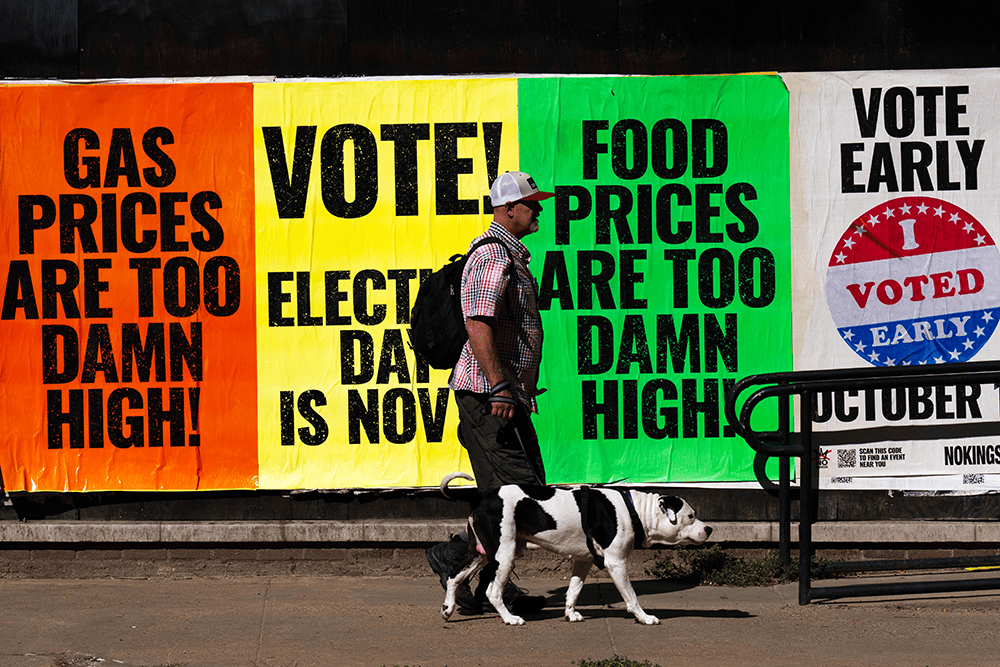
I attend a gathering in the US every other November, in the week of national elections. After Trump’s 2024 victory, I was amazed to find business as usual in Atlanta, even though Georgia was a swing-state battleground. Los Angeles in 2008 felt different, but Obama-mania swiftly evaporated. The truth is that most Americans care a great deal about the price of gasoline and groceries but a lot less than media coverage might suggest about which party wins federal power.

The Putin plot thickens
But do they care enough about their 250-year-old polity to want to see Trump impeached, now he’s been thrashed at the polls? Received wisdom says Democrats in Congress should focus on boosting whoever emerges as their presidential candidate for 2028, rather than trying to hold the incumbent to account for a catalogue of corruption charges that could be litigated till kingdom come. If there’s one item worth pursuing, however – so a disenchanted Republican suggested – it might be the slowing down of Ukraine’s Starlink and Starshield internet service last month, disrupting ability to intercept Russian jet drones and allegedly costing Ukrainian civilian lives before it was restored to full speed. Elon Musk, the tycoon behind Starlink, was clearly involved – and his $446 million of donations to Republican midterm campaign coffers has painted a big target on his back. But he claims all decisions on Starshield emanate from government, while Trump naturally denies any role in the episode.
On the other hand, whispers my Republican source, why would Musk have done such a thing unless Trump asked him to – ‘and what if Putin asked Trump to make it happen?’. In short, no conspiracy theory is too far-fetched for the fag-end of this stranger-than-fiction presidency.
Shed tears
Americans also care more than they used to about data centres. Opposition to new ones, for fear of high electricity prices, water shortage and AI-driven job losses, has soared. It was a factor in the Texas Democrat Gina Hinojosa’s gubernatorial win, while the likes of Governor Josh Shapiro of Pennsylvania have pivoted from gladhanding developers to corralling them with ‘guardrails’.
Resistance to data centres is likewise becoming an issue in the UK, on the basis that our electricity supply is inadequate, their ‘compute’ capacity will largely benefit US tech giants and we don’t like sinister sheds that emit a constant hum. Given our failure to attract other industrial investment, however, we should study Loudoun County in Virginia, of which a small area known as ‘Data Center Alley’, serving Washington’s military-industrial complex, generates household incomes that are double the national average and 40 per cent of local tax revenues. If the wide-open spaces of Texas reject these monsters, maybe we should welcome serried ranks of them to enrich the M4 corridor.
Track fault
On the rattling Piccadilly line to Heathrow (the twice-as-fast Elizabeth line had been knocked out by a ‘track fault’) I learned from a discarded copy of Metro that a milestone event for the HS2 rail project was happening that very morning. Tunnellers were breaking through to connect the half-completed route from Birmingham to the concrete box of the future Old Oak Common interchange, which is the largest new station to be built in Britain for a century but won’t greet its first traveller until 2036 at the earliest. Completion of the through-route to Euston remains in doubt, even for 2040.
Meanwhile, public interest in a project first mooted 25 years ago, whose costs have tripled to £103 billion, is so diminished that Metro’s page-four article was the only media coverage I could find other than in New Civil Engineer. But at least Metro’s reporter elicited a quote from rail minister Lord Hendy which, though far from eloquent, sums up the whole fiasco: ‘All of us are having real difficulty getting our heads around it.’
Making tax difficult
I’ve been having real difficulty getting my own head around the Chancellor’s latest £17 billion assault on the self-employed, imposing more frequent income tax payments, which will cause a cash-flow crunch in 2029 when the new system comes into force alongside current twice-yearly fiscal collections. This is the latest episode of the decade-long and many-times-delayed Whitehall farce that is ‘Making Tax Digital’, which I have previously castigated as ‘a model of how not to make public-service change happen while passing the buck and the stress to the hard-pressed citizen’.
Is Labour really so hostile to self-starters? A chance hotel-breakfast conversation provides a parable. Here is a young British entrepreneur whose south London company supplies food products to supermarkets across the UK. But he runs it from Dubai, where he moved to a gated compound with every facility for a comfortable, lower-tax life, including a school, half of whose parent families are Brits in exile from ‘a government that just wants to punish us’.




Comments