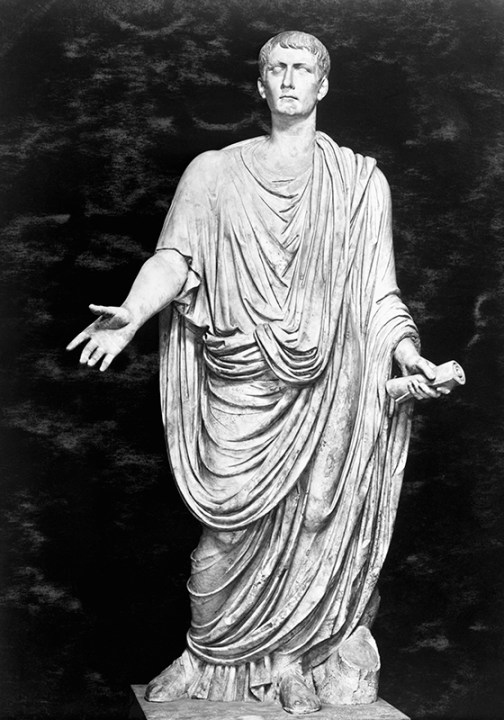


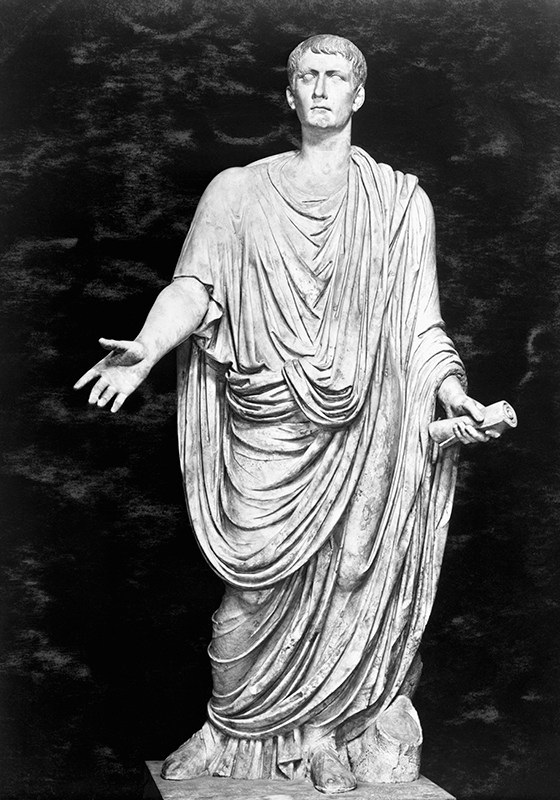
Elissa Slotkin, Abdul El-Sayed and James Talarico seem very far away. I came to Rome a few days ago to talk about “the Humanities and Democratic Governance” as part of a two-day conference on “Classical Foundations and Moral Authority.” One of the first things I did on arriving in the Eternal City was to scout out the spot where Julius Caesar was betrayed and murdered in 44 BC. I noticed a small bouquet of flowers commemorating the hallowed place where Pompey’s theater had once stood. A few days later, visiting the Forum, I saw more flowers, coins and other offerings at the ruins of the temple that Augustus had erected on the spot where the crowd had cremated Caesar following his assassination. I was told there would be no math, but I believe the event commemorated took place 2,070 years ago.
Opinions about Caesar differ. As a general, he ran up a pretty large butcher’s bill. Plutarch estimates that his conquests in Gaul cost a million dead and another million enslaved. But there are many items on the plus side of Caesar’s ledger. There was a reason, after all, that the people loved him. He did a lot to make their lives better. Rome was safer, more prosperous and more powerful because of his activities. Was Caesar’s authority a “moral authority”? When thinking about outsize historical characters such as Caesar, I always recall Horace Walpole’s observation that “no country was ever saved by good men because good men will not go to the length that may be necessary.”
If the humanities teach us anything, it is that nothing in this changeable world is settled for good
That sort of thing makes many people squeamish. If we have to have heroes, we prefer that they be without blemish. But it may be that one of the chief benefits of “the humanities” is to complicate our moral calculus. Studying the humanities does not relieve us of the obligation of judgment or its effect: action. But such study does remind us that the humanities have to do with human things. And human things are edged about with oddity and imperfection. “Homo sum,” the playwright Terence wrote, “humani nihil a me alienum puto”: “I am a man, nothing human is alien to me.”
Terence’s confession, I hasten to add, does not imply the enervating relativism of “Tout comprendre, c’est tout pardonner.” On the contrary, its chief effect should be to extend the realm of our humility. When we ask about the relation between the humanities and “democratic governance,” we should begin by recognizing that “democratic” is basically a eulogistic, not a descriptive, term. That is, there is no necessary link between the study of the humanities and the triumph of democracy (or any other form of government for that matter).
The real issue, I think, is less declarative. Those people laying down flowers or coins for Caesar: what is implicit in their commemorative gestures? What are they remembering? What power are they seeking to channel? Santayana said that he who is ignorant of the past is condemned to repeat it. Does that suggest that historical knowledge is somehow redemptive, that it might reprieve us from such repetition? Such a hope stands behind conference topics such as “the Humanities and Democratic Governance.”
In one of his essays on humanism, T.S. Eliot warned that culture was more than a parade of names and phrases, first prize in the game of so-called “cultural literacy.”
If you “boil down Horace, the Elgin Marbles, St. Francis, and Goethe,” Eliot said, the result will be “pretty thin soup.” “Culture,” he concluded, “is not enough, even though nothing is enough without culture.” Eliot went on to link cultural aspiration with religious affirmation. “Either everything in man can be traced as a development from below, or something must come from above. There is no avoiding that dilemma: you must be either a naturalist or a supernaturalist.”
Perhaps so. But that “something from above” can be understood in a multitude of ways. What Eliot elsewhere commends as “the historical sense” – the “perception, not only of the pastness of the past, but of its presence” – provides entrée to the humanist’s estate. It is not primarily a matter of facts and figures, the march of “events, my dear boy, events” (as Harold Macmillan put it), but the ineluctable claims of place, people, identity. “We do not merely study the past,” the philosopher Roger Scruton noted, “we inherit it, and inheritance brings with it not only the rights of ownership, but the duties of trusteeship. Things fought for and died for should not be idly squandered. For they are the property of others, who are not yet born.” Thus those anonymous pilgrims paying homage to Caesar 2,000 years after his murder.
What does all this have to do with “democratic governance”? Consider The Federalist Papers. Alexander Hamilton posed the key question in the first of those 85 newspaper articles supporting the adoption of the US Constitution. Are men “really capable or not of establishing good government from reflection and choice”? Or are they “forever destined to depend for their political constitutions on accident and force”? Hamilton, James Madison and John Jay expended great labor trawling through the graveyard of failed or imperfect polities to forge an answer. Most would agree that they did a pretty good job.
That said, their efforts were by no means final. If the humanities teach us anything, it is that nothing in this changeable world is settled for good. “What form of government have you given us?” a lady asked Benjamin Franklin as he left the Constitutional Convention in 1787. “A republic, madam,” said Franklin, “if you can keep it.” Can we?





Comments