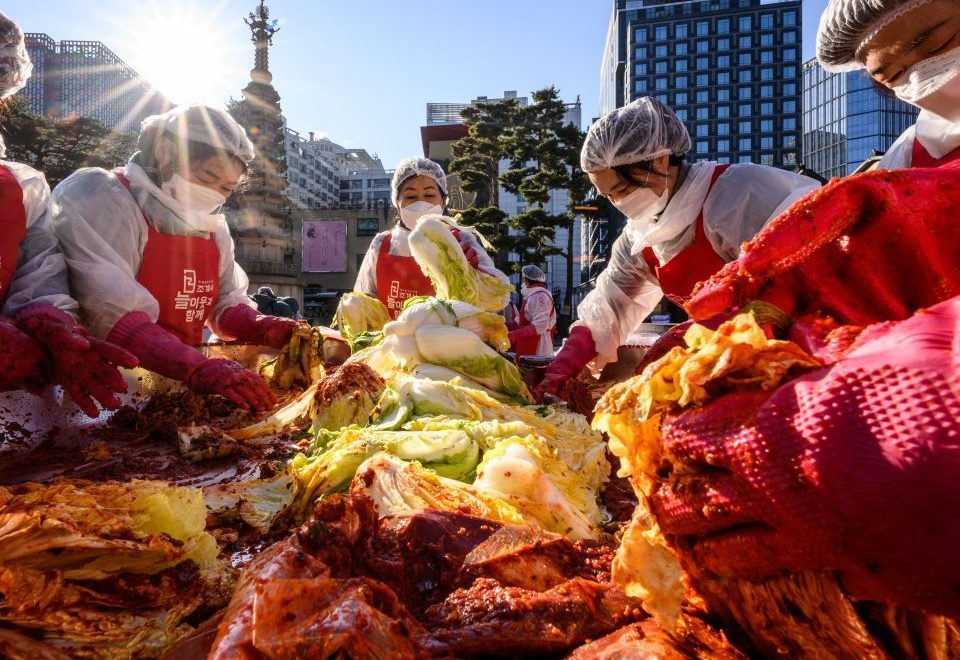
Kimchi: a traditional Korean dish made with salted, fermented vegetables. Records indicate it is at least 2,000 years old, though the modern kimchi as we would recognise it – napa cabbage generously coated with a thick paste of garlic, ginger, gochugaru chilli flakes, and fish sauce – only became widespread in the late 19th century.
When it comes to food, we all find ourselves craving the familiar, unadulterated tastes of childhood
The importance of kimchi to Korean national identity and culture is hard to overstate. Many Koreans eat kimchi every day, if not at every meal. During the Vietnam War, South Korea’s President Park personally implored Lyndon Johnson to help provide kimchi rations to demoralised Korean soldiers at the front. Johnson approved this request, at a cost of about $2 million annually, catalysing the industrialisation and mass commercialisation of kimchi. More recently, the South Korean government spent years and millions of dollars on R&D to get a space-certified kimchi ready in time for the nation’s first astronaut aboard the ISS in 2008.
Though some Koreans sought to distance themselves from kimchi after the war, associating it with deprivation and shameful colonial-era memories of being shunned due to its smell, over time it became a fiercely protected source of national pride. Kimchi received iconic status on the international stage when it was included as one of the official foods of the 1988 Olympic Village.
Since then, Korea has fought two ‘kimchi wars’ with Japan and, far more controversially, with China over its heritage. In 2013, kimjang – the centuries-old, communal Korean practice of making a whole year’s worth of kimchi in the late autumn – was inscribed by UNESCO as Intangible Cultural Heritage.
For Koreans, homemade kimchi is the ultimate symbol of maternal love. All throughout university, I lived in fear that my mother would ignore my protests and send over a pungent package, leaving me to have a very awkward conversation with the porters. I explained I didn’t need it because I didn’t eat Korean food during term time. ‘But Sang-Hwa,’ she would tell me, ‘you can have it with everything!’
It’s true, Koreans do add kimchi to everything, including Western classics like pizza, burger, and pasta. In fact, many Korean tourists bring their own kimchi to counterbalance the food they encounter here, which they find too oily, heavy, and sweet. Some, especially the elderly, are even known to open a tub of kimchi at restaurants, though the more considerate ones will usually wait until they return to their hotel rooms.
Most popular
John Keiger
France’s school riots offer a bitter taste of what will happen if Le Pen wins

I was therefore much amused to recently read in the Daily Mail about Gen Z’s Sunday roast ‘makeover’. Their culinary innovations (or abominations, depending on your perspective) include: adding ketchup and mayonnaise, swapping roast potatoes for mash, leaving off gravy and Yorkshire pudding, and replacing traditional trimmings with… kimchi.
As a senior member of Gen Z (and a boomer at heart), I have usually missed every fad and trend. But faced with the looming end of my twenties, I decided to embrace my youth and see what the fuss was all about. Lacking the skills and kitchen space to prepare a roast at home, I had to find a suitable pub nearby. Lacking even more the social obliviousness of a Korean octogenarian, I broke out in sweats as I furtively opened my Tupperware of kimchi and, trembling, placed some on my plate in a small pile discreetly hidden beneath the canopy of my Yorkshire pudding. I dragged my partner with me to share in my embarrassment – though, as the Asian one, I was inevitably the main target of the curious stares.
I have to give it to Gen Z. To my surprise, the kimchi worked extremely well, especially with the cauliflower cheese. Its tangy acidity and crisp, effervescent texture provided a striking contrast to an otherwise rich and heavy meal, while its cool temperature offered a welcome sensation of freshness. It acted as an effective palate cleanser much in the way a good glass of wine would – except it awakened novel areas of my taste buds with unfamiliar, yet strangely invigorating combinations.
Would I have it again? Definitely, but perhaps not as my weekly staple. Particularly when it comes to food, we all find ourselves craving the familiar, unadulterated tastes of childhood. As exciting as novelty may be, sometimes you just want the boring, predictable comforts of tradition, preserved and handed down to you over generations. I love both Korean and English cuisine; I also like to enjoy them without mixing the two all the time.
That said, the flavours of the kimchi roast were undeniably fantastic. Who knows? Maybe this will eventually become a classic Anglo-Korean pairing, seamlessly woven into British culture like chicken tikka masala or curry sauce with Friday night fish and chips. And there is a thrilling alchemy to good fusion food. As my better half said as we got up to leave: ‘Kimchi is innovative. Ketchup is just gross.’






Comments