
There are few things more delicious than falling down a rabbit hole. No, don’t worry, I’m not serving up a second recipe for rabbit in a row. I mean discovering a recipe or dish which, not only have I not cooked or tried before, but haven’t even heard of. A little while ago, a reader asked me about Hawkshead cake, which Beatrix Potter used to make with her husband at Christmas. Hawkshead is the village Potter grew up in, in the Lake District, and the cake is actually more of a tart, made with puff pastry and filled with currants and syrup.
This is where the proverbial rabbit hole came in, because I couldn’t quite stop there. I then learned about the whole class of sticky currant cakes which come from the north-west, which include my own local Eccles cake, and the Chorley cake, but also the much lesser known Bolton flatcake, Lancashire tart and Hawkshead cake. All, it seems, are some variation on pastry (usually puff
or shortcrust), currants and something sweet to bind them.
Both ginger and rum are used in abundance, so the tart thrums with spice and booze
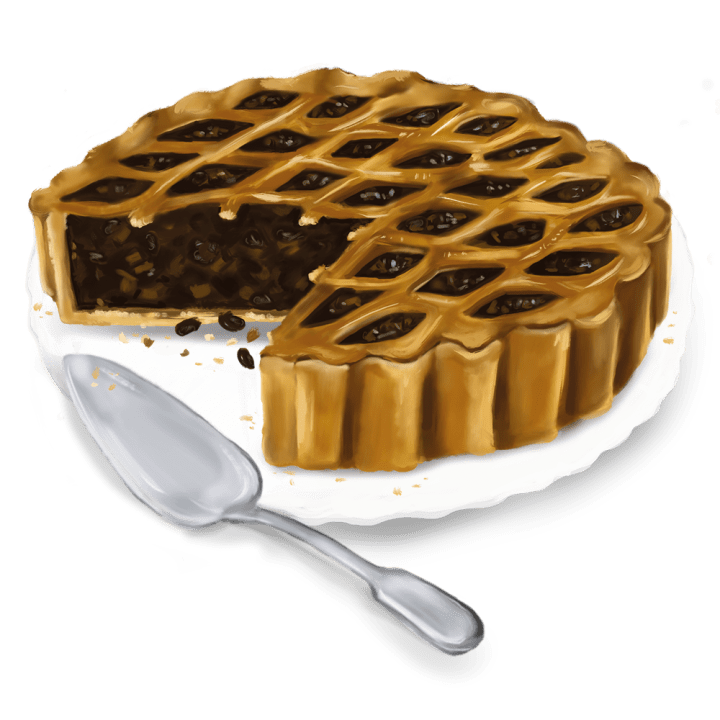
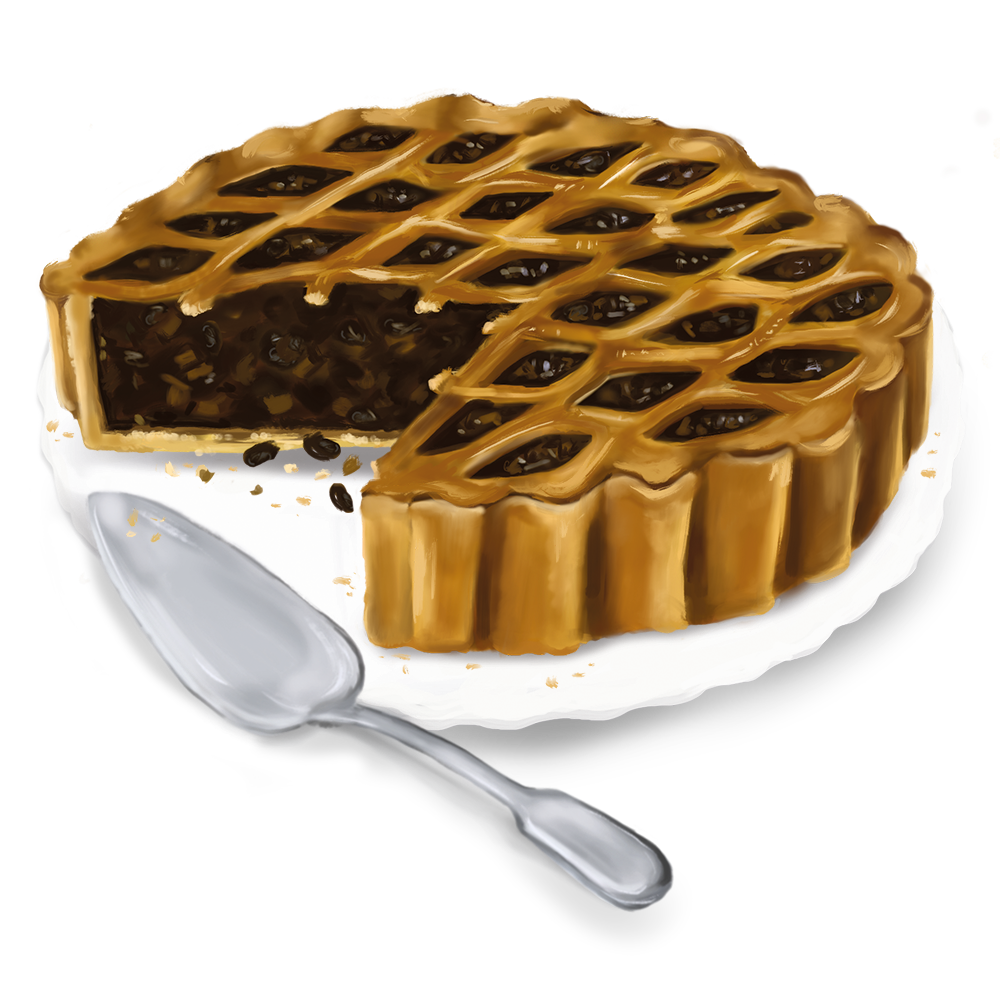
Finally, this culinary labyrinth led me to the Cumberland rum nicky, a shallow shortcrust pie with a filling of sliced dates, stem ginger, dark sugar, butter and rum. It has a pastry top, too, which can be latticed, or complete but with little holes poked into it to let the steam out – it’s likely that its name comes from these ‘nicks’ in the pastry. The filling is usually bulked out with raisins, currants or sultanas or, in some cases, dried apricots.
Here, it’s the filling that had me hooked: it’s obviously quite similar to a standard mincemeat, but this particular combination of dates, ginger and rum was new to me. It felt terribly exotic for its time. I found myself thinking about it in idle moments, telling people whom I knew had absolutely no interest in this hypothetical tart – a tart I had never even seen eaten let alone cooked – about it
at length. I’ve always been fascinated by those dishes and recipes which are hyper-regional, known and loved in a place to a point where they bear its name, play a role in its very identity, but never really make it beyond county lines.
The rum may seem a singular choice for a tart or pie made in Cumberland in the 19th century but just preceding that time, the ports in the north-west of England had grown in significance. What had begun life as local fishing ports became important trading posts for the triangular trade between England, West Africa and the Caribbean. England would export cloth and other goods to West Africa, from where slaves would be transported to the Caribbean; the products of that slave labour would then be sent back to England, often arriving in Whitehaven, a port in what was then the county of Cumberland.
It is an unavoidable and uncomfortable fact that our sweetest baking traditions would have been impossible without the slave trade. Imports like rum, ginger and unrefined sugar would arrive here from the Caribbean meaning that ingredients which would have been unknown or unattainable were comparatively common to those local to these ports. So, at the turn of the 19th century, when this trading was at its height, common local north-western dishes would feature these unusual-for-the-time flavours.
Think of it as a spicy, sticky mince pie, but on a larger scale. Both ginger and rum are used in abundance, rather than homeopathically, so the tart thrums with spice and booze. The dates bring their natural sticky, toffee jamminess to the proceedings and are such a natural enhancer of mincemeat, they should become a standard component. Rum and melted butter are particularly happy bedfellows – allow yourself a moment as the two meet in the mixing bowl, and whoosh! The whole room is filled with their scent: sweet, woody, spicy, nutty, rich. I would wear it as a perfume. This pie also doesn’t need blind-baking, which feels like a gift to the cook. I can imagine it with chopped pecans mixed through the filling, though I could never commend something so inauthentic to you.
Serves: 8
Hands-on time: 30 minutes
Cooking time: 30 minutes
Pastry
300g plain flour
30g icing sugar
150g butter, cold and cubed
½ tsp fine salt
2 large egg yolks
Filling
50g butter
100g raisins
200g pitted dates, stoned and sliced
125g stem ginger pieces, diced
3 tbsp dark rum
50g dark brown sugar
- Stir the flour, icing sugar and salt in a large bowl. Rub the butter in, before adding one egg yolk and just enough cold water to bring the dough together. Wrap in clingfilm and refrigerate for at least an hour.
- Melt the butter and combine with the dates, ginger, raisins, rum and dark brown sugar, and stir well. Leave to stand for an hour.
- Preheat the oven to 180°C. Divide the dough into two pieces, one twice the size of the other. Roll the larger piece into a disc to cover the bottom and sides of a shallow 20cm tart tin. Lay the pastry flush against the base and sides; trim the overhang to a centimetre above the edge of the tin. Paint the edge of the pastry with a little water.
- Stir filling and spoon into the tin.
- On a floured surface, roll the smaller piece of pastry into a disc slightly bigger than the tin. You can poke holes in the disc, opening them up a little, or use a lattice roller to make a lattice top, or cut the pastry into strips and lay these in a lattice pattern. Press the edges to seal the top with the base, then trim away any excess. Brush the top with the egg yolk.
- Bake for 30 minutes, cool for 15 minutes, then remove from the tin. Serve warm with clotted cream.
Join Olivia Potts for Truffles and Trattoria in Rome on 2-6 December 2026. For more details about this Spectator Club trip, go to spectator.co.uk/tastings





Comments