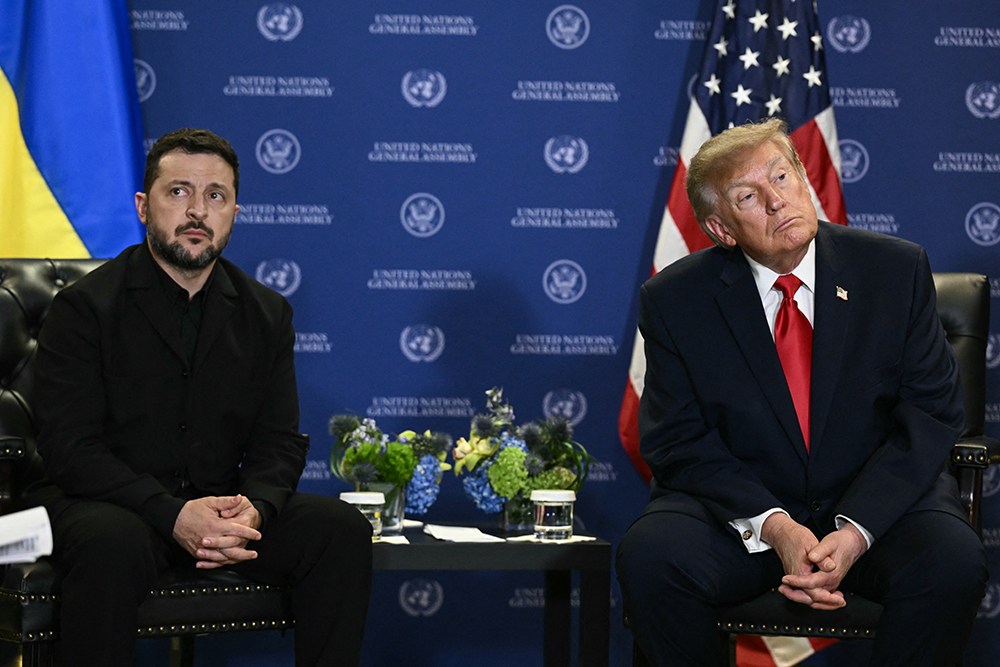


Has Donald Trump effectively changed sides in the Ukraine war? Over just a few tumultuous days, Trump’s already rocky relations with Volodymyr Zelensky have tumbled into something close to irreconcilable breakdown. After Trump announced that he would be de-sanctioning Russian diesel exports in an attempt to lower global prices, Zelensky had the temerity to call him “weak.” Trump responded bluntly that “it’s time for Ukraine to get a new president,” then squarely (and unfairly) blamed Zelensky’s continued strikes on Russian oil refineries for an international fuel price spike. For good measure, he announced that the Prioritized Ukraine Requirements List (PURL) initiative by which European governments buy US armaments to donate to Ukraine would be wound up – while senior officials reportedly threatened that the US would no longer share satellite intelligence with Kyiv. Trump is now aligned with Putin insofar as both are calling for Zelensky to go. More, Trump seems hellbent on crippling Ukraine’s ability to fight on.
Ukraine can probably be bullied into submission by Trump’s heavy-handed methods
Much of what has been going on between Washington, Moscow and Kyiv over the past week appears inexplicable. Trump’s agreement to allow Russia to export up to five million tons of diesel is too small to ease a supply crunch significantly, but it will boost the Kremlin’s war economy and hand Putin a significant diplomatic victory. The PURL procurement instrument has so far funneled nearly $7 billion of European money direct to US arms manufacturers. Ending it hurts both Ukraine and the US military industrial complex. And US satellite intelligence has been the backbone not only of Ukraine’s targeted deep strikes all over Russia but also of the country’s defensive shield against incoming drones and missiles launched from Russia. Cutting off that vital US intel hampers Kyiv’s offensive capabilities while crippling its ability to defend Ukrainian cities.
Even stranger was Trump’s announcement that both sides had agreed to an “energy ceasefire” for 60 days, with Kyiv refraining from hitting refineries and Moscow holding back on destroying Ukraine’s electricity infrastructure. But no such agreement had been made, as was quickly made clear when Russia launched yet another devastating wave of attacks against substations and transmissions hubs.
Seen from Kyiv, Trump’s moves look very much like an attempt to force Ukraine to make peace on Putin’s terms. But emerging details of a peace plan discussed in Miami last Friday show that there could be a method behind Trump’s apparent madness. The “four-pillar” plan was discussed by Trump envoys Jared Kushner and Steve Witkoff with top Ukrainian representatives and reported by the Washington Post.

Key to the peace deal is the idea that Putin would not just end his war but also sign up to a new economic and security architecture for Russia, Ukraine and Europe that would restore stability to the region and prevent future conflict from flaring up again. The first pillar of the deal would be finding ways to finance Ukraine’s reconstruction, from rebuilding the devastated areas of the country to providing benefits for families of dead and wounded soldiers and restoring the shattered economy. The second component would be to provide security guarantees for Ukraine in the form of a pledge from the US and European nations that they would respond militarily if Russia attacked again – but, crucially, would not include NATO membership. The third pillar would be the economic reintegration of Russia, Ukraine and Europe through an energy deal that would include reopening pipelines carrying Russian oil and gas to Europe, with Ukraine and Russia splitting the profits.
The last and most tricky part of the deal focuses on how exactly to partition Ukraine and on the status of the Russian-occupied territories. According to the Washington Post, the Miami deal envisions partition along the current line of control, with some mutual territorial swaps to rationalize the new border. But getting that concept agreed requires the Ukrainians to acknowledge that they have lost the occupied lands and for the Russians to drop their demands for Kyiv to withdraw from the remaining 11 percent of Donbas that remains under Ukrainian control.
The Miami peace plan – which is essentially picking up where negotiations between Moscow and Kyiv left off when talks in Istanbul were broken off in April 2022 – will be highly controversial for both sides. But it does have the one indisputable merit of an immediate cessation of hostilities, sparing the lives of thousands of soldiers and civilians and avoiding a winter in which a swath of Ukrainian cities will be rendered uninhabitable by Russian strikes. For Trump, a ceasefire would also have the added benefit of bringing down global fuel prices caused, in reality, by the ongoing Hormuz crisis precipitated by his own decision to attack Iran.
Ukraine, which is desperately reliant on satellite intelligence and on supplies of US weaponry, can probably be bullied into submission by Trump’s heavy-handed methods. Europe, for all its promises to support Ukraine, simply doesn’t have the military manufacturing capability or the satellite networks to replace America.
More fundamentally, Europe, facing its own looming fiscal crisis, is also running out of money to continue to fill Ukraine’s endless financial black hole. And decades of green energy policies have left Europe fatally dependent on energy imports – including from Russia. European leaders decried Trump’s lifting of diesel sanctions – a $100 million deal – yet Europe has paid roughly €8 billion for Russian Liquefied Natural Gas (LNG) this year alone and more than €238 billion for Russian energy supplies since February 2022. Indeed, Europe’s imports of Russian LNG have risen by nearly 10 percent since the Hormuz crisis cut off supplies from Qatar.
The biggest question over the Miami deal is whether Putin is ready to call a halt. Russia roundly ignored Trump’s announcement of an energy ceasefire, and Kushner and Witkoff came away from meetings in Moscow last month with zero concessions from the Kremlin’s side. Clearly Putin believes he is on the brink of precipitating the political, military and economic collapse of Ukraine. And Trump’s attempt to force Kyiv to abandon deep strikes – Ukraine’s most effective tactic of this stage of the war – may not be enough to convince Putin to stop.





Comments