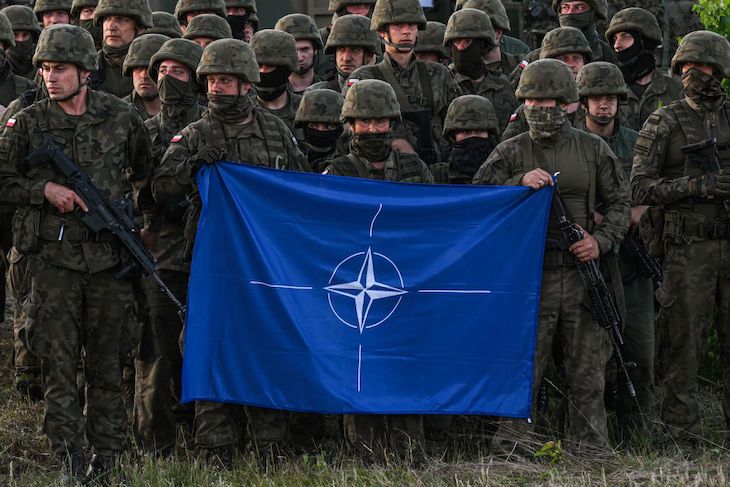
Amid the Sturm und Drang of Donald Trump’s White House and Pete Hegseth’s Pentagon, General Alexus Gregory “Grynch” Grynkewich laid-out what he terms NATO’s “Theory of Victory.” This is a concept of operations that will “block the initial attack… blunt it and prevent further advance. And, if required, break the enemy’s forces and the operational war fighting system that is arrayed against us.” In short: Block, Blunt, and Break.
General Grynkewich was careful not to point fingers but the location of his talk, at the Warsaw Security Forum, left no doubts as to who the potential “adversary”
General Grynkewich is both SACEUR (Supreme Allied Commander Europe, NATO’s lead operational commander) and USEUCOM, the commander of all US troops in the European theater. He was explaining how NATO, derided once by French President Emmanuel Macron as “braindead,” would fight and win. Grynkewich was careful not to point fingers, but the location of his talk at the Warsaw Security Forum left no doubts as to who the potential adversary is.
The message to Russia’s President Vladimir Putin was clear: we see you and we are ready for you. The General stressed that the “Theory of Victory” sits within the broader NATO strategy of Deterrence and Defense of the Euro-Atlantic area, or DDA. He reiterated what has always been NATO’s purpose, “to preserve peace,” and that deterrence of aggression was sought. He was not, he said, laying-out a plan for conquest.
The theory was not described as a plan, but enough detail was provided to get a sense of how a conflict might evolve. Grynkewich believes NATO possesses what he called the “decision advantage” over Russia, based on superior intelligence gathering and analysis. He does not believe NATO countries would be taken by surprise – the hope is that aggression could be identified and rapidly responded to, and that this would deter the adversary.

However, should deterrence fail, land forces would block enemy advances, maneuver to fix enemy formations, deny further seizure of Alliance territory and so destroy his advancing forces. All of this will be accomplished in concert with NATO’s air forces, navies and space and cyber forces. Once the block is achieved, the enemy’s ability to sustain its offensive or maneuver its second echelon forces will be blunted by, “Synchronized employment of multi-domain effects down to the tactical level”, an updated version of General Guderian’s aphorism to concentrate force to win, “Boot ‘em; don’t spatter them.”
And, if that doesn’t work, Nato will then proceed to break the war fighting system of the adversary, layering high-end and highly effective precision munitions with, “…an overpowering mass of affordable and scalable systems.”
Pressure on the adversary will be constant and unyielding, through and across all domains, land, sea, air, space, and cyber. Enemy forces will be starved of replenishment, their commanders unable to control, and support facilities reduced and destroyed.
It is a compelling vision and one that has been drawing on lessons from the Ukraine conflict: the Block reflects how the Russian advance was held initially, then thrown back; the Blunt, to systematically target and destroy, especially in the Crimea, Russian support and logistics areas by the use of cruise missiles, drones and rockets; and the Break, using hybrid drone cruise missiles, with ranges in excess of 600 miles, to strike strategic targets throughout Russia. The difference being that Grynkewich hopes and expects that the collective will, resources and firepower of Nato will overmatch any Russian response, unlike the Ukrainians who, however competent and brave they are, will always be on the resources back-foot. And this is where the vision, however cogent and well thought-out it is, may start to unravel.
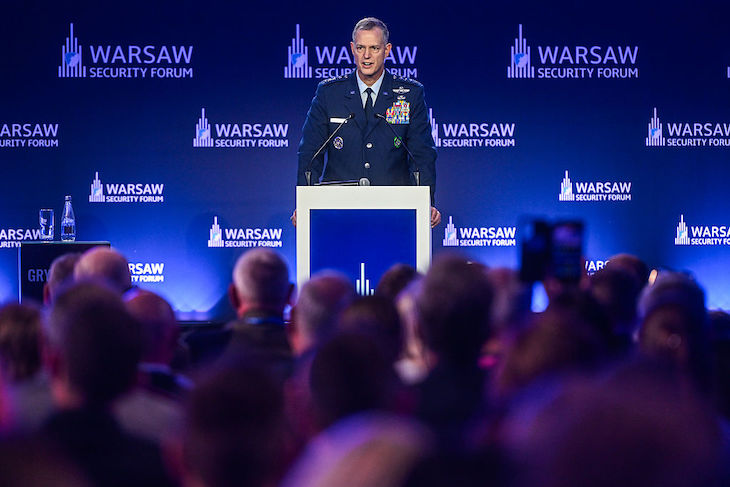
Grynkewich was very open why he was giving this briefing now; in classified form, it has been circulating for over a year. While he himself stated that he did not assess that conflict was imminent or inevitable, in the Q&A, he said that he recognized, “…with the amount of activity that’s going on, in terms of sabotage and arson, I think our populations are… a bit nervous.”, which probably counts as one of the understatements of the year.
So revealing this now is designed to help calm nerves, which is a reasonable objective, given that one of Russia’s disinformation objectives is, by contrast, to sow dissension and doubt. But beyond the rhetoric, and Grynkewich saying that, “we’ve got this”, he also rightly stressed that this will take the one billion citizens of the alliance working together; that may be more difficult to achieve.
The General, at the beginning of his presentation, had praised the Poles for their determination to carve their own destiny, and specifically, their leadership in defense with historic levels of investment, an expanded industrial base, rapid military mobilization and a focus on societal resilience. They have, in SACEUR’s words, taken, “…deterrence and defense seriously”; Poland, for him, is, “..where actions match words.”
No doubt the UK contingent at that briefing, but perhaps some other countries as well, were squirming at that point. But his, and our, other challenge is whether the US will remain as the indispensable glue that holds the current version of Nato together? His population figure for the alliance, one billion, includes the USA, but the US is actively looking at withdrawing its forces from Europe, driven by cost, the not unreasonable proposition that the Europeans, the world’s 500 million richest citizens, should be able to defend themselves, and a perceived, growing ideological gulf between America and Europe.
If, in addition, the Europeans are then also unable, or unwilling, to secure US bases effectively, as the recent events at both RAF Fairford and RAF Molesworth have indicated, then that is another reason for the powerful ‘America First’ lobby to urge ‘time’ on forward basing, and with it EUCOM and the US presence in Europe. The General’s confidence that all countries, including his own, supported him may be misplaced.
So we have a dilemma. On the one hand, we have a military concept of operations, rooted in the brutal realities of modern war as revealed in Ukraine and the Middle East, that looks, and feels, coherent and cogent: it should work.
On the other, the fundamental underpinning of the Nato Alliance, firstly, countries that will commit the resources required to their own defense, to support the collective, and secondly, the full-throated engagement of the US, are in question.
History is full of ironies but this would be amongst the greatest: Nato knew how to fight and win but couldn’t quite summon the will to do so.




Comments