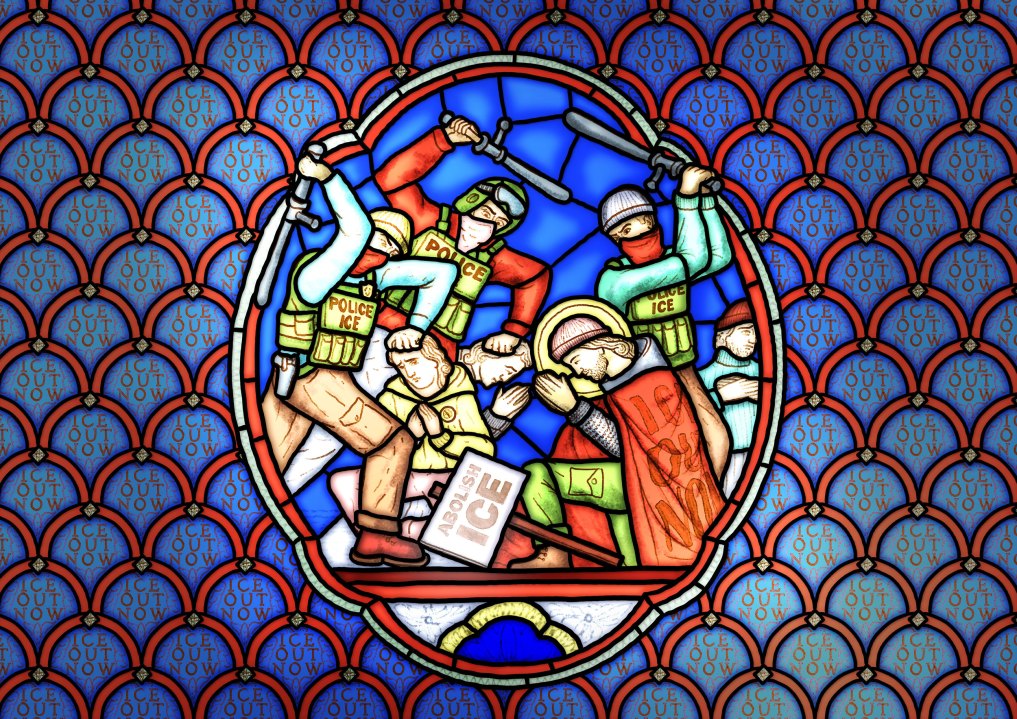



There’s something very religious about nihilism. For proof, look to the new capital of American nihilism, Minneapolis. A callousness toward death and danger has fallen over the city. Of the many disturbing videos to come out of Minnesota’s anti-ICE protests, one of the stranger examples shows a white man walking up to a line of heavily armed law-enforcement officers, shouting: “Shoot us in the fucking face! Shoot me in the fucking head!”
What possesses someone to do that? I understand being against Donald Trump and Stephen Miller’s blitzkrieg deportation policy. And it’s not irrational, in the viral age, to protest theatrically. But this is psychotic. It is the death drive in overdrive. Suicidality is spread across these demonstrations, just as it was during 2020’s George Floyd riots.
The fervor of this behavior is religious, but the end goal is simply destruction. This is Christian nihilism.
The rioter must be serving some other Christian-esque divinity, one who promises redemption via revolution
Say this screaming protester really were to be shot. What would his death bring about? It wouldn’t stop any Venezuelan or Somali immigrant from being detained. I suspect someone might argue that his taking a bullet would call attention to what ICE is doing in Minnesota. But ICE – whatever else it is doing – isn’t opening fire at random on large crowds, so the protester would be asking ICE to start doing the very thing he supposedly wants it to stop doing. This man’s death would bring about no practical, material gains for anyone.
It seems some spiritual motive is compelling him to beg for destruction. Is he looking to be martyred? If he were to be killed, it wouldn’t have been for committing any specific crime. As an innocent man, then, his murder would be analogous to the death of a scapegoat – or to Christ’s. And presumably he’d be spiritually rewarded for taking on the wrath of a wicked society, or something.
His cry for the grave is like a twisted wish to fulfill Christ’s promise that “whosoever shall lose his life for my sake shall find it.” But the Christian God would never ask someone to throw their life away like this. A saint isn’t supposed to ask to be martyred. The rioter must be serving some other Christian-esque divinity, one who promises redemption via revolution. What he and the many, many ideology-obsessed Americans have done is adopt the self-sacrificing form of Christianity, but empty it of its contents.

Violence serves a central role in Christianity: the hinge of history, the Crucifixion, is bloody. Christ endures the Cross to purify mankind, because he knows we crave purity. Revolutionary leaders have stolen this idea, given it a godless twist and sold it to their followers to encourage them to sacrifice themselves for whatever cause demands it.
Examples of this abound. Frantz Fanon: “At the level of individuals, violence is a cleansing force.” Mao Zedong: “Revolutionary war is an antitoxin that not only eliminates the enemy’s poison but also purges us of our own filth.” Filippo Tommaso Marinetti: “We will glorify war – the world’s only hygiene.” The upshot is obvious: lay yourself (and others) on the altar of revolution, and in exchange you get some abstract purifying shower.
At least in the case of Christianity the bargain is clear. Dying for the church earns you a nice mansion in the afterlife. Today’s bloodthirsty rioters expect no such reward. When they undergo their deadly purifying action, they expect to be made into nothing.
This revolution-as-salvation fantasy has a strong grip on the imagination – certainly among the American elite, which remains permanently nostalgic for the political violence of the 1960s. Proof of this came last year in the glossy form of Paul Thomas Anderson’s One Battle After Another. Approaching three hours in runtime, this bulky film is about the supposed virtue of the French 75, a group of revolutionaries reminiscent of various 1960s terrorist cells such as the Weather Underground.
Anderson’s villain is the loathsome Colonel Lockjaw, who leads a cruel anti-immigration campaign in the American streets. The French 75 resists him, which is all good and well in the context of the film as Lockjaw is in fact a monster. But the version of revolutionary politics presented here is no doubt idealized.
Naturally, the critical class ate it up. The movie won four Golden Globes – Best Director, Best Screenplay, Best Supporting Actress and Best Comedy/Musical – and has been nominated for 13 Oscars, including Best Picture.
I hold the minority position that this movie’s pro-rebellion politics is in fact ironic and that Anderson is mocking revolutionaries and anti-revolutionaries alike. But that’s an article for another day, and in any case, if I’m right then most people did not pick up on the irony. Most critics have interpreted it as another glorious film about “radicals and their plans for revolutionary politics,” as a New Yorker critic put it.
The practical effect is to affirm the hazy daydreams of overeducated elites and fuel the fantasies of dissatisfied young Americans, a group increasingly open to force as a means of achieving political ends: a recent Harvard poll found that 39 percent of 18- to 29-year-olds say they’re cool with violence for such purposes. Bloodthirst is super in right now – why should we be surprised to see people hopping on Instagram to proclaim Charlie Kirk had it coming?
All this rage is for the purification of self and society, and the people willing to embrace death for this purification become canonized. The Christian nihilist movement is eager to turn them into icons and heroes. Cities across America commissioned heroic murals of Floyd after he was killed. His face was as unavoidable as the image of the Virgin Mary is in Catholic cities. Floyd didn’t deserve to die, but he certainly didn’t deserve to be canonized, either. What can you say of a country that venerates such a man except that it’s drifting toward some destructive end?
After Brian Thompson, the UnitedHealthcare CEO, was shot in December 2024, my social media feeds were flooded with friends and peers turning Luigi Mangione, the suspected gunman, into a political and sex symbol. One Instagram account called him “the patron saint of healthcare justice” and illustrated him with a halo and other trappings of Christian iconography. Never mind that Thompson’s assassination will have zero effect on American healthcare reform. Real change isn’t the point – it’s bright flashes of brutality that light up a phone screen to interrupt hours of scrolling.
All this taste for pseudo-religious terror has been cultivated further by the fact that cameras are everywhere. Would our Minneapolis protester still beg to be shot in the face if he weren’t sure there was some phone in the vicinity recording him, an observer ready to post him online? In this light, the grotesque, exaggerated protest behavior looks like little more than performative roleplaying. Let’s call it religious ritual.
Minnesota has become the stage for a giant morality play. On one side are the righteous, religious anti-ICE protesters. Their scene partners are the vicious state villains with guns. These guys are putting on a shock-and-awe performance of their own and seem to have been told by the White House that they can do no wrong. The protesters are telling themselves the same thing. The problem with this setup is that their firearms aren’t props, and they’re not stage-fighting; the line between performance and reality can evaporate in a second. What happens after that is usually tragic.
Despite the potential for real danger, the roleplaying continues. Lives are lost. Martyrs are upheld as heroes, yet their deaths essentially accomplish nothing. “Alex Pretti was a hero,” Mark Ruffalo wrote on Bluesky after the ICU nurse was shot in Minnesota last month. Their deaths – which were needless – are consecrated, but for nothing.
Penance with no chance of absolution defined the riots of 2020. Remember when Minneapolis Mayor Jacob Frey appeared before a crowd of defund-the-police rioters and proclaimed, “I’ve been coming to grips with my own brokenness”? The mob decided that wasn’t good enough and pushed him home while screaming, “Shame!” No wonder the same city is undergoing another round of ruinous displays six years later, and no wonder things feel so spiritual.
They pilfer Christian ideas but strip them of the central truth that every life is holy
This sucks. Call it the Dark Ages of 2026. During the Black Plague, platoons of lay Christians began to self-flagellate in public as a response to disease and war and the overall nastiness of 14th-century life. This was rightly considered barbaric even then. Lots of authors have noted that America and the West have a self-flagellating tendency, but rarely does this habit take the physical form that it has in Minneapolis.
Most protesters are not headed out to the barricades with Christian nihilism on their minds. In fact, most probably do not see any connection between what they’re doing and real danger – which is part of the problem.
Renée Good, for example, was not a terrorist. She didn’t deserve to die. But she was convinced to show up by people with a philosophy that is both religious and destructive. Those same people have since used her death as a useful device.
What’s clear from the chaos is that people want religion. They want the self-sacrifice that goes along with it, the community, the devotion, the rituals, the saints, the virtues, the self-denial, the salvation. They even want the liturgy, if their affinity for chanting is any indication.
They want, in a word, Christianity. But they don’t want to go to church. Perhaps they don’t want to experience the fear, the humility and the pain that come with accepting that there is something much bigger than nothing out there, and that that something demands serious, lifelong duties. Maybe they can’t fathom loving their neighbor as themselves, or the idea that they themselves could be loved unconditionally. These are relics of the past.
Instead, they pilfer Christian ideas and actions but strip them of the thing that makes them worthwhile: the central truth that every life is holy. Overcoming belief in the sanctity of human life is the first gut-check that the revolutionaries must perform. Ignoring and suppressing this truth is what the revolutionary must do, repeatedly, until they believe in no truth at all.
The Christian nihilists are getting better and better at this. Their evangelists are everywhere. Their cult may be America’s fastest growing religion.




Comments