Christianity

Enjoy Anglican priests while you still can

Something amazing happened as I was walking my 91-year-old mother through Ledbury: we saw a bobby on the beat. He was even in a helmet, not a baseball cap. “A real policeman!” squealed various people, reacting as they might to a steam train or an Austin-Healey, reminders of more distinctive days. The same surprise may soon be evident when we see dog collars. A new scheme, oversight ministry, adopted by some Church of England dioceses, is taking vicars off the streets. Instead of being front-line clergy they will become “oversight ministers” and “area deans,” managers of lay, unpaid “focal ministers.

anglican priests

Enjoy Anglican priests while you still can

Something amazing happened as I was walking my 91-year-old mother through Ledbury: we saw a bobby on the beat. He was even in a helmet, not a baseball cap. ‘A real policeman!’ squealed various people, reacting as they might to a steam train or an Austin-Healey, reminders of more distinctive days. The same surprise may soon be evident when we see dog collars. A new scheme, oversight ministry, adopted by some Church of England dioceses, is taking vicars off the streets. Instead of being front-line clergy they will become ‘oversight ministers’ and ‘area deans’, managers of lay, unpaid ‘focal ministers’.

Wandering bishops, rival popes & schismatic churches

From our UK edition

30 min listen

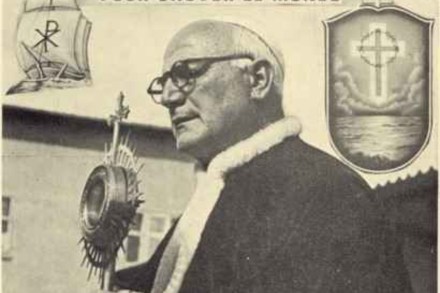
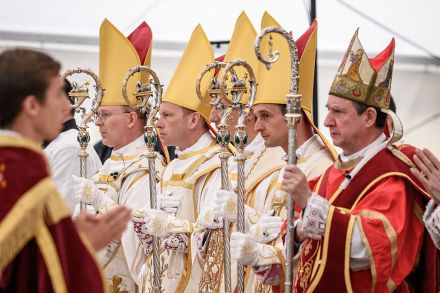
What happens when a bishop breaks with Rome but still claims apostolic succession? Damian Thompson is joined by historian Magnus Lundberg, Professor of Church and Mission History at Uppsala University in Sweden, to explore the strange world of ‘wandering bishops’, rival popes and tiny schismatic churches. They trace the tangled web of consecrations that have produced thousands of bishops outside the authority of Rome, and explore the grandiose titles and ceremonies of these independent bishops. They also examine the roots of sedevacantism, the legacy of Archbishop Lefebvre and the Society of St Pius X, and ask whether the latest breakaway bishops could create yet another schism.

Wandering bishops, rival popes & schismatic churches

An exhilarating chase: The Runner, by Scarlett Thomas, reviewed

From our UK edition

Billed as a literary thriller from one of the masters of the genre, Scarlett Thomas’s The Runner is a far denser philosophical novel than readers might expect – albeit one built around a propulsive chase. The author transforms ultramarathons into a metaphor for modern capitalism, using the story of a fugitive runner to question what gives life value in a world dominated by money, surveillance and relentless growth. Capitalism is presented as a race without a finishing line, with running symbolising an economic system that demands endless progression: ‘The whole world is just relentlessly upupup. Why is everything just another hill?

Looking for Katrin: Rory MacLean goes in search of his dead wife

From our UK edition

One September, Rory MacLean’s wife, Katrin, was diagnosed with terminal cancer. Seven months later she was dead. The couple had been married for 32 years. In the wake of his wife’s death, MacLean decided to write a book about the afterlife. He had already written books about Russia and Myanmar, Berlin and Crete, but it was not clear where this journey should begin. ‘Unfortunately, few who entered heaven alive returned with a guidebook.’ Over the next five years, he travelled the globe, learning how different faiths understood the afterlife and exploring various sacred sites and religious rites. At the same time he read a wide range of mystical writers and collected insights into death from science, philosophy and the history of religion.

The Byzantine empire ends in an orgy of rape and slaughter

From our UK edition

Is there really anything new to say about the conquest of Constantinople? In the absence of fresh archaeological discoveries, a previously unknown text or neglected eyewitness account, can we reasonably expect, almost 600 years later, to break new ground? Anthony Kaldellis, a Greek-American classics professor at the University of Chicago, thinks so. His 1453 claims to offer a new perspective, namely that, contrary to almost all modern accounts, the Ottoman Sultan Mehmed II’s ultimate victory was ‘far less assured than is often thought’. It was a close run thing. Constantine XI, the last Byzantine emperor, almost won. For many readers familiar with this story, that won’t sound especially new at all.

Was America meant to be a Christian nation?

From our UK edition

28 min listen

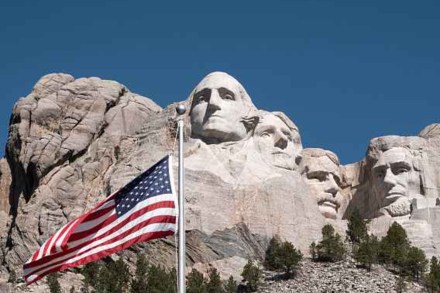
It might be 250 years since the Declaration of Independence but the document continues to prove controversial, with political groups arguing over the intention behind the document – just watch any Supreme Court case. To mark the 4th of July, Professor Gregg Frazer joins Damian Thompson to talk about the intention of the founding fathers in terms of religion – did they really want America to become a Christian nation? With President Trump courting evangelical Christian voters, rising religious tensions amongst religious minorities and some sections of society advocating for ‘Christian nationalism’, is America’s free market in religious ideas being tested to its limit? Produced by Patrick Gibbons.

Was America meant to be a Christian nation?

The brutal excommunication of the Society of Saint Pius X

On Wednesday, the largest traditional Catholic order of priests in the world, the Society of Saint Pius X, consecrated four bishops without a papal mandate. The Vatican’s response was swift and brutal. Today, it announced that not only have the four new bishops and the two consecrators been excommunicated but, shockingly, so will all the priests and faithful who continue to adhere to the Society’s work – an edict that will likely affect more than a million Catholics worldwide.

society

Blame the Enlightenment for species extinction

From our UK edition

As if she hadn’t got enough on her plate already, the high-powered Danish journalist and mother of three Lea Korsgaard decides to track down all Danish butterfly species in a single summer. She knows nothing about butterflies, claims to be unsure about what has sparked her unusual ambition and sets about learning a new language – of nature, lepidoptera and obsession – with a disarming lack of expertise. The nature-quest narrative is an eccentric but surprisingly well-populated subgenre of nature writing. Midway through my own journey to find all British butterfly species in one year, I was devastated to discover that there was an earlier book on the same undertaking by Robin Page.

Are Mormons Christian?

From our UK edition

21 min listen

For Christians and non-Christians alike, Mormons remain a bit of an enigma – especially in the UK. In the US however there are almost 7 million and they punch above their weight in terms of political influence; notable members of congress include former senator, and one-time presidential candidate, Mitt Romney. This influence meant that a row erupted in the past fortnight when the Pentagon released its updated list of religious affiliations and listed the Church of Latter-Day Saints independently from other Christian denominations, implying members were not Christian. This move was quickly denounced, with Mike Lee – a Mormon and Republican Senator – leading the charge, calling the move ‘outrageous’, the Pentagon subsequently backtracked.

Are Mormons Christian?

The Catholic Church has turned on the faithful

The Catholic world has been in an uproar since February, when the Society of Saint Pius X, a Catholic order of traditionalist priests, announced its intention to consecrate bishops with or without papal approbation, for the second time since 1988. On May 26, the identities of their four candidates were revealed: one American, one Swiss, and two Frenchmen.  The Society acknowledges the extraordinary nature of its action, but insists that the Church is in a serious crisis. Without their own bishops, it says, no one will ordain priests trained exclusively in traditional Catholic doctrine and liturgy, and the faithful who rely on them will be left without recourse.

Pius X

How to reclaim your life

I stopped charging my phone beside my bed four years ago and have never regretted it. Alarm clocks seemed destined to go the way of the DVD, but I am on a solo mission to restore them to bedside tables around the world. The harsh tone of the alarm is certainly no match for what Spotify can give us, but it’s worth avoiding the 30 minutes of doomscrolling that the phone inevitably causes. Since making the switch from the waking blue-light bath, I have rediscovered those early hours of the morning, with their associated peace and silence, before children and work invade my limited headspace. Carving out that half hour before the noise begins has helped restructure my priorities in life. Every year the Pope chooses a preacher for the Roman Curia’s annual Lenten retreat at the Vatican.

Michael Gove on why the Pope’s AI intervention shames our politicians

From our UK edition

15 min listen

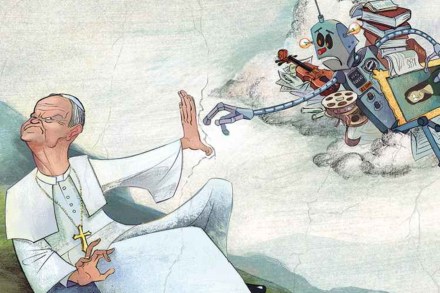
The Spectator's editor Michael Gove ‘was born into a sternly Presbyterian culture’, but – in this week's magazine – is ‘giving thanks to the Pope’ for producing Magnifica Humanitas, his encyclical about artificial intelligence (AI). AI will be ‘as transformative as the Industrial Revolution’ but decisions ‘about where this technology is going and how it might be deployed are concentrated... in perilously few hands’. Michael joins Damian Thompson on Holy Smoke to explain why the document reveals Pope Leo to be 'intellectually confident and coherent', what the Christian response to AI should be and why he believes Catholic social teaching is 'absolutely essential' in instructing us for how to deal with this next technological revolution. Produced by Patrick Gibbons.

Michael Gove on why the Pope's AI intervention shames our politicians

It’s little surprise that an Israeli soldier was caught desecrating a crucifix

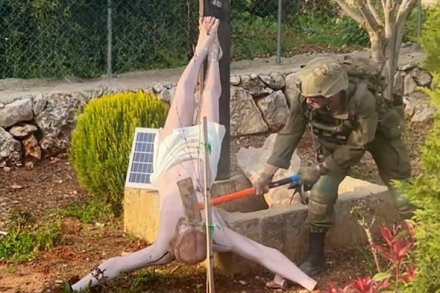
There’s something apposite, I suppose, about the desecration of a crucifix. In this case, it was an Israeli soldier in southern Lebanon who took a sledgehammer to one on private property and smashed the Jesus figure on the cross. The original crucifixion, as anyone who heard the gospels over Easter will recall, was marked by the humiliation of Jesus; this attack on the figure of one who took on suffering willingly was another humiliation, through the image. Mind you, if the charmer with the sledgehammer had reflected that the Christ-figure is, in Christian belief, not just God-made-man but God-made-Jew, he might have eased off a bit.

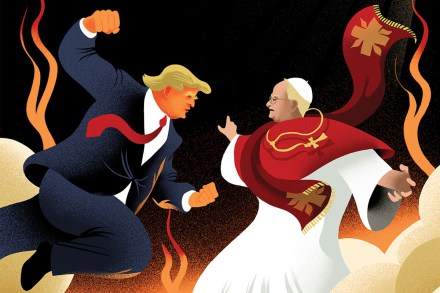
Why has Trump picked a fight with the Pope?

From our UK edition

25 min listen

Donald Trump’s latest clash with the Pope has stunned even the more hardened of America-watchers. According to the President of the United States Chicago-born Pope Leo XIV, the spiritual leader of 1.3 billion people, is 'WEAK on crime and terrible on foreign policy.' He also claimed that, 'If I wasn’t in the White House, Leo wouldn’t be in the Vatican.' Is the war in Iran the only reason the Pope and the President have clashed? And what does it tell us about religious relations in the US today? In a special podcast collaboration, the host of Holy Smoke Damian Thompson and the host of Americano Freddy Gray discuss the dispute. Produced by Patrick Gibbons and Natasha Feroze.

Why has Trump picked a fight with the Pope?

What’s really behind Trump’s clash with the Pope?

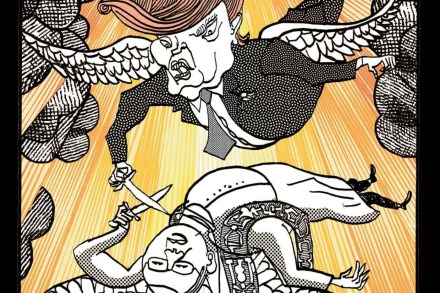
Donald Trump’s latest clash with the Catholic Church stunned even the most hardened veterans of culture-war X. According to the President of the United States, the Chicago-born Pope Leo XIV, the conspicuously holy spiritual leader of 1.3 billion people, is “WEAK on crime and terrible on foreign policy.” He also claimed that, “If I wasn’t in the White House, Leo wouldn’t be in the Vatican.” For commentators accustomed to the fog of modern diplomatic platitudes, such trash talk was the equivalent of a Holy Roman Emperor hurling insults at a medieval pontiff.

trump pope damian thompson

How homosexuality has torn apart the United Methodist Church

From our UK edition

18 min listen

The United Methodist Church has experienced a sharp decline over the past century, from an estimated 11 million members in the 1950s to around 4 million now. However, over 1 million of those are estimated to have left since 2022 alone, due to splits over the teaching of homosexuality. Can the Church survive? And what does this tell us about Christianity in America in general – are we entering a 'post-denominational era'? Mark Tooley, president of the Institute on Religion and Democracy – and a committed Methodist, joins Damian Thompson to discuss. Produced by Patrick Gibbons.

How homosexuality has torn apart the United Methodist Church

How would you sell Christianity today? with Rory Sutherland

From our UK edition

30 min listen

Advertising guru – and the Spectator's Wiki Man – Rory Sutherland joins Damian Thompson to try and tackle the question 'how would you sell Christianity – today?' If religions have previously thrived by providing a form of social network and an 'elevated trust mechanism', perhaps there ways in which they can adapt for modern society – especially as many people appear to be turning away from conspicuous consumption and searching for meaning. In this Easter special they ponder: are religious people less likely to be alcoholics? Does driving make you a better person? And are Churches today akin to the carrier pigeon of yesteryear? Produced by Patrick Gibbons.

How would you sell Christianity today? with Rory Sutherland

The truth about the quiet revival – with grounds for optimism 

From our UK edition

25 min listen

The past year has seen a deluge of reports and investigations about young people finding faith and flocking back to Christianity – including here on Holy Smoke. All roads lead back to a Bible Society study which claimed that – backed up by polling from YouGov – a ‘quiet revival’ was underway. Yet, one year on, YouGov has pulled the survey due to data errors and the Bible Society was forced to apologise. While the credibility of the survey is undermined, this doesn’t necessarily chime with anecdotal evidence from some quarters. So what is the truth behind the ‘quiet revival’?

The truth about the quiet revival – with grounds for optimism 

Is politics becoming more religious? With Tom Holland & Jonathan Sumption

From our UK edition

39 min listen

Is British politics becoming more religious? Madeline Grant certainly thinks so, arguing – in the Spectator’s cover article – that the next election could be the most religious for decades. Issues like immigration and Islam, assisted dying – and even the establishment of the Church of England are likely to play a role. The current Labour government's ‘most telling divide’, Madeline writes, is between MPs – like Shabana Mahmood and Wes Streeting – who understand religion – and 'those who don’t’. For the Edition’s Easter special, host Lara Prendergast is joined by vicar – and Madeline’s husband – The Rev’d Fergus Butler-Gallie, former Supreme Court justice Jonathan Sumption and the historian and broadcaster Tom Holland.