

There are many reasons to admire America, and also a few reasons to disapprove. On the plus side there is free speech, the right to protect oneself, a relatively dynamic economy and 198 versions of beef jerky. On the downside, an inconsistent attitude to turning right at lights, too much fructose and the possibility of a civil war on the way.
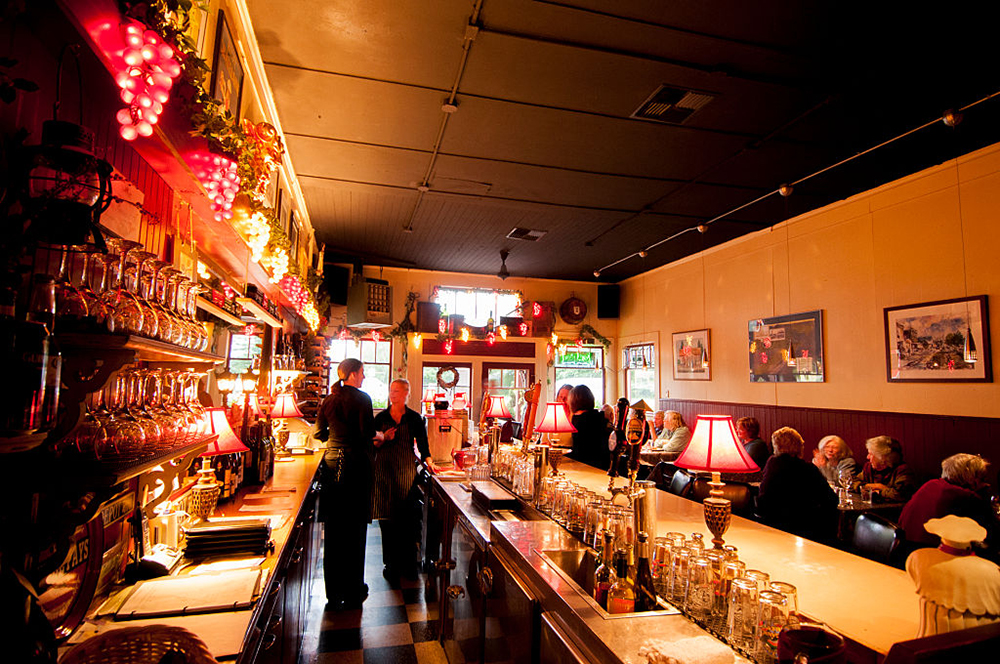
However, on a recent long trip up the American West Coast, from palm to pine, I came away realizing that America has one great advantage over Europeans: a serious understanding of the concept of eating at bars in restaurants. By which I don’t mean nibbling nuts and necking a cocktail while waiting for a table. I mean actual eating, of a proper meal, while seated on a barstool.
On one night in Portland, I found myself sitting between a retired tech CEO and a jazz trumpeter
In America, almost every restaurant will have a bar for diners. By contrast, Europeans – who invented the restaurant – have not yet grasped the advantages of this arrangement. We treat eating at the bar as something awkward – a last resort, or a social emergency: “Errr, we’re really full, I suppose you could eat at the bar?”
There are, however, a few curious exceptions to this. The first is seafood restaurants. For some inexplicable reason, although we eschew bar-eating elsewhere, we accept it in places mainly serving crustacea. We pull up a stool, order half a dozen Helford natives, and nobody faints. The reason may be that oyster bars are a reimportation from America, which perfected the system with its confident lively energy, all that flinging about of shallot vinegar, lemon wedges and Tabasco.
The second exception in Europe, and worldwide, is airports, where bar-eating is tolerated because it allows the maximum number of bodies to be processed. This is not true bar-eating, however, merely space triaged by accountants.
Then there’s Spain. The Spanish will happily stand at a bar eating tapas – jamón, gambas, blistered padrón peppers – while talking, laughing, gesturing and occasionally bidding for independence from Madrid. And the tapas bar is one of gastronomy’s treasures: loud, chaotic and welcoming. But tapas is not dinner. At 1 a.m., the Spanish still retire to a table for the real meal.
All of which is a great shame because bar-eating, American-style, is brilliant. Let me count the ways.
I recently went to a popular restaurant in San Francisco. It was heaving with people; the tables were packed, I didn’t have a booking, so the hostess smiled sympathetically and said: “Could be two hours?” Then I looked at all the empty bar stools and asked if I could eat there. She looked at me and said, “Sure, just go ahead, grab a stool.” Suddenly I was a citizen, not a supplicant. I slid onto a stool, ordered a pilsner, and within seconds was talking to the bartender about his wife’s affair. Moments later, the ribeye arrived. Eating at the bar is fast. There is no wait for the waitperson. Food is plonked in front of you. Also, when you eat at the bar, the social dynamics are pleasingly different. At a table, you interact only with those you arrived with. At the bar, you are, if you wish, welcomed into the New World.
One night in Portland, I found myself sitting between a retired tech chief executive and a jazz trumpeter. Within minutes we were sharing fries and discussing the relative merits of Brexit, Donald Trump and those really small, sweet West Coast oysters called Kumamotos.
At a table, we three would never have collided; at the bar we were a happy triumvirate of chitchat, like Churchill, Roosevelt and Stalin at Yalta, but eating chowder rather than reorganising postwar Europe. And by eating at the bar, we were all the same: just chaps at a counter. In that sense, bar-eating is American democracy in action, it is individualistic yet equalizing, it is the great Republic applied to restaurants.
Thirdly – and quite importantly for a travel journalist like me (who often eats solo) – sitting at the bar is the one form of dining where solitude is not treated as pathological. In Europe, eating alone at a table is still seen as a little odd, or sad. It induces in waiters a wince of sympathy, so they bring too much bread.
It also makes other diners feel sorry for you, which is annoying. The other week I was quite happily eating alone at a table on the Sardinian coast, browsing my iPad, but another couple clearly felt like I was a tragic Billy-no-mates who needed cheering, and they condescendingly spoke to me as they left, saying I seemed content with my screen, to which I replied: “Yeah, I’ve found some really great bondage porn.”
That shut them up and they scuttled away, but the fact is this unpleasantness would not have occurred if I’d simply been allowed to eat at the bar. At the bar, everyone is kind of alone, so no one is alone. It’s normal. No psychodrama.
The final advantage of bar-eating is one of the best of all: the clean getaway. There is no hostage situation with coats and bags. No lingering at the doorway while your fellow diners put on scarves at a pace generally associated with glaciation. You sign the bill, nod and disappear into the night. Done.
Weirdly, there is one other country – aside from the US – which has mastered bar-eating. And that country is Japan. Whether at a famous sashimi bar in Tokyo where six seats solemnly face a revered chef slicing tuna belly under a spotlight, or a tiny izakaya in Hokkaido where eight salary men get loudly and steadily drunk, the Japanese, too, understand the great benefits of cuisine served at a countertop.
There is probably some vast underlying reason why Japan resembles America in this way, and why both differ from Europe. But the truth is: I cannot think of one. See you at the bar!





Comments